Stocks slide on extended chip slump, rising oil prices, and fractured Fed decision
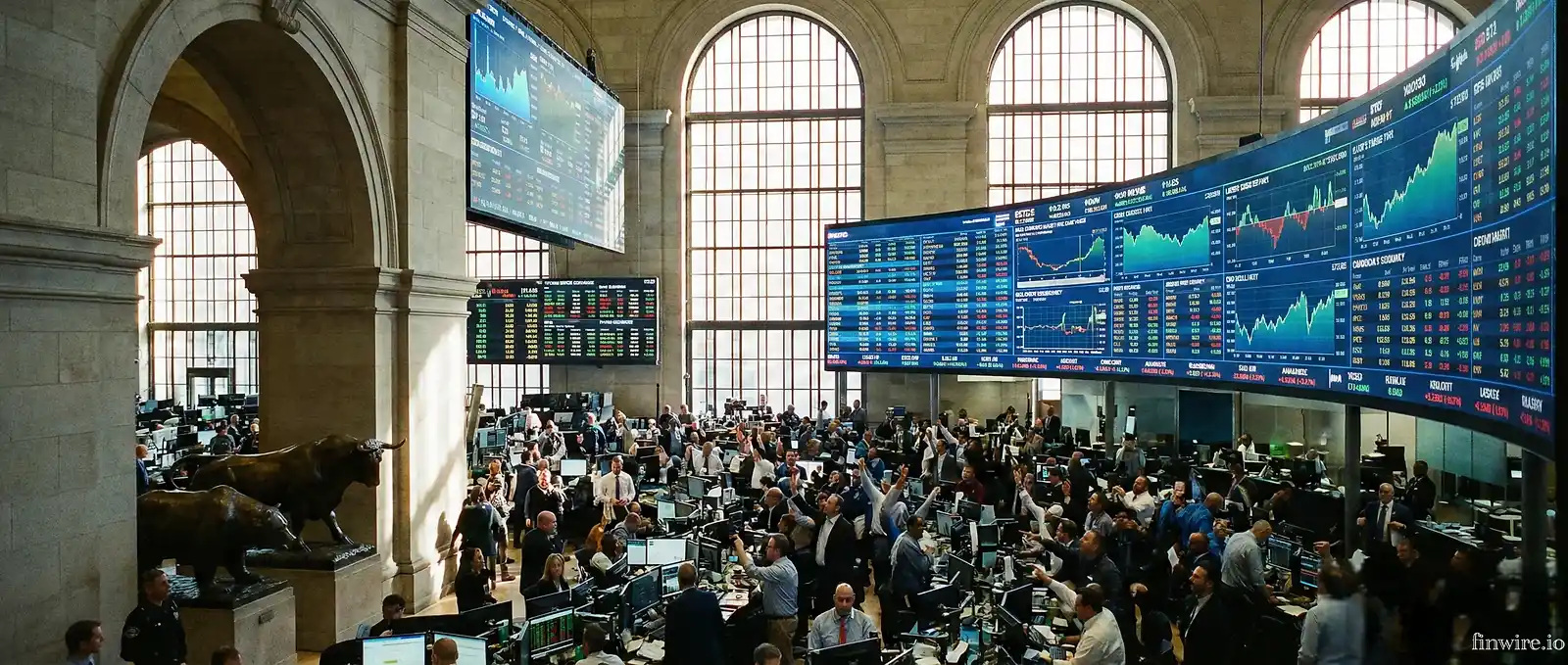
U.S. stocks on Wednesday slumped, weighed down by an extended decline in chip stocks and surging oil prices.
Equities had earlier cut some losses after the Federal Reserve held interest rates steady, removing some jitters amid market participants about a possible rate hike instead. However, three policymakers dissented with the decision and voted to tighten policy, underscoring the extent to which volatile oil prices have complicated the central bank’s job.
The focus is now on quarterly results from tech titans Microsoft and Meta Platforms after the closing bell, which will represent the next major test for the slumping artificial intelligence trade.
The benchmark S&P 500 index shed 1.5% to end at 7,321.63 points, the tech-heavy NASDAQ Composite declined 1.7% to close at 24,442.94 points, and the blue-chip Dow Jones Industrial Average fell 2.2% to settle at 51,594.86 points.
"I don’t believe the overall environment is bearish now, while it is not especially bullish either. Revenues and earnings coming out now are generally very strong, inflation does seem to be coming down, etc. There is a rotation going on certainly in chips and related companies that probably got too extended and into more value names. We will see if this continues as the mega caps report this week and next," Peter Tuz, president at Chase Investment Counsel, told Investing.com.
Divided Fed shows growing dissent over how to handle inflation
The Federal Open Market Committee (FOMC) on Wednesday kept the federal funds rate unchanged at 3.50%-3.75%. The focus is now on new Chair Kevin Warsh’s upcoming press conference.
The Fed’s job has been complicated by the dynamic situation in the Middle East and the volatility in oil prices since its last rate decision in mid-June. At that time, crude benchmarks were elevated, prompting nearly half of the FOMC’s members to pencil in anticipated rate hikes this year. Oil slid soon after that following the inking of an interim peace deal between the U.S. and Iran, only for that agreement to fall apart this month and lead to a resurgence in crude prices.
While the Fed decided to hold rates steady, three regional presidents - Beth Hammack, Neel Kashkari, and Lorie Logan - voted against the action and instead preferred to raise rates by 25 basis points. The dissent showed that policymakers were divided over how to combat resurgent inflation driven in part by the Middle East conflict.
At the post-decision press conference, Warsh said the FOMC had a "good family fight" and an "active, robust" discussion centered on four areas: persistent inflation, recent economic shocks, price pressures arising from those shocks, and monetary policy tools. He also said the dissents by the three regional Fed presidents did not "capture the full essence of the discussion." Warsh noted that the effect of soft June inflation data on the rate decision was "not much."
It should also be noted that rising U.S. Treasury yields have effectively played the role of a rate hike, as an increase in yields usually makes borrowing more expensive for consumers and businesses. The benchmark U.S. 10-year yield has jumped more than 14 basis points since the Fed’s June meeting.
Warsh on Wednesday noted that increases in nominal and real yields across the Treasury curve since the last meeting had been "among the most significant in the last two decades, ranking around the top decile or so."
"But if the Committee didn’t change its policy rate, what happened? In the inter-meeting period, market attention centered on real data and real economic developments. Prices reacted in real time to incoming information, and the reduction in forward guidance may have been a factor. Market participants are learning to play the ball, not the referee—and market prices will continue to respond in the direction and magnitude they see fit. This is, in my view, a change for the better—and we are just getting started," the Fed chair said in his prepared remarks.
Chip stocks set for longest daily losing streak since December
The AI trade saw more pressure on Wednesday, with chip stocks - represented by the Philadelphia Semiconductor Index - notching a five-day losing run for the first time since late December.
This week’s rout started with a Wall Street Journal report that Nvidia was in talks to provide around $250 billion toward a massive data-center project tied to OpenAI. The news sparked concerns about the circular nature of deals in the AI space while compounding worries over the spending spree by major names in the industry.
Competition from China has also emerged as a primary drag on U.S. chip stocks recently, sparked by headlines such as the success of Moonshot AI’s Kimi K3 model, the blockbuster Shanghai debut of memory chipmaker CXMT, and progress in domestic production of immersion deep ultraviolet lithography machines.
On Tuesday, SK Hynix was a catalyst for more selling. South Korea’s-second largest company reported a whopping 557% Y/Y increase in quarterly operating profit to 60.54 trillion won ($41.70 billion), helped by price increases for premium high bandwidth memory chips used to power AI processes. However, the bumper results failed to match sky-high expectations, echoing a recent trend of blowout performances by major AI names failing to calm investor jitters.
"With SK Hynix shares up more than 250% year over year, last night’s disappointing earnings miss showed that describing the memory leader as priced for perfection may be an understatement," Ryan Lee, senior vice president of product and strategy at Direxion, said.
"The most encouraging signal was the continued shift in demand toward SK Hynix’s highest-margin high bandwidth memory products. While production capacity for these products remains more limited, demand is clearly robust and should position the company well over the longer term," he added.
SK Hynix’s Korean-listed stock closed 9.6% lower, weighing on the broader KOSPI benchmark which slid 6%.
On Wall Street, the AI trade now faces a big test in Microsoft and Meta’s results. The behemoths, both so-called hyperscalers, are pouring billions of dollars into building AI infrastructure, or the combined hardware and software stack needed to handle massive data and computing power used to build and train AI processes. Last week, Elon Musk’s Tesla and Google-parent Alphabet both highlighted elevated AI-related spending plans.
Oil soars around 7% after U.S. says Iran launched surprise attack
After sliding over Monday and Tuesday following a pause in tit-for-tat strikes between the U.S. and Iran from over the weekend, oil prices jumped about 7% on Wednesday after Washington said the Islamic Revolutionary Guard Corps (IRGC) had "attempted" a "surprise attack" on U.S. forces based in the Middle East. "All Iranian missiles were successfully intercepted," U.S. Central Command (CENTCOM) said.
President Donald Trump later told Fox News that the U.S. military had "just minutes" to shoot down the incoming missiles from the surprise attack, and said that Washington would respond by "hitting them hard."
Separately, CENTCOM said it and Saudi Arabia’s armed forces had conducted "precision strikes" in Iraq against Iran-backed proxies that had been directed by the IRGC to attack U.S. forces and Saudi energy infrastructure.
Ayushman Ojha and Pranav Kashyap contributed to this article