U.S. stocks end in the red as PPI boosts Fed rate hike bets, WTI crude tops $100
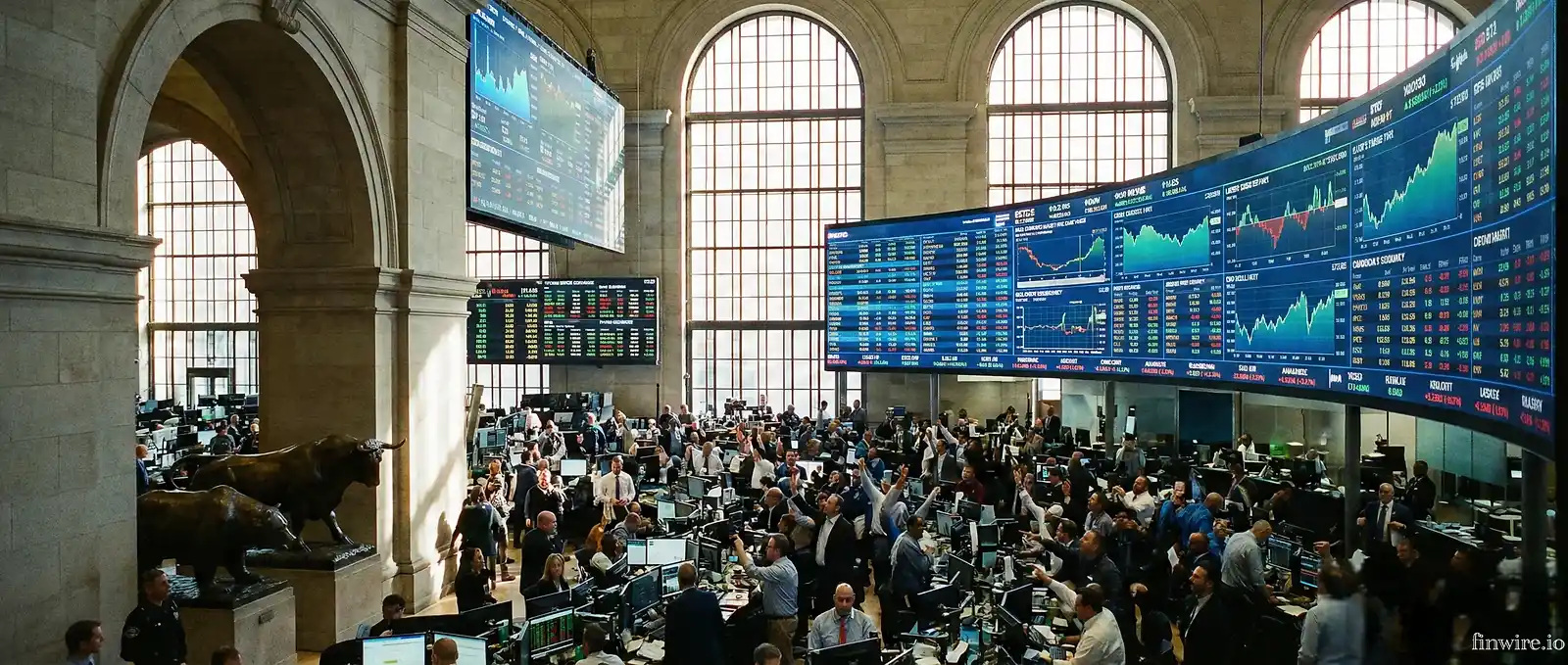
U.S. stocks ended lower on Thursday while Treasury yields surged, after a key producer inflation report showed an acceleration in headline figures in August, prompting traders to add to bets for a Federal Reserve rate hike next week. Elevated oil prices also weighed on sentiment.
The benchmark S&P 500 shed 0.6% to close at 7,592.12 points, the tech-heavy NASDAQ Composite fell 0.7% to settle at 26,081.73 points, and the blue-chip Dow Jones Industrial Average lost 0.6% to conclude at 52,064.46 points.
Since posting an all-time high in mid-August and eking out gains for that month, Wall Street has struggled as the focus has moved from earnings strength to a muddled macro picture. The S&P is now 2.7% below its record close.
"Today’s action reinforces a theme we’ve been highlighting: the market has shifted from a positively skewed, earnings-driven environment to a more macro-driven and uneven backdrop. Rates, inflation, oil prices, and Fed expectations are back at center stage," Keith Lerner, chief investment officer and chief market strategist at Truist, told Investing.com.
Mostly hawkish PPI report
The spotlight on Thursday was on the August U.S. producer price index (PPI) report.
According to the Bureau of Labor Statistics, headline PPI ticked up 0.4% M/M and 5.4% Y/Y in August, versus consensus estimates of 0.4% and 5.3%, respectively. Moreover, headline figures for July were revised up to an increase of 0.1% M/M and 4.8% Y/Y.
On a core basis, PPI inched up 0.2% M/M and 4.6% Y/Y, compared to consensus estimates of 0.3% and 4.6%, respectively.
The headline acceleration in August was driven by a 1.1% M/M gain in the index for final demand goods, with over three-fourths of the broad-based rise attributed to prices for final demand energy.
The PPI report comes a day ahead of the more closely-watched consumer price index (CPI) data, and comes just days after a blockbuster August nonfarm payrolls report. Taken together, the indicators point to a highly resilient U.S. labor market and an economy besieged by price pressures. In such a scenario, a central bank typically considers tightening monetary policy.
Those expectations were reflected in Fed interest rate odds. As per the CME FedWatch tool, the probability of a quarter-point rate hike by Federal Open Market Committee (FOMC) on September 16 now stood at 73%, up from about 64% before the PPI data.
"While the Fed, in an effort to avoid partisan perceptions, has typically avoided any material policy actions such as interest rate moves ahead of elections, this time may well be different," Oliver Pursche, senior vice president at Wealthspire Advisors, told Investing.com.
"There is an increasing case to be made to hike rates next week, although certainly not an overwhelming case. Moreover, by hiking rates 25 bps, Fed Chairman (Kevin) Warsh can demonstrate to market participants that he and the Fed remain independent and free of political influence. This would likely be well received by investors," he added.
U.S. Treasury yields also moved higher after PPI, as bonds were dumped. The benchmark 10-year yield was last up 12.4 basis points to 4.961%, its highest level since October 2023. The shorter-end, more rate-sensitive 2-year yield added 14 basis points to 4.567%, its highest since July 2024.
The bond market had slumped in the previous session as well, after a highly anticipated U.S. Treasury Department buyback update underwhelmed investors.
The department said it would repurchase up to $6 billion in 10-year to 20-year maturities, triple that of its previous target. The Treasury last month had announced its intention to increase long-bond buyback sizes to at least $4 billion in a surprise intervention move aimed at stemming a bond rout. Market participants had anticipated repurchases of as much as $10 billion.
The results of the 10-year to 20-year operation on Thursday showed that the Treasury received $10.489 billion of offers for buybacks and accepted $5.187 billion.
"The 10-year Treasury yield has broken above the widely watched 4.8% level, surpassing its January 2025 high. With all eyes on 5% and Friday’s CPI report, investors are reassessing the outlook for inflation and Fed policy," Truist’s Lerner told Investing.com.
"This is creating a more challenging near-term environment, particularly for interest-rate-sensitive areas such as small caps and some of the broader participation we’ve seen in recent months. That said, the good news is credit spreads remain tight and valuations have reset. Eventually, the market will refocus on earnings. As a result, the bull market still deserves the benefit of the doubt, but we expect this choppier period to continue," he added.
WTI tops $100 for first time in over three-and-a-half months
Turning away from the U.S. economic calendar and towards the Middle East, oil prices extended their weekly surge on Thursday. A day after Brent crude futures, the global benchmark, topped $100 for the first time since May 26, U.S. West Texas Intermediate crude futures also surpassed that level for the first time since May 21.
Oil prices are now on track for two straight weeks of massive gains, driven by a resurgence in military action between the U.S. and Iran after a weeks-long stalemate over control of the Strait of Hormuz.
U.S. Central Command on Tuesday said it had destroyed five Iranian crude oil carriers in response to the targeting of a U.S. Navy warship by the Islamic Revolutionary Guard Corps. Meanwhile, Iran’s state media said Tehran responded to the strikes by hitting two American vessels, eight oil tankers, 10 U.S.-backed ships, and a U.S. military base in Jordan.
President Donald Trump on Wednesday told reporters that there will be a "lot more" attacks on Iranian tankers. "I think the war will end immediately after the (midterm) election...They’re desperate to try and affect the election so that we could get a nice, weak group of people in there and leave them alone and let them have their nuclear weapon," the U.S. leader added.
Apple climbs a day after unveiling foldable iPhone
Looking at Thursday’s U.S. stock movers, Apple recovered from a slight loss in the previous session to close 3.6% higher. The tech behemoth on Wednesday unveiled the iPhone Duo, its first foldable version of its flagship smartphone, under the leadership of new top boss John Ternus.
Priced at $1,999, the device is Apple’s most expensive iPhone yet. Analysts appeared to issue a mixed verdict on the company’s launch event, with Citi noting that the fall lineup - comprised of the Duo along with the iPhone 18 Pro and Pro Max - was heavily skewed towards premium devices.
Oppenheimer said it expects the Duo to become "the most successful foldable phone on the market" but cautioned that supply would likely be limited to 8 million to 10 million units this year.
Elsewhere, Cooper slumped nearly 15% and ended as the top percentage loser on the S&P 500, after the medical device maker missed quarterly top-line expectations and completed a strategic review with a decision to retain CooperSurgical, its business catering to women’s health and fertility.
Speaking of earnings, cloud-computing giant Oracle and design software group Adobe are slated to report quarterly results after the closing bell. The returns could provide fresh insight into the state of a boom in spending on artificial intelligence infrastructure.
Ayushman Ojha and Scott Kanowsky contributed to this article