Wall Street notches best week since August, even as Nvidia craters nearly 13%


Wall Street ended largely lower on Friday as renewed selling in technology stocks, led by Nvidia, overshadowed relief from cooler-than-expected to in-line U.S. producer inflation data.
Stock index futures had earlier extended gains after the data and markets had opened higher. But with the artificial intelligence trade remaining the dominant headline for markets, focus rapidly shifted from interest rates back to the technology sector.
In what has been another tumultuous week for Wall Street, the S&P 500 ultimately rebounded strongly for its best weekly performance since early August. The benchmark gauge last Friday had slumped to its worst weekly slide since the "Liberation Day" week in April 2025.
An unprecedented corporate governance crisis at Nvidia dominated headlines. The poster-child of the artificial intelligence industry saw a shock departure of CEO Jensen Huang on Thursday, after mounting pressure on the executive following the revelation of multiple extramarital relationships including with one person accused of being a Chinese spy. Shares of the world’s most valuable chipmaker plunged 12.8%, its worst weekly performance since "Liberation Day" week.
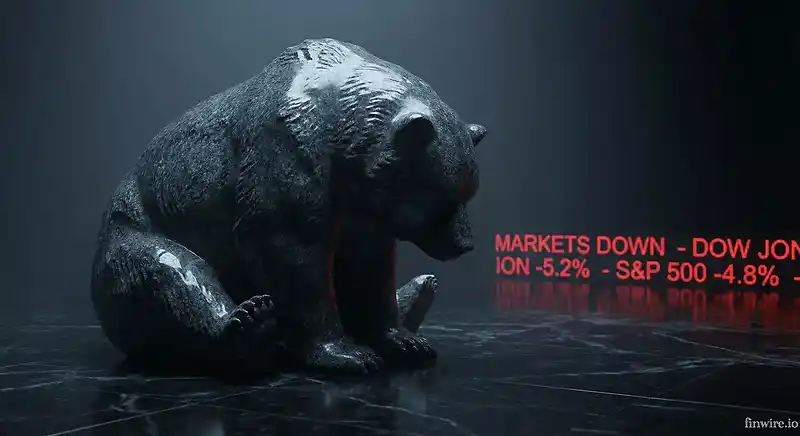
The S&P on Friday fell 0.4% to close at 7,562.39 points, while the tech-heavy Nasdaq Composite dropped 0.9% to settle at 25,136.27 points. The blue-chip Dow Jones Industrial Average inched up 0.1% to conclude at 52,348.03 points.
"Since Monday, markets have been hyper-focused on Nvidia and what it might mean for the AI trade and broader economy over the coming months. Right now, the company is in turmoil, not simply because of Mr. Huang’s departure, but because no one has a clear picture of what (if any) trade or national security secrets were revealed," Oliver c, senior vice president at Wealthspire Advisors, told Investing.com.
"Odds are that investors will gain some visibility relatively quickly. On a long-term basis, the risks in Nvidia stem from 1) does China succeed in its effort to realize a CUDA-killer stack? and 2) do any of the post-LLM architectures dramatically shrink training and inference budgets," he said.
"Looking past the Nvidia headlines, markets will keep their focus on economic and earnings data to discern how monetary and fiscal policies might change in the coming months. Looking ahead to 2027, so far, the investment environment looks favorable. Stock valuations are reasonable given earnings growth expectations. And while that could change, there is no sign of trouble in the near term. Bond yields are sitting near multi-year highs, providing investors with a solid coupon to help offset overall portfolio volatility," Pursche said.
Wall Street’s tumultuous week
Despite a dramatic week filled with consequential data and shock corporate drama, the S&P jumped 2.5% for the week while the surged 2.3%. The Dow added 2.1%.
Tech-sector earnings this week have pointed to resilient artificial intelligence demand and excitement has been building around the potential blockbuster initial public offering of Claude chatbot maker Anthropic.
AI chipmaker Cerebras Systems jumped more than 13% after it reported better-than-expected quarterly revenue and guidance, and also announced a new deal with Microsoft. Applied Materials and Cisco Systems also offered rosy forecasts, but shares fell 4.8% and 6.2%, respectively.
Meanwhile, Nvidia shares dipped 3.2%. On Thursday, the stock tumbled by more than 4%. Even though it pared back much deeper losses earlier in the session, with analysts at CMC Markets noting some dip-buying, the loss means that the better part of $1 trillion in Nvidia’s market value has been erased this month alone.
Colette Kress, most recently Nvidia’s finance chief, has taken over as CEO on an interim basis. Meanwhile, the company has tapped an outside firm to conduct a search for potential successors to Huang, Bloomberg News reported. Nvidia is due to report its latest quarterly results next week.
Huang was ousted from the helm of Nvidia after revelations surfaced that he had multiple extramarital affairs, including one with an alleged Chinese spy and another with an employee. Huang also had an intimate relationship with a second employee, Reuters has reported, citing two people familiar with the matter.
Analysts have been fretting over the implications of the controversy. Huang, who co-founded Nvidia in the early 1990s, has built the group into an artificial intelligence behemoth which both supplies the chips powering AI systems and acts as a sort of central bank backstopping its customers. Whether new leadership at Nvidia continues to pursue the same strategies -- particularly circular financing arrangements championed by Huang -- remains a key question for investors.
Elsewhere, Microsoft said it was still working to fix its Outlook and Teams services, which remained disrupted after a major outage which began on Thursday. Shares were lower premarket.
Looking at geopolitics, oil prices were higher, yet were heading for a weekly decline amid easing fears of a renewed fighting in the Middle East and signs of recovering oil supplies.
PPI relief after hot CPI
While the corporate drama at Nvidia and its overall effect on the artificial intelligence trade grabbed all the spotlight, watchers of monetary policy were also paying attention to the U.S. producer price index (PPI) report for October.
As per the U.S. Bureau of Labor Statistics, headline PPI ticked up 0.3% M/M in October, decelerating markedly from September’s 1.4% rise and coming in below the consensus estimate of 0.4%. On a Y/Y basis, headline PPI climbed 6.5%, the largest 12-month increase since November 2022, but below the forecast of 6.6%.
Core PPI, which excludes volatile food and energy prices, advanced 0.3% M/M in October, slowing down from September’s 0.8% figure and matching estimates. Producer prices added 5% Y/Y, flat from September and also matching forecasts.
The PPI was a relief, coming on the heels of hotter-than-anticipated October consumer price index (CPI) readings, a blockbuster nonfarm payrolls report, and hawkish comments from Federal Reserve Governor Christopher Waller. That combination had led to traders all but locking in a Fed rate hike in December, and even consider a supersized 50 basis point hike rather than the usual 25 basis points.
"Although the Fed has a dual mandate of full employment and price stability, they are purely focused on the latter at this point, and so every data release on inflation will be closely scrutinized. This morning’s PPI data came in mixed and, although the monthly numbers seem to be coming down, the Y/Y numbers are higher now than last year," Chris Zaccarelli, chief investment officer at Northlight Asset Management, said.
"Today’s PPI data – which shows some signs of improving, albeit still too-high – is unlikely to change the Fed’s approach in December because the CPI data was already outside their comfort zone," he added.
Ambar Warrick, Scott Kanowsky, and Jaiveer Shekhawat contributed to this article