Tyson Foods (NYSE:TSN) Reports Sales Below Analyst Estimates In Q2 CY2026 Earnings - StockStory

Meat company Tyson Foods (NYSE:TSN) missed Wall Street’s revenue expectations in Q2 CY2026, with sales flat year on year at $13.87 billion. Its non-GAAP profit of $0.99 per share was in line with analysts’ consensus estimates.
Is now the time to buy Tyson Foods? Find out in our full research report.
Tyson Foods (TSN) Q2 CY2026 Highlights:
- Revenue: $13.87 billion vs analyst estimates of $14.01 billion (flat year on year, 1% miss)
- Adjusted EPS: $0.99 vs analyst estimates of $0.99 (in line)
- Operating Margin: 2.6%, in line with the same quarter last year
- Free Cash Flow Margin: 3.5%, similar to the same quarter last year
- Sales Volumes fell 2.8% year on year (-0.1% in the same quarter last year)
- Market Capitalization: $20.41 billion
Company Overview
Started as a simple trucking business, Tyson Foods (NYSE:TSN) is one of the world’s largest producers of chicken, beef, and pork.
Revenue Growth
Examining a company’s long-term performance can provide clues about its quality. Any business can experience short-term success, but top-performing ones enjoy sustained growth for years.
With $55.69 billion in revenue over the past 12 months, Tyson Foods is one of the most widely recognized consumer staples companies. Its influence over consumers gives it negotiating leverage with distributors, enabling it to pick and choose where it sells its products (a luxury many don’t have). However, its scale is a double-edged sword because there are only so many big store chains to sell into, making it harder to find incremental growth. For Tyson Foods to boost its sales, it likely needs to adjust its prices, launch new offerings, or lean into foreign markets.
As you can see below, Tyson Foods’s sales grew at a sluggish 1.5% compounded annual growth rate over the last three years as it failed to grow its volumes. We’ll explore what this means in the “Volume Growth” section.
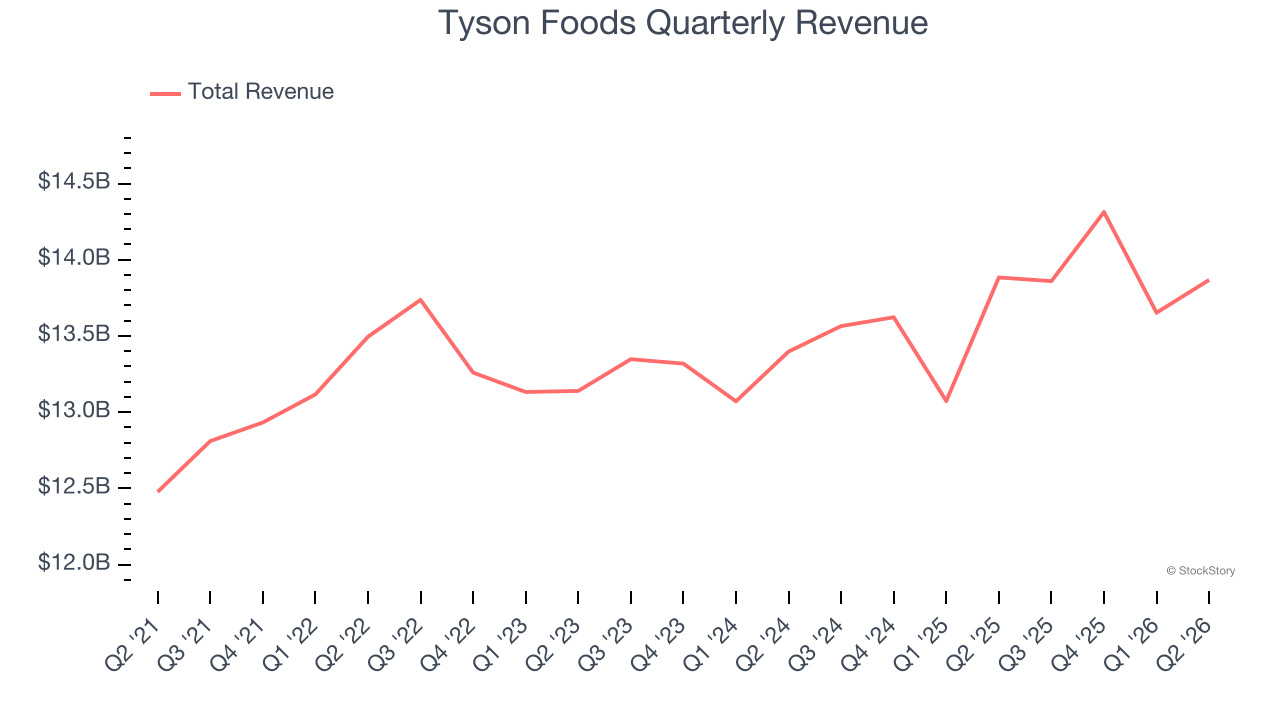
This quarter, Tyson Foods missed Wall Street’s estimates and reported a rather uninspiring 0.1% year-on-year revenue decline, generating $13.87 billion of revenue.
Looking ahead, sell-side analysts expect revenue to grow 2.6% over the next 12 months, similar to its three-year rate. While this projection implies its newer products will catalyze better top-line performance, it is still below the sector average.
Volume Growth
Revenue growth can be broken down into changes in price and volume (the number of units sold). While both are important, volume is the lifeblood of a successful staples business as there’s a ceiling to what consumers will pay for everyday goods; they can always trade down to non-branded products if the branded versions are too expensive.
Tyson Foods’s quarterly sales volumes have, on average, stayed about the same over the last two years. This stability is normal because the quantity demanded for consumer staples products typically doesn’t see much volatility. 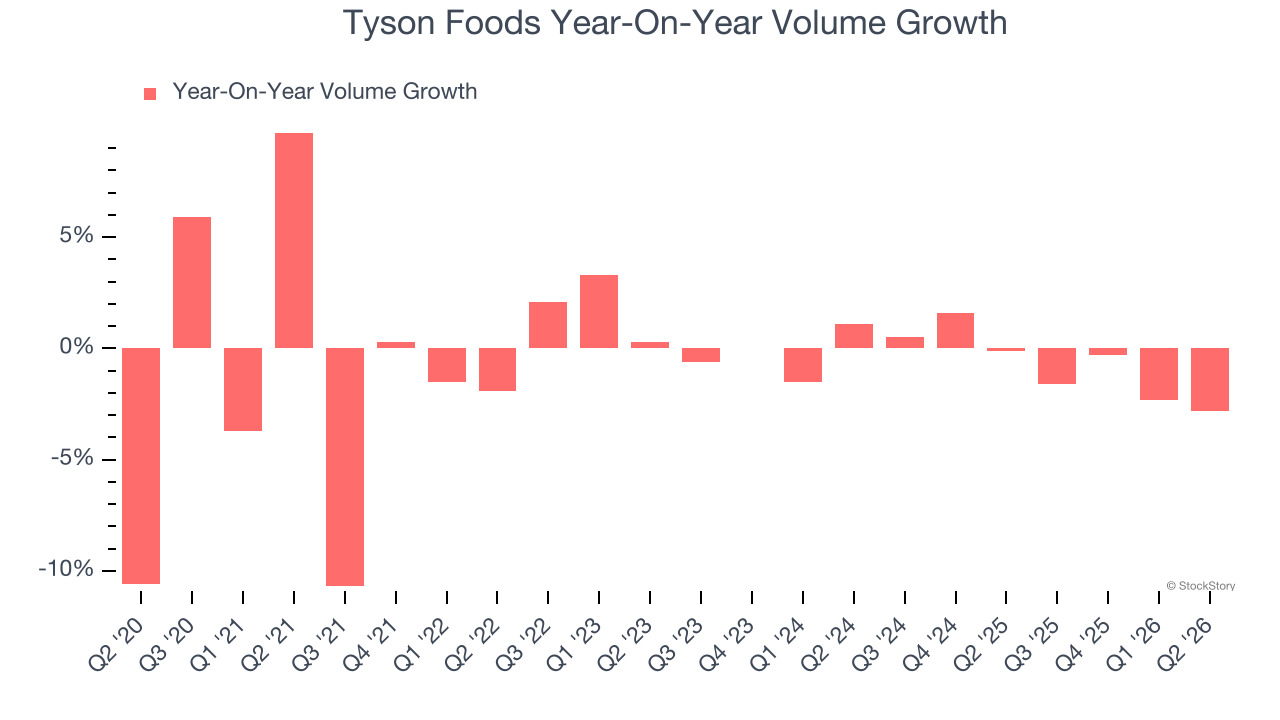
In Tyson Foods’s Q2 2026, sales volumes dropped 2.8% year on year. This result represents a further deceleration from its historical levels, showing the business is struggling to move its products.
Key Takeaways from Tyson Foods’s Q2 Results
We struggled to find many positives in these results. Its gross margin missed and its revenue fell slightly short of Wall Street’s estimates. Overall, this quarter could have been better. The stock traded down 1.9% to $56.86 immediately after reporting.
Tyson Foods’s earnings report left more to be desired. Let’s look forward to see if this quarter has created an opportunity to buy the stock. The latest quarter does matter, but not nearly as much as longer-term fundamentals and valuation, when deciding if the stock is a buy. We cover that in our actionable full research report which you can read here (it’s free).