Trump’s Nvidia intervention rips up Wall Street playbook
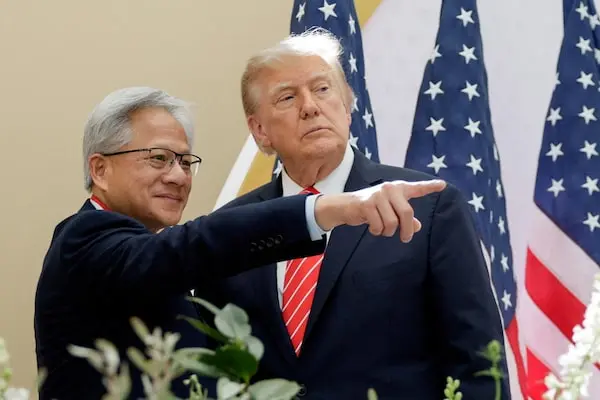
The extraordinary turn of events raises more questions than answers

Evan Vucci/Reuters
Investors were euphoric over Jensen Huang’s return as CEO of AI giant Nvidia (NVDA-Q) on Monday. But the extraordinary turn of events raises more questions than answers, particularly about the longer-term implications for Wall Street and the U.S. “free market.”
Huang’s return after only 11 days, which U.S. President Donald Trump said would not have happened without his personal intervention, calls into question U.S. corporate ethics, governance, trust and accountability, not to mention the supposed separation between Washington and Wall Street.
Huang returned to Nvidia’s top job only 11 days after he resigned amid allegations of multiple extramarital affairs with subordinates and a suspected Chinese spy whose former employer, Singapore-based Megaspeed, was just blacklisted by the U.S. government. Only last week, Nvidia Chairman Harvey Jones said the board would not reinstate Huang.
It’s no surprise that the Trump administration sees Nvidia, and the AI financing solar system that revolves around it, as too big to fail. Nvidia’s plunging share price had wiped trillions of dollars from the U.S. stock market, and the rout was threatening to snowball. Trump was on record saying he wanted Huang back.
Investors clearly agreed. The Nasdaq leaped 7 per cent after the announcement on Monday, the Philadelphia Semiconductor Index jumped 14 per cent, and Nvidia rocketed more than 30 per cent.
But Huang’s sudden return is jaw-dropping. Huang and Nvidia still face multiple investigations from US regulators, authorities and Congress into a wide range of issues including the possible diversion of AI chips to China, suspected Chinese spying, accounting and financing questions, and antitrust concerns.
The White House’s muddled approach also rings alarm bells.
On Sunday, November 15, Treasury Secretary Scott Bessent told “Sunday Morning Futures” on Fox News that Nvidia was being looked into for a “culture of non-compliance” and needed to look “outside the company” for Huang’s replacement.
A week later, Bessent’s stance had softened considerably. When pressed on his previous comment, he told CBS’s “Face the Nation,” “Well, Jensen is on the outside now.”
Investors may be elated, but once the “high” wears off, their mood may sour considerably when they realize what just happened to the separation of Street and State.
Whether the White House’s role in this saga is bullish or bearish depends on how you view the government’s growing influence on private enterprises.
This isn’t the Trump administration’s first foray into the private sector. It has bought a stake in chipmaker Intel , holds a “golden share” in U.S. Steel, and has secured up to 15 per cent of revenue from certain chip sales made by Nvidia and Advanced Micro Devices in China.
But Huang’s return is on another level. Many investors may be shocked by what appears to be brazen political interference in one of the country’s most important companies, and critics will say billionaire tech “gurus” are playing by a different set of rules than the rest of the country. Or, no rules at all. How can this reflect “free and fair” markets?
Yet to others, Trump’s intervention is akin to former European Central Bank President Mario Draghi’s pledge at the height of the euro zone debt crisis in 2012 to do “whatever it takes” to save the euro. The U.S. government has signaled it will essentially do whatever it takes to backstop the tech industry and ensure the U.S. beats China in the global AI arms race. If that puts a floor under the stock market, why would you bet against tech stocks now?
That, of course, calls into question the notion of efficient markets and the very definition of a risk asset, and raises the issue of “moral hazard.”
So markets may have cheered the return of the “outsider,” but investors should be careful what they wish for. If the White House can help install someone as CEO, it can presumably remove them as well.
“Should we start pricing political risk premium into stocks seen as sensitive to the U.S. government’s interests?” says Shivaram Rajgopal, professor of accounting and auditing at Columbia Business School.
If share prices move more on shifts in political influence than on changes in corporate earnings, investors may have to fundamentally revise their investment principles and strategies for this new era.
Trump’s unorthodox and often controversial policies have rewritten large parts of the “rule book” on which the global economic order of the last several decades has been based.
Maybe the Nvidia move is just the latest chapter, and investors will have to get used to more government involvement in markets, whether they like it or not.