The great Canadian art transfer is here. But what happens if the kids don’t want it?

Gabriel Hutchinson/The Globe and Mail
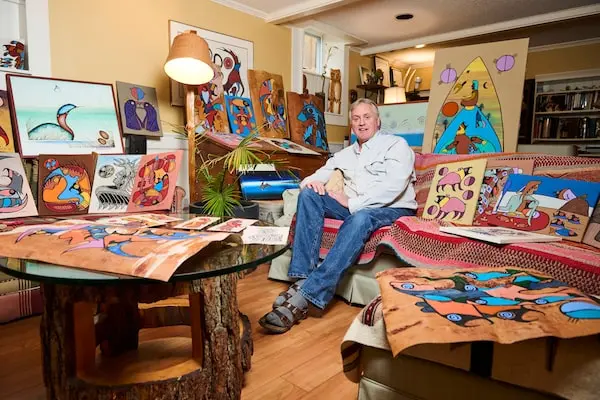
Alan Gordon built a successful career in forestry, but his passion was art. In the 1970s, he and his wife held art shows at the local library in Sault Ste. Marie, Ont., exhibiting First Nations artists from Manitoulin Island.
Aftershe died, the shows came to an end but Mr. Gordon kept buying from the Anishinaabe artists who’d become his friends. Some went on to achieve renown and have their works exhibited in Canadian art institutions as part of the Woodland school art movement, including John Laford, Ahmoo Angeconeb and Roy Thomas.
When Mr. Gordon moved into a care home in 2017, two years before he died, he passed his art collection to his two sons – all 857 pieces.
For Rob Gordon, a 64-year-old geophysicist in Oakville, Ont., managing this inheritance has become a part-time job. Literally. He registered a business, Algonquin Heritage, through which he could sell pieces from his father’s collection, made one significant sale to the National Gallery of Canada, and partnered with a curatorial business to rent some of his pieces to commercial buildings. Buthe’s starting to worry the sheer amount of pieces will be more a burden than an inheritance for his children.
“That’s the thing, and both my wife and I agree, it isn’t the thing you want to pass onto your kids,” he said.

Gabriel Hutchinson/The Globe and Mail
Over the next several years, Canadian baby boomers are expected to bequeath an estimated $1-trillion to their Gen X and millennial children, in what will be the largest wealth transfer in history. Alongside the homes, cottages and investment accounts, some families will transfer art.
Deloitte’s most recent Art and Finance Report pegsthe value of artbeing transferred in the United States at nearly US$1-trillion. While there are no similar figures available for Canada, Fidelity’s 2024 Affluent Canadians Study found that 67 per cent of investors with at least $1-million in investible assets hold artwork, cars, jewellery and other personal property as part of their estate.
And art isn’t exclusively the domain of the wealthy: Many Canadians have picked up or inherited even one piece that has become more valuable with time.
But the next generation doesn’t want their parents’ art – or at least, not all of it. Years of donations have filled museums to bursting. And auction houses won’t take everything. Where will it all go?
For Mr. Gordon, the answer was his basement. A big metal rack holds canvases as large as six feet by four feet, drawers are full with birch bark paintings, and a large wooden chest holds about 100 paper artworks. Until he connected with the professional curators, he’d rented a heated storage unit for the rest.

Gabriel Hutchinson/The Globe and Mail
Boomers have been a collecting generation. Part of it was circumstance: The number of working artists in Canada more than tripled between 1971 and 2001, according to a 2004 report funded by the Canada Council for the Arts, the Ontario Arts Council and the federal Department of Canadian Heritage.
“My wife’s an artist, I know so many artists who are all producing things to cover the walls. There is more stuff than is needed – and not that much wall,” said Bill Kime, asenior decorative arts specialist at Waddington’s Auctioneers and Appraisers in Toronto.
He said Waddington’s often works with estates, but also regularly hears from baby boomers who want to downsize their collections, aware that their family members won’t want them.
Pieces with “intrinsic value” still get high bids, but the changing preferences of younger collectors has meant large amounts of art and decorative objects will be declined. “As an example, generic British watercolours, which would’ve been all the rage back in the 1970s and 1980s, are a struggle to sell today,” he said.

Gabriel Hutchinson/The Globe and Mail
Robyn McCallum, director of Scotiabank’s Art and Collectibles Program, a division of the bank’s wealth management group that advises clients with art, collectibles or other luxury assets, said art and collectibles often aren’t properly factored into estate plans. They’re complex assets that aren’t easily liquidated or divided among heirs and can require valuation, insurance, storage and conservation. Even pieces without significant value should be appraised to ensure the estate is equitably distributed among heirs, she said.
Beyond the practicalities, “what people discount, as well, is how emotional these assets can be for collectors and families,” Ms. McCallum said.
For Mr. Gordon, the inheritance created friction with his brother: He was doing all the work, but the brothers were evenly splitting the proceeds of sales. They eventually settled on a 60-40 divide.
Jill Balfour, a 72-year-old retired civil servant in Toronto, inherited her love of art from her mother. She also inherited a piece by a First Nations painter, a depiction of the colonial period of early Canada, that now has value.
Ms. Balfour said she’s “thought long and hard” about what to do with the piece: She’s torn between keeping it in the family and donating it to a group that’s collecting the painter’s works to develop a gallery in their name.
“That is really hard to make a decision between the sentimental, the family value and the historical element of it,” she said.
People with valuable art tend to want to gift their pieces to a museum, Ms. McCallum said. But “museums have their own policies and collecting practices,” and might not be willing to take donations. That can have tax implications for the estate if a posthumous donation is declined.
In a 2019 survey of nearly 400 Canadian cultural institutions, including museums and archives, almost half of respondents said their collection size had doubled or more than doubled in the past two decades. Roughly the same amount said their storage units and aisles were overcrowded, and that objects in their collections were at risk of damage due to storage issues.

Gabriel Hutchinson/The Globe and Mail
Tax credits have contributed to ballooning collections. The federal government has special tax credits for cultural property of outstanding significance that allow donors to receive a charitable tax credit to be deducted against 100 per cent of their net annual income. In 2023-24, the federal board that certifies donations issued 260 tax certificates for cultural property valued at a combined $81-million, the majority of it fine art.
As well, a “well-kept secret” in the museum world is that donors will often attach their less important pieces to the donation of a seminal work, said David Moos, co-founder of Museum Exchange, an online platform that acts as a matchmaker between art donors and museums and institutions across North America. “Out of inertia or fear of alienating people,” given the resource-strapped nature of many museums, the institution will accept them all, he said.

Gabriel Hutchinson/The Globe and Mail
Museum Exchange is meant to solve the problem by helping art owners find homes for their pieces, Mr. Moos said. Donors post the artworks they’re looking to part with, and interested curators apply to receive them. Mr. Moos said the donor base is a mix of major collectors and middle-class people who’ve acquired a few pieces that their children don’t want.
Ms. McCallum said Scotiabank clients whose artworks haven’t been accepted by a museum have donated to the bank’s donor-advised fund – which helps people with more significant philanthropic gifting – and received a tax receipt for the art’s fair market value.
Mr. Gordon loves his dad’s art collection, and so do his kids, but they’ll probably only keep a fraction of the pieces.
The work of dispensing with the rest continues. Mr. Gordon donated about 10 artworks to his alma mater, and estimated he’s sold about 100 pieces to individual buyers over the past several years. He’s called a long list of galleries and museums across the country inquiring about donations, with mixed success.
“Sometimes on a Friday night, after everyone’s gone to bed,” he said, “I have a glass of port and scour the internet for a place where there might be some interest, send out a couple of e-mails and hope for the best.”