The Fairfax rally has stalled. For new investors, maybe that’s a good thing
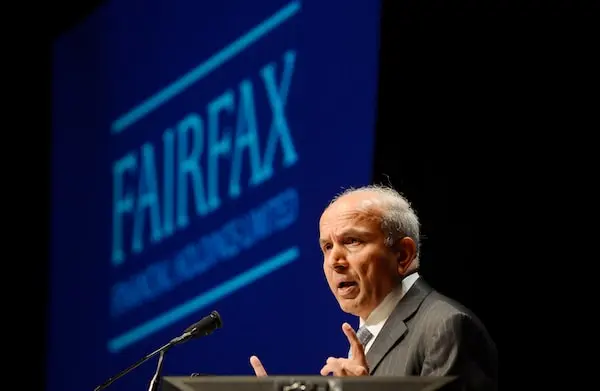

Fairfax CEO Prem Watsa speaks during the company's annual meeting in Toronto in 2013. A slew of deals this year has not lifted investor sentiment toward the stock, which has lagged the S&P/TSX Composite Index.Aaron Harris/Reuters
You can’t say that Fairfax Financial Holdings Ltd. FFH-T has been idle this year, given the big deals it has announced this month alone.
But move over Boots Group and IDBI Bank, Fairfax’s headline-grabbing acquisitions in October. To get the stock price moving again, the company’s insurance operations and extensive bond holdings will have to step up.
The stock has been drifting this year and recently traded at levels seen about 17 months ago.
That marks a downward shift from the three-year stellar rally that propelled the stock a total of 320 per cent from October, 2022, to its peak at the start of 2026. But it also raises the possibility that the pause could reward latecomers to the stock.
Fairfax is modelled on Warren Buffett’s Berkshire Hathaway Inc. BRK-B-N In both cases, their property and casualty insurance companies collect premiums that are used as a source of capital to fund long-term investments.
“There’s no business like the insurance business, if you can manage it properly. That’s allowed us to compound close to 20 per cent over 40 years,” Prem Watsa, Fairfax founder and chief executive officer, said on a conference call with analysts this week.
Just as investors followed Mr. Buffett’s every market move and utterance, Mr. Watsa has his devoted fans as well.
The investment decisions made with a portfolio valued at nearly US$75-billion, at the end of 2025, certainly attract attention.
This week, Fairfax announced a US$5.6-billion deal to acquire a controlling interest of IDBI Bank, the sixth-largest private Indian bank, based on assets.
Earlier this month, Fairfax backed the Weston family’s acquisition of The Boots Group, the British drugstore chain, by taking a 50-per-cent stake.
In August, Fairfax completed a takeover of Andrew Peller Ltd., the Canadian winemaker. Also that month, it sold its remaining shares in BlackBerry Ltd. BB-T, ending a 16-year investment.
None of these developments has lifted investor sentiment toward the stock. Fairfax has lagged the S&P/TSX Composite Index by about 22 percentage points this year.
Two things could get the stock moving again, though, and neither has anything to do with wine, banking or Boots.
First, the property and casualty insurance business might be Fairfax’s bread and butter, but it is also notoriously cyclical. The cycle is currently defined by weak growth in premiums and rising competition for customers.
Investors will learn more when the company reports its third-quarter financial results.
In the second quarter, it reported that net premiums written – a measure of growth in the core insurance business – expanded by just 2.4 per cent, year-over-year. Compare that to the first half of 2025, when premium growth was 6.5 per cent, and you can see why the stock’s rally has sputtered.
But analysts are generally upbeat here, arguing that Fairfax appears to be taking a disciplined and profitable approach to underwriting in a challenging market, which should pay off when the cycle turns for the better.
The second thing that could get the stock moving is relief from the beleaguered bond market.
Fairfax has a substantial bond portfolio, valued at more than US$40-billion at the end of 2025. But bond yields have been soaring to multiyear highs, weighing on bond prices and fixed-income portfolios, as global financial markets respond to persistent inflation and massive government debt loads.
Jeff Fenwick, an analyst at ATB Cormark Capital Markets, expects that Fairfax’s total investment losses could be US$750-million in the third quarter, driven largely by falling bond prices.
Fair enough. But this is a company that has been making the right forecasts on bonds this year, which should cushion the blow.
Wade Burton, president of Hamblin Watsa Investment Counsel, Fairfax’s investment management arm, uttered these prescient words on a call with analysts in July, just as rising bond yields began to attract more attention:
“The risk is tilted towards inflation running higher than expected, which favours our high-quality, short-duration fixed income portfolio,” Mr. Burton said.
Even better than positioning the bond portfolio for rising yields, Fairfax now looks like a decent way to bet that bond yields may have peaked: When the yield on the 10-year U.S. Treasury bond slipped below 5.1 per cent on Thursday – down from a two-decade high above 5.3 per cent last week – the stock rallied more than 5 per cent.
Investors often gravitate to Fairfax for its skill at investing in cheap stocks (okay, some have been headscratchers). The compelling reasons to invest today might not be as interesting – but the rewards could be bigger.