TFSA trouble is teaching a new generation about an old U.S.-Canada irritant
Countries’ treaty does not recognize three tax-advantaged accounts available to Canadian residents

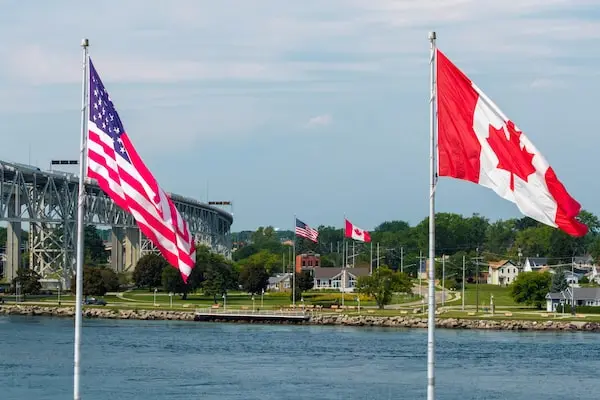
Canadian and U.S. flags fly near the Blue Water Bridge, connecting Sarnia, Ont., and Port Huron, Mich.Carlos Osorio/Reuters
Long before the trade war, Benjamin Oldman, a Connecticut native who now lives in Montreal, learned the hard way about a far older nuisance in the relationship between Canada and the United States.
After graduating from McGill University in 2019 and starting work in marketing,Mr. Oldman opened a tax-free savings account, or TFSA, with his bank. It was shortly thereafter that he discovered his own savings would not be allowed to grow tax free in the account, after all.
TFSAs and other registered accountsmay be a great way for most Canadians to grow their savings, but for some with ties to the U.S., they come with tricky and complicated tax implications that make investing a game of navigating tax treaties.
Nearly 20 years since the last time the Canada-U.S. tax treaty was negotiated,the U.S. considers income earned inside a TFSA to be taxable for Canadian residents who are U.S. citizens, including those who hold dual citizenship.
The same holds for other tax-advantaged accounts such as registered education savings plans, or RESPs, and first home savings accounts, FHSAs.
Not only that, but U.S. citizens must also, often, file a flurry of complex U.S. forms on an annual basis, something that commonly requires paying for costly tax advice.
Ottawa to create CRA-run income-verification system for mortgage applicants
Mr. Oldman ended up closing his TFSA and openinga registered retirement savings plan, or RRSP, instead, which isrecognized by the tax treaty as a tax-deferred account.
A TFSA, he said, would give him more flexibility for shorter-term goals, such as saving for a house.
“I’m trying to save money, like everybody says to do when you’re a young person,” Mr. Oldman, 29, said. “I’ve just been disadvantaged by this situation that I didn’t choose to have.”
Mr. Oldman is hardly the only one facing this dilemma. There were nearly 461,800 U.S. citizens living in Canada in 2021, including over 311,800 dual citizens, according to Statistics Canada’s most recent census data.
For them, gaps in the Canada-U.S. tax treaty are one part of the problem. The agreement is intended to avoid double taxation for individuals reporting income to both countries, including dual citizens, U.S. citizens living in Canada and Canadians working and living in the U.S.
First signed in 1980, the documenthas been renegotiated a handful of times, but not since 2007. The TFSA, which first became available in 2009, was never included.
The same holds for the FHSA, which was introduced in 2023. The RESP, although much older, never had its tax-deferred status recognized by the U.S.
The second issue for U.S. citizens in Canada is thatthe U.S. is one of very few countries – Eritrea being another usually referenced – that taxes its citizens on their worldwide income, regardless of where they live.
All other countries, by contrast, apply taxes based on residency, said Sam Rook, a portfolio manager and managing partner at Quintessence Wealth in Toronto. This means you only pay taxes to the country where you live.
While Americans can invest in registered accounts that aren’t covered by the tax treaty, any income earned and realized capital gains inside them have to be declared to the U.S. each year, said Kris Rossignoli, a senior private wealth manager for Cardinal Point Wealth, a Canada-U.S. wealth management adviser.
And depending on how TFSAs, RESPs or FHSAs are structured, the U.S. may also view them as foreign trusts, which comes with an obligation for account holders to file additional documentation annually to avoid the risk of punitive penalties.
Opinion: The billions being drained from TFSAs tell a story about retirement, and the cost of raising a family
Even the RRSP is not a panacea for U.S. citizens in Canada looking for ways to grow their savings tax-free.
Andrea Thompson, acertified financial planner and founder of Modern Cents, said people usually seek her out after they’ve maxed out their RRSPs as dual or U.S. citizens.
“That’s where you tend to see a lot of stagnation around, ‘What else can I access? What else can I do?’,” Ms. Thompson said.
Then there are questions such as those raised byAlbert Gunnison, 29, aNew Hampshire native who now lives in Toronto with his Canadian fiancée.
Mr. Gunnison, who is getting married in February and planning to apply for Canadian citizenship, is wondering whether he will be able to take advantage of a spousal RRSP once married or use the Home Buyers’ Plan to buy a house.
The Home Buyers’ Plan allows account holders to withdraw up to $60,000 from their RRSP tax-free to purchase their first home, as long as the amount is repaid within a set period.
But Mr. Rook, of Quintessence Wealth, cautioned U.S. citizens in Canada could face tax issues on such a withdrawal.
Ms. Thompson said answers she gives her clients, like those to Mr. Gunnison’s questions, often depend on individual circumstances. She recommends always disclosing what’s in your accounts when filing and seeking a cross-border specialist for help.
Mr. Gunnison, for his part, is saving aggressively inside the RRSP, although he would have preferred to do so in a TFSA, which he believes is a better avenue for saving for shorter-term goals.
“For now, our focus really is just to invest as much as possible in the channels that we have available to us,” Mr. Gunnison said.