Taiwan loosens margin call rules in bid to steady market amid AI rout
Move raises threshold for forced selling in a market dominated by chipmaker TSMC

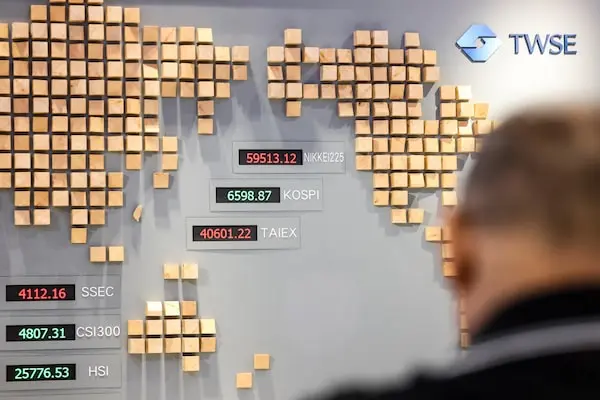
A board shows numbers for the TAIEX Index and other markets at the Taiwan Stock Exchange in Taipei in May.I-HWA CHENG/AFP/Getty Images
Taiwan’s brokers will relax margin lending rules to try to reduce selling pressure in one of the hardest-hit markets in a global rout of AI-related stocks, the stock exchange said on Monday, as authorities across Asia sought to reassure investors.
The move comes after Taiwan’s benchmark index, dominated by chipmaker TSMC TSM-N, recorded its sharpest weekly drop in more than three decades last week, raising the risk of further falls should leveraged investors be forced to sell.
Securities firms agreed to lower minimum margin maintenance ratios as of Tuesday to 120 per cent from 130 per cent, the exchange said in a statement. That means the threshold is higher for brokers to force customers to sell shares or to top up accounts with cash or other collateral if their investments fall in value.
The move is intended to reduce selling pressure during periods of volatility, the statement said.
Retail leverage has dropped sharply in Taiwan but forced-selling risks remain elevated, according to a Goldman Sachs note published on Saturday, which showed aggregate maintenance margin ratios at 132 per cent, suggesting a lot of clients were close to the margin-call threshold.
It is the latest of several support measures that on Monday, at least, were stabilizing some of Asia’s chipmaker-heavy markets that have been hammered in recent weeks.
Shares recover
TSMC shares were up 1.5 per cent on Monday, and Taiwan’s equity benchmark bounced 2.1 per cent after falling 17 per cent last week.
Investors globally are questioning whether the vast sums of mostly borrowed money spent building data centres, filled with chips from TSMC, Samsung and others, to power AI tools, will generate profits large and fast enough to repay lenders.
Chinese exchanges announced similar margin relaxations over the weekend. Earlier on Monday Taiwan’s exchange encouraged investors to take a long-run view and companies to launch buybacks. South Korea’s finance minister reiterated plans on Monday to stabilize its stock market if needed.
On Saturday, Taiwan said it would further tighten short-selling rules and that it had already put its US$15-billion stock stabilization fund to work in the market.
“The purpose of these measures is to avoid speculative behaviour that continues to cause unnecessary panic,” Taiwan Premier Cho Jung-tai told a meeting of financial regulators and business leaders on Monday.
Cho said there was “still room” for the stabilization fund and other resources he did not specify to be used to stabilize the market.
“We are willing to make a positive and proactive review of the fund’s scale, with the aim of continuing to stabilize the financial system,” he added, without elaborating.
TSMC senior vice-president Cliff Hou and major Nvidia NVDA-Q supplier Foxconn chairman Young Liu were among those who attended the meeting.
Hou and Liu told reporters afterwards that tech demand remained strong.
“We believe that as long as our technology and production capacity can keep delivering, the continued growth of the semiconductor industry will not change because of short-term volatility,” Hou said.
Taiwan’s government has repeatedly said economic fundamentals are good.
Economy Minister Kung Ming-hsin, speaking at the same meeting, pointed to export order data last month which surged by its fastest clip on record thanks to AI demand.
“Orders in October are usually reflected in November and December shipments, so this very high growth rate suggests that export growth in November and December will also be very strong,” he added.