S&P 500, Nasdaq hit record highs as U.S.-Iran tensions cool and oil prices dip
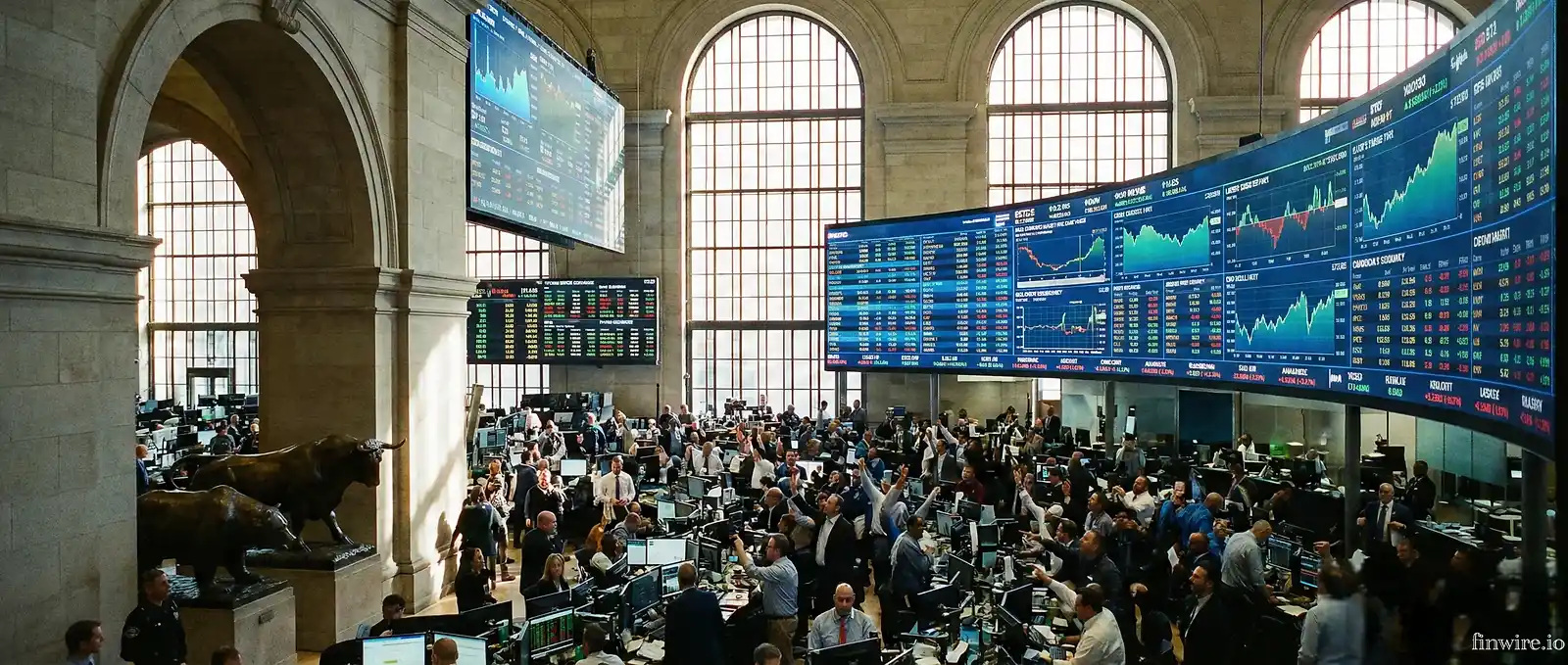
U.S. stocks were higher on Tuesday, as sentiment was boosted by some calming rhetoric from Washington following a renewed spike in tensions with Iran. Gains in the materials and technology sector, along with a strong corporate earnings season, also helped.
At 15:25 ET (19:25 GMT), the benchmark S&P 500 index was up 1% to 7,273.21 points, while the tech-heavy NASDAQ Composite added 1.1% to 25,349.40 points, with both gauges hitting a record high. The blue-chip Dow Jones Industrial Average climbed 0.8% to 49,341.50 points.
"U.S. equities have been strong since pre-market trading as the ceasefire appears to be holding despite yesterday’s tensions. Oil is down more than 3%, fueling equity buying," Michael O’Rourke, chief market strategist at Jones Trading, told Investing.com.
"The memory and storage names continue to power the semiconductor and tech hardware groups sharply higher. The upward momentum in the tech sector is driving approximately 70% of the S&P 500 gain today. There is some weakness in the financial sector after Anthropic announced several new artificial intelligence agents that are weighing on data services providers," O’Rourke added.
U.S. says Iran ceasefire not over
The situation in the Middle East escalated quickly over the weekend and on Monday, after President Donald Trump announced a U.S. effort called "Project Freedom" to help reopen stalled shipping traffic through the Strait of Hormuz. The vital conduit for a fifth of the world’s oil has been effectively shuttered by Iran since the start of the conflict, leading to the biggest supply disruption in history.
Iran responded by firing missiles upon U.S. destroyers approaching the strait, claiming to strike one. U.S. Central Command dismissed the claim, saying no ships had been struck, and instead said two U.S. merchant ships had successfully transited the strait.
Separately, the United Arab Emirates on Monday said it had intercepted missile and drone attacks from Iran. The attacks caused a fire at the Fujairah Oil Industry Zone, a massive oil trading and storage hub located in the emirate of Fujairah.
The U.S. on Tuesday calmed the mood somewhat by asserting that Project Freedom was a distinct effort solely to expedite safe passage of commercial ships through the strait.
"Project Freedom is defensive in nature, focused in scope, and temporary in duration—with one mission: protecting innocent commercial shipping from Iranian aggression. American forces won’t need to enter Iranian waters or airspace, it’s not necessary. We’re not looking for a fight," U.S. Secretary of War Pete Hegseth told reporters.
"Right now, we know we have a lane of safe passage that commercial shipping can float through," he said, adding that the ceasefire with Iran was not over.
Trump on Tuesday, when asked what actions by Iran would violate the ceasefire, replied "you’ll find out." The president added that Iran knew what to do and "more importantly" what not to do.
"I can say this, Iran wants to make a deal," Trump said.
In an interview with ABC News on Monday, Trump suggested that the war in Iran could stretch on for another three weeks, even as he claimed the U.S. had already "won" the conflict.
Iran says talks progressing, oil retreats
Also helping to de-escalate tensions was some positive commentary from Iranian foreign minister Abbas Araghchi.
"Events in Hormuz make clear that there’s no military solution to a political crisis. As talks are making progress with Pakistan’s gracious effort, the U.S. should be wary of being dragged back into quagmire by ill-wishers. So should the UAE," Araghchi said on X.
The minister also called the U.S. effort to ensure safe passage of commercial ships through the strait of Hormuz "Project Deadlock."
"The new equation of the Strait of Hormuz is in the process of being solidified. The security of shipping and energy transit has been jeopardized by the United States and its allies through the violation of the ceasefire and the imposition of a blockade," Mohammad Bagher Ghalibaf, Iran’s parliament’s speaker, said on X.
Oil prices slipped on Tuesday on the positive rhetoric from the U.S. and Iran, after surging in the previous session. Brent crude futures expiring in July, the global oil benchmark, were last down 4% to $109.88 a barrel, while West Texas Intermediate crude futures expiring in June dropped 3.7% to $102.50 a barrel.
Market participants also took heart from more evidence that Project Freedom was helping ships transit the strait, after shipping giant Maersk said a U.S.-flagged vehicle carrier operated by one of its subsidiaries had exited the Gulf via the strait with the assistance of American military support.
Job openings dip, services sector growth slightly soft
Away from the Middle East conflict, traders received an indicator on the labor market ahead of Friday’s closely-watched April nonfarm payrolls report.
According to the Bureau of Labor Statistics’ latest Job Openings and Labor Turnover Summary (JOLTS), U.S. job openings came in at 6.866 million in March, above the consensus estimate of 6.850 million but falling from February’s 6.922 million.
"The slight decline in the JOLTS measure of job openings in March undermines the theory that the labor market is starting to revive. Timelier unofficial data suggest openings have continued to grind lower since then," Samuel Tombs, chief U.S. economist at Pantheon Macroeconomics, said on X.
But the number of hires in March increased to 5.554 million, and the hiring rate ticked up to 3.5%.
"There was a big bounce back in the official U.S. hiring rate in March. 3.5% hiring rate is the highest in almost 2 years!" Heather Long, chief economist at Navy Federal, said on X.
"The war in Iran is likely to halt progress. But any sign of a hiring pickup is welcome news after the ’hiring recession’ in the past year or so," Long added.
Separately, the Institute for Supply Management (ISM) said U.S. economic activity in the services sector expanded in April, with the headline index coming in at 53.6, a smidge lower than the estimate of 53.7 and March’s reading of 54.0.
Notably, the ISM’s gauge of prices paid by services organizations for materials and services stayed flat at 70.7 in April, significantly below expectations for a much bigger spike due the impact of surging oil prices.
AMD earnings ahead
Turning to the earnings season, AMD is set to report after the closing bell later today, with traders curious to hear how the chipmaker is progressing in its challenge to rival artificial intelligence semiconductor powerhouse Nvidia.
In February, AMD projected that revenue would fall slightly in the first quarter to around $9.8 billion, plus or minus $300 million, compared to $10.27 billion in the preceding three-month period. The downbeat outlook came even as AMD received a boost from a resumption of sales to China, underlining the battle the company faces to compete with Nvidia.
In earnings-related moves, data analytics firm Palantir beat quarterly estimates and lifted its revenue forecast, but shares declined 7.2% as finance chief David Glazer flagged that the group’s expenses would increase in 2026.
U.S.-listed shares of Shopify slumped more than 15%, even as the Canadian e-commerce firm topped quarterly estimates.
More broadly, the earnings season has provided a source of optimism for investors jittery over the impact of the Iran war, driven largely by AI-linked hyperscalers. S&P 500 companies are anticipated to post aggregate profit growth of 28% versus a year ago for the first quarter, more than double expectations at the beginning of the reporting period in early April, Reuters reported, citing LSEG I/B/E/S data.
In other active stocks, Intel surged nearly 13% after Bloomberg News reported that Apple had held exploratory discussions with the company and Samsung Electronics about producing main processors for its devices.