Should investors be keen to buy Anthropic stock? The IPO is enticing – but oddly timed


AI mania has faded in recent months, with the tech-heavy Nasdaq lagging behind sectors such as utilities and consumer staples

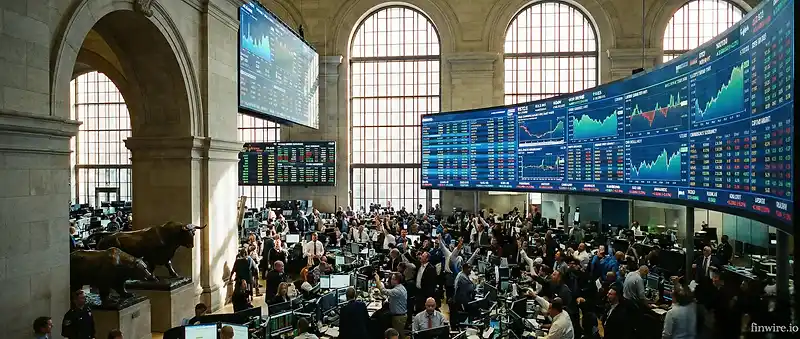
A screen displays news about Anthropic's IPO on the floor of the New York Stock Exchange on Oct. 26.Jeenah Moon/Reuters
Anthropic PBC’s debut as a public company next week is going to be huge in every way – in terms of the amount of money it will raise, in terms of the value it will ascribe to the entire company and, not so incidentally, in terms of the reams and reams of paperwork that will accompany the deal.
The prospectus for the initial public offering, including footnotes, sprawls across more than 400 pages. Let’s assume you are not going to read the entire hulking mass. Which key points should you focus on before deciding whether to invest?
Start with a quick look at the financial statements. They show a fascinating mixture of pros and cons.
There is, for instance, the lack of profit. Anthropic, like many young tech companies, is shredding money. On paper, it lost a staggering US$104-billion in the first nine months of this year.
The situation is not quite as dire as it looks. Most of the loss was a non-cash expense relating to the repricing of the company’s convertible securities. (As Anthropic’s valuation soared, the estimated accounting value of its convertible obligations rose on paper, and accounting rules recorded that increase as a loss even though no cash left the company.) If you strip out this accounting exercise, Anthropic lost only – only! – US$1.3-billion from January to September.
From SpaceX to Anthropic, markets have a new playbook for mega-share debuts
That’s certainly an improvement on the original figure. Still, a billion-dollar loss is a billion-dollar loss.
On a happier note,Anthropic’s revenues are surging. They shot from US$4.6-billion in all of 2025 to US$33.2-billion in the first nine months of this year.
The hope is that soaring revenues will enable the company to stay ahead of its massive spending on compute – the digital processing power needed to run artificial-intelligence applications – and eventually turn a profit.
Recent signs are positive. In the first three quarters of 2025, compute and infrastructure expenses equalled 172 per cent of Anthropic’s revenue – in other words, they were costing the company nearly double what it was bringing in the door in sales. But in the first nine months of this year, Anthropic’s sales surged to the point where compute and infrastructure costs gobbled up only slightly more than half (57 per cent, to be exact) of revenue.
If revenue growth continues to outpace the rising cost of compute, the company is well on the road to profitability. (That is, real profitability as measured by generally accepted accounting principles. The company claims to already be profitable on its own “adjusted operating” metric, but that is an in-house accounting calculation that should, like most such numbers, be treated warily.)
Here’s where things get tricky, though. While Anthropic’s recent trajectory is impressive, the company also faces big risks. These are outlined in a 90-page section of the prospectus that reads like a dystopian novel. It appears that a myriad of problems – everything from out-of-control AI agents to chip shortages to the loss of key personnel – could stymie Anthropic’s plans. (The Globe and Mail is part of a coalition of news publishers that is suing Anthropic in Ontario court for unauthorized use of copyrighted materials.)
Want to be part of the Anthropic IPO? What Canadian investors need to know
The fog of uncertainty means that estimates of the company’s value span a comically wide range. The research firm Morningstar, for instance, outlines a base-case scenario that pegs the company’s value at US$92 a share, or about US$1.7-trillion in total. It also sketches bear and bull cases that run the gamut from US$25 to US$188 a share.
Other analysts acknowledge a similar jumble of possibilities. The message here is that nobody really knows.
At last report, Anthropic was targeting a valuation of US$1.3-trillion to US$1.4-trillion, or roughly US$70 to US$78 a share. That is down substantially from the US$2-trillion that it was rumoured to be shooting for as recently as September.
Should you be eager to buy in at $78 a share or below? The numbers look reasonable compared with both the much higher price that was expected back in September and the baseline cases from Morningstar and others.
Skeptical investors, though, may question why the AI pioneer is going public right now.
The timing is odd. AI mania has steadily faded in recent months, and for good reason.
“AI is in a financial bubble,” economists Jared Bernstein and Ryan Cummings declared in September. They estimated that since 2024, a handful of big publicly traded companies had poured roughly US$1.2-trillion into AI investments. The problem is that these “hyperscalers” had made only US$277-billion in revenue, leaving a gap of about a trillion dollars.
The market appears to be paying attention to these disappointing numbers. In recent months, the tech-heavy Nasdaq index has lagged behind humdrum sectors such as utilities and consumer staples stocks. Meanwhile, the U.S. midterm elections earlier this month signalled that voters are less than thrilled about construction of AI-focused data centres.
So why doesn’t Anthropic wait for sunnier days, when it could presumably aim for a much higher valuation? The most charitable explanation is that the momentum behind the huge IPO is simply too big to stop. The more concerning possibility is that the company thinks this is as good as things will get for the foreseeable future.
Investors who are tempted by the IPO should be prepared to be patient.
Related Articles
- Stock Markets News
Anthropic IPO faces test after recent selloff: What Wall Street experts are saying
- Stock Markets News
Could the AI sell-off put Anthropic’s IPO timing and valuation at risk?
- Business News
Anthropic's blockbuster share listing - 5 surprising things we now know
- Stock Markets News
Exclusive-Investors flock to Anthropic IPO but question durability of AI lead
- Business News
Anthropic’s IPO timing threatened by AI backlash, historic tech rout