Premarket: U.S. stock futures falter on AI jitters, Nasdaq braces for steep monthly fall
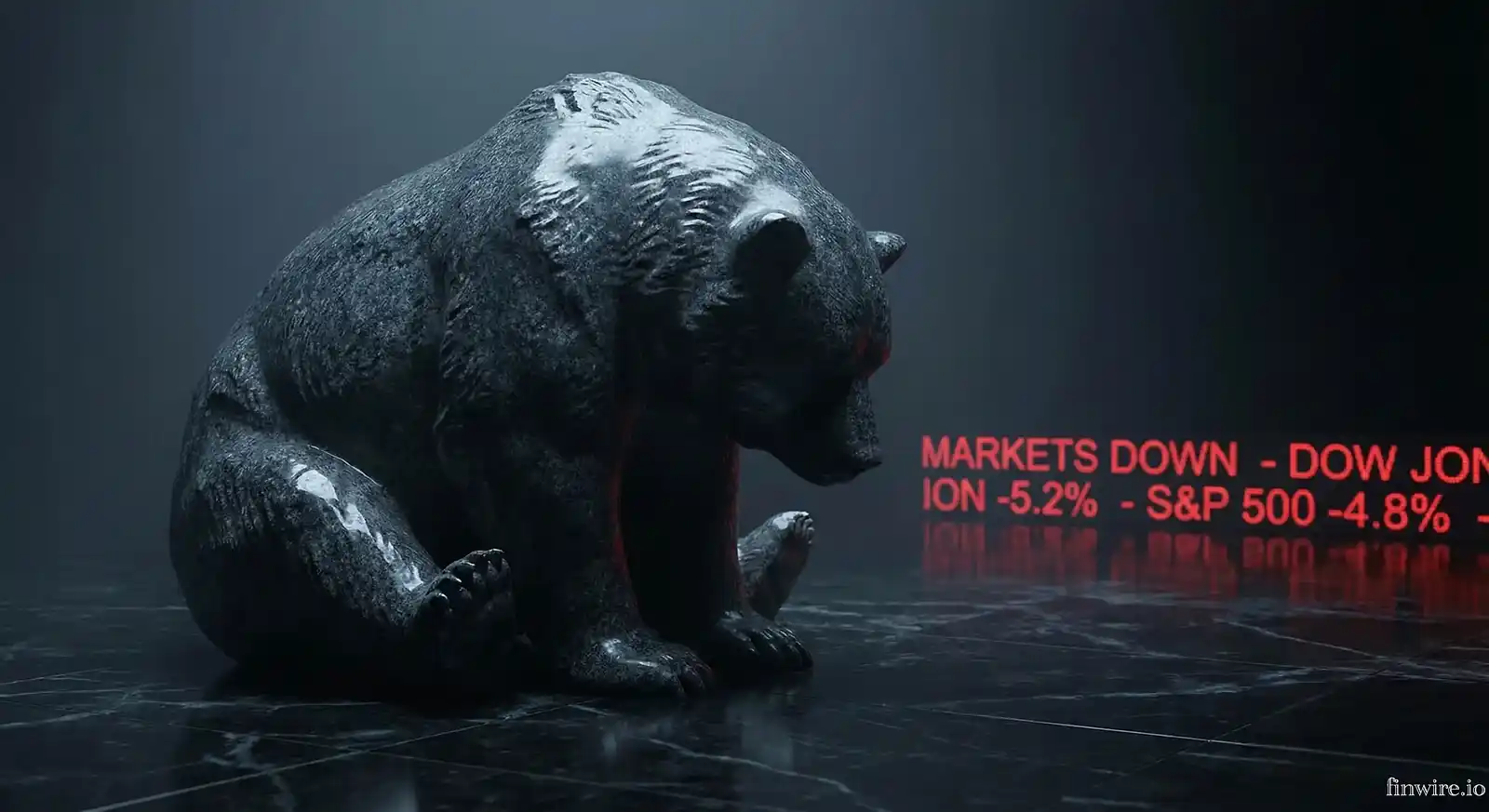
U.S. stock index futures slid on Friday as growing AI unease weighed on technology stocks, with the Nasdaq staring at its steepest monthly drop since March 2025, and investors awaited key inflation data later in the day.
Technology stocks saw immense turbulence this month due to AI concerns, even as investors fretted about the payoff from massive planning spending on artificial-intelligence technology.
Brewing tariff uncertainty also stoked volatility after the U.S. Supreme Court last week voided most of the duties U.S. President Donald Trump imposed last year. In response, Trump announced a temporary global tariff of 10 per cent that came into effect on Tuesday.
Nvidia inched up 0.4 per cent in premarket trading after sliding more than 5 per cent in the previous session despite strong earnings, a sign that risk sentiment for all things AI remained shaky.
Zscaler lost 9.1 per cent after the cloud security firm reported a wider net loss in the second quarter, while Intuit dipped 3.6 per cent after the financial software company forecast third-quarter profit below estimates.
Software shares were rocked earlier this year on fears of industrywide AI-led disruptions. Financial brokerages, data analytics and legal services, real estate services and trucking are also hit hard by brewing AI concerns.
The S&P 500 and the Nasdaq clocked losses in the last session, with the Nasdaq closing below its 50-day moving average for the 17th straight session. The closely followed moving average is seen as a proxy for the intermediate-term trend.
In economic data, a January producer prices reading due before the bell could offer insights into the U.S. Federal Reserve’s interest rate path.
At 6:00 a.m. ET, Dow E-minis fell 271 points, or 0.55 per cent, S&P 500 E-minis shed 24.75 points, or 0.36 per cent, and Nasdaq 100 E-minis lost 78 points, or 0.31 per cent.
Most megacap and growth stocks inched lower. Chip stocks including AMD and Broadcom also declined.
Netflix added 7.4 per cent as investors cheered its decision to exit the fight for Warner Bros Discovery, which fell 2 per cent, while Paramount Skydance advanced 7.8 per cent after it won the race for some of the world’s most prized TV and film assets.
Block surged nearly 19 per cent after the payments firm said it will cut over 4,000 jobs, nearly half its workforce, as part of an overhaul to embed artificial intelligence across its operation.
Dell climbed 10.6 per cent after the PC-maker said it expects revenue from its key AI-optimized servers business to double in fiscal year 2027 and promised to return more cash to shareholders.
Duolingo dropped almost 25 per cent after the language-learning app forecast first-quarter and 2026 bookings below expectations
Global shares edged up on Friday to within a fraction of a fresh record high, and were set for a monthly gain, even as geopolitical tensions and persistent concerns about AI caused wild swings under the surface.
Manish Kabra, head of U.S. equity strategy at SocGen, said in the absence of any major news, the market is refocusing on fundamentals which he described as “rock solid.”
“This is on a global basis. When I say fundamental, this is the profit cycle, the growth cycle, the broadening of the growth,” said Kabra.
Global shares rose 0.2 per cent, while Europe’s STOXX 600 was up 0.4 per cent, buoyed by positive earnings.
Markets were also closely watching the latest developments in U.S. and Iran nuclear talks, as Washington amassed more military resources in the Middle East.
An Omani mediator of U.S. and Iran nuclear talks gave an optimistic summary of the latest round of negotiations, but signs of a breakthrough that would avert potential U.S. strikes remained elusive.
“With no major breakthroughs announced in the U.S.–Iran talks, crude markets remained in wait-and-see mode, continuing to price in a significant risk of military escalation between the two countries,” said Mantas Vanagas, senior economist at Westpac Group.
U.S. crude rose 1.4 per cent to $66.16 a barrel, and Brent rose to $71.65, up 1.3 per cent. Spot gold shed 0.15 per cent to $5,178.29 an ounce.
The U.S. and Iran plan to resume negotiations over Tehran’s nuclear programme after consultations in their countries’ capitals, Omani Foreign Minister Sayyid Badr Albusaidi said in a post on X after the day’s meetings in Switzerland.
Any substantial move forward could curb chances for U.S. President Donald Trump to carry out a threatened attack on Iran that many fear could escalate into a wider war.
The dollar index, which measures the greenback against a basket of currencies, was flat at 97.73, with the euro up 0.07 per cent at $1.1805. The yen was flat 156.16 per dollar.
Sterling rose 0.1 per cent to $1.349 after British Prime Minister Keir Starmer’s Labour Party suffered an election defeat in an area of Greater Manchester that it had dominated for almost a century.
The yield on benchmark U.S. 10-year notes fell 2.6 basis points to 3.99 per cent.
Data in Japan showed cooling inflation in Tokyo and weaker-than-expected factory output, complicating the case for policy rate increases by the central bank. The data came on the heels of Prime Minister Sanae Takaichi putting forward two Bank of Japan board nominees who share her dovish mindset.
Japanese Finance Minister Satsuki Katayama signalled heightened vigilance over currency moves, telling parliament the government is monitoring the yen’s recent drop with a strong sense of urgency.
Reuters