Oracle vs. Microsoft: Big Tech’s AI Cloud Battle Has a New Underdog


Microsoft had the early AI lead, but Oracle is quickly turning itself into a serious AI contender.
Microsoft (MSFT) and Oracle (ORCL) are both legacy tech giants, but when the AI boom took off, Microsoft had the clearer advantage. Azure already had enormous scale, and Microsoft’s partnership with OpenAI gave it an early strategic advantage in the race. Oracle, meanwhile, looked like the one trying to catch up. But Oracle’s position quickly changed. Oracle is rapidly expanding its AI infrastructure business, winning major contracts and emerging as an unexpected underdog in the AI cloud battle.
Let’s find out which is the better stock to buy now.
The Case for Microsoft (MSFT): The First Mover
Microsoft had an advantage going into the AI race. It had the legacy products, the enormous scale, steady revenue and earnings growth, customer relationships, a solid balance sheet, and a partnership with OpenAI. All of these factors gave it a clear advantage to build a software ecosystem that Oracle is still trying to build around AI.
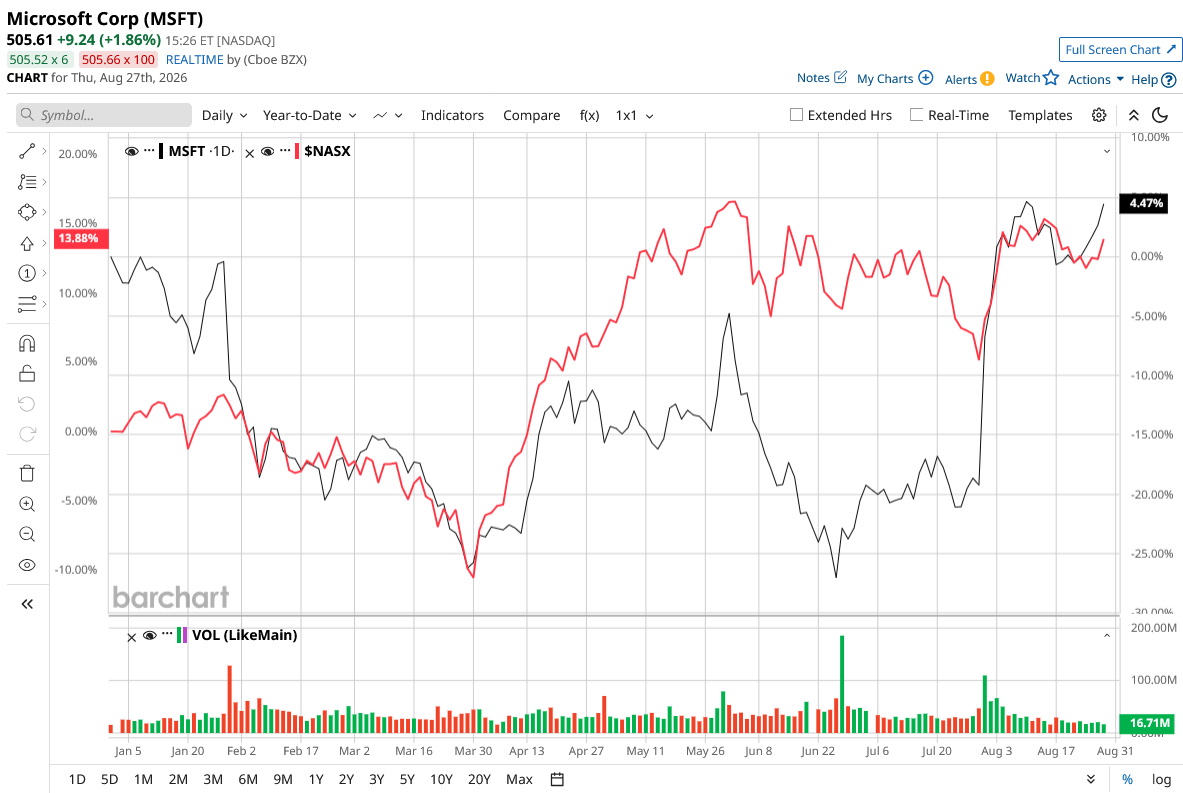
In fiscal 2026, Microsoft Cloud revenue exceeded $214 billion, while Azure revenue surpassed $100 billion. This shows that Microsoft's AI cloud opportunity is already sitting on top of a massive commercial base. Total revenue increased 18% year-over-year (YoY) to $331.8 billion, while adjusted earnings rose 22% in fiscal 2026. Microsoft is moving aggressively to expand its AI infrastructure. During the quarter, the company brought 31 new data centers online across five continents, taking the total to 88 facilities. It also increased capacity by another gigawatt and expects its overall infrastructure footprint to nearly double within two years. At the same time, Microsoft has cut GPU deployment times in its largest regions by roughly half, helping it bring new capacity to customers faster. That matters because Azure is still facing demand that is greater than its available capacity, with newly added capacity being absorbed quickly.
Microsoft is also giving Azure customers considerable flexibility when it comes to AI models. Its cloud platform now offers access to more than 11,000 models, spanning OpenAI, Anthropic, Mistral, xAI, and Microsoft's own MAI models. That makes Microsoft's AI strategy less dependent on a single model provider.
Foundry is also crucial to this strategy. The Foundry platform is gaining traction quickly, with its customer base reaching 100,000 and revenue growing by more than 100% YoY. Notably, the number of customers using Foundry at a one-trillion-token annualized run rate has increased fourfold. Importantly, Microsoft's financial strength gives it another advantage in the AI cloud race. The legacy giant generated $19.6 billion in free cash flow during Q4, despite spending $41 billion in capital expenditures. The company returned $10.2 billion to shareholders through dividends and buybacks. Operating cash flow was much higher at $55.4 billion in Q4 and $136 billion for the full fiscal year. The company ended the quarter with $76.8 billion in cash, cash equivalents, and short-term investments. Overall, Microsoft's advantage is already visible in its scale. It has the customers, the cloud footprint, the applications, the developer ecosystem, and the AI distribution.
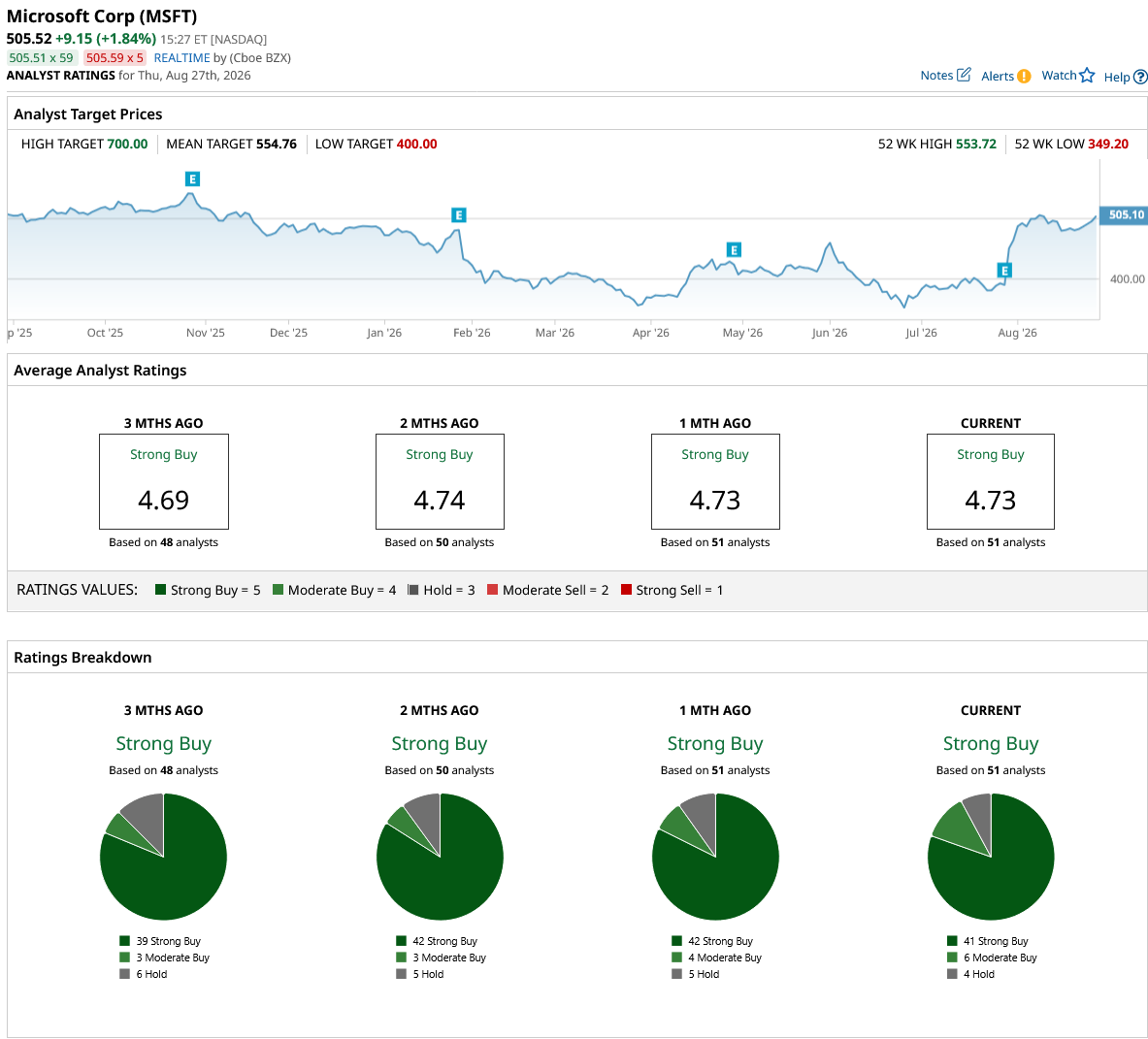
On Wall Street, MSFT stock remains a consensus “Strong Buy.” Of the 51 analysts covering the stock, 41 rate it a “Strong Buy,” six say it is a “Moderate Buy,” and four rate it a “Hold.” Wall Street expects MSFT to climb by 10% from current levels if it hits its mean target price of $554.76. Plus, its high price estimate of $700 implies the stock has an upside potential of 38% over current levels.
The Case for Oracle (ORCL): The “Underdog”
Oracle has a smaller cloud business than Microsoft. However, the sheer pace with which its cloud infrastructure has grown offers a strong case for the "underdog" claim. In its most recent fourth quarter, Oracle’s cloud infrastructure revenue increased 93% YoY, while total revenue increased 21% to $19.2 billion. Similarly, cloud database revenue also jumped 29%, showing that AI opportunity is not just limited to selling raw computing capacity.
But the most important metric that investors might have overlooked was the massive remaining performance obligations, or RPO, which increased by a whopping 363% YoY to $638 billion. This figure wasn’t just an estimate but actual revenue that will be recognized over the coming months. This was backed by long-term contractual customer commitments across AI infrastructure and cloud services.
In fact, Oracle signed $67 billion worth of AI infrastructure contracts in Q4 alone, bringing its combined bring-your-own-hardware and prepaid customer contracts to $75 billion. And the company has already started putting that capacity to work. Oracle supplied customers with over 1.2 gigawatts of infrastructure capacity throughout fiscal 2026. Additionally, delivery for the first quarter of fiscal 2027 was approaching 1 gigawatt, with GPU utilization at 97.5%.
Oracle is making enterprise AI easier to buy by offering token-based and outcome-based pricing, while its applications business provides a built-in channel for AI adoption. Basically, Oracle has multiple ways to turn AI demand into revenue. But that strategy comes with heavy investments. Oracle spent $48 billion on capital expenditures in fiscal 2026 and is budgeting roughly $70 billion for the following year. To support that expansion, it expects to secure about $40 billion from a mix of debt and equity financing in fiscal 2027. That is the trade-off behind Oracle’s “underdog” story. The upside could be substantial if these massive investments generate the returns management expects.
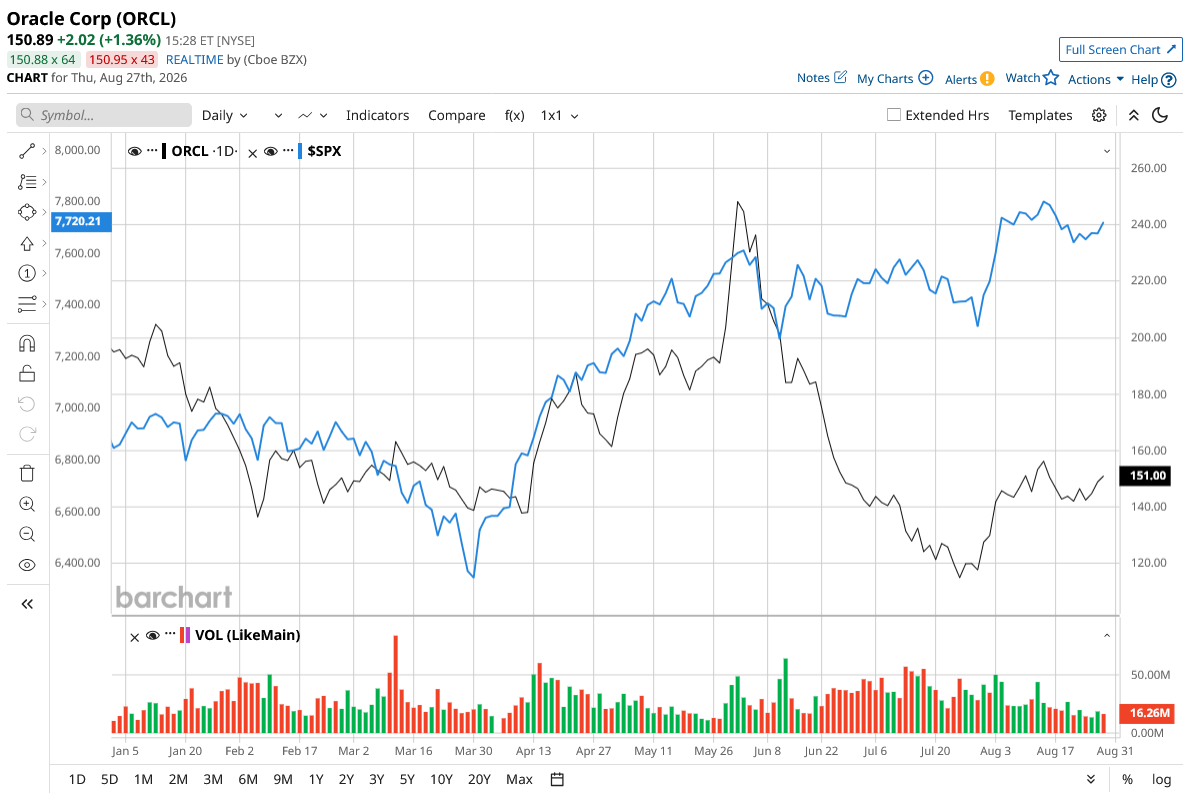
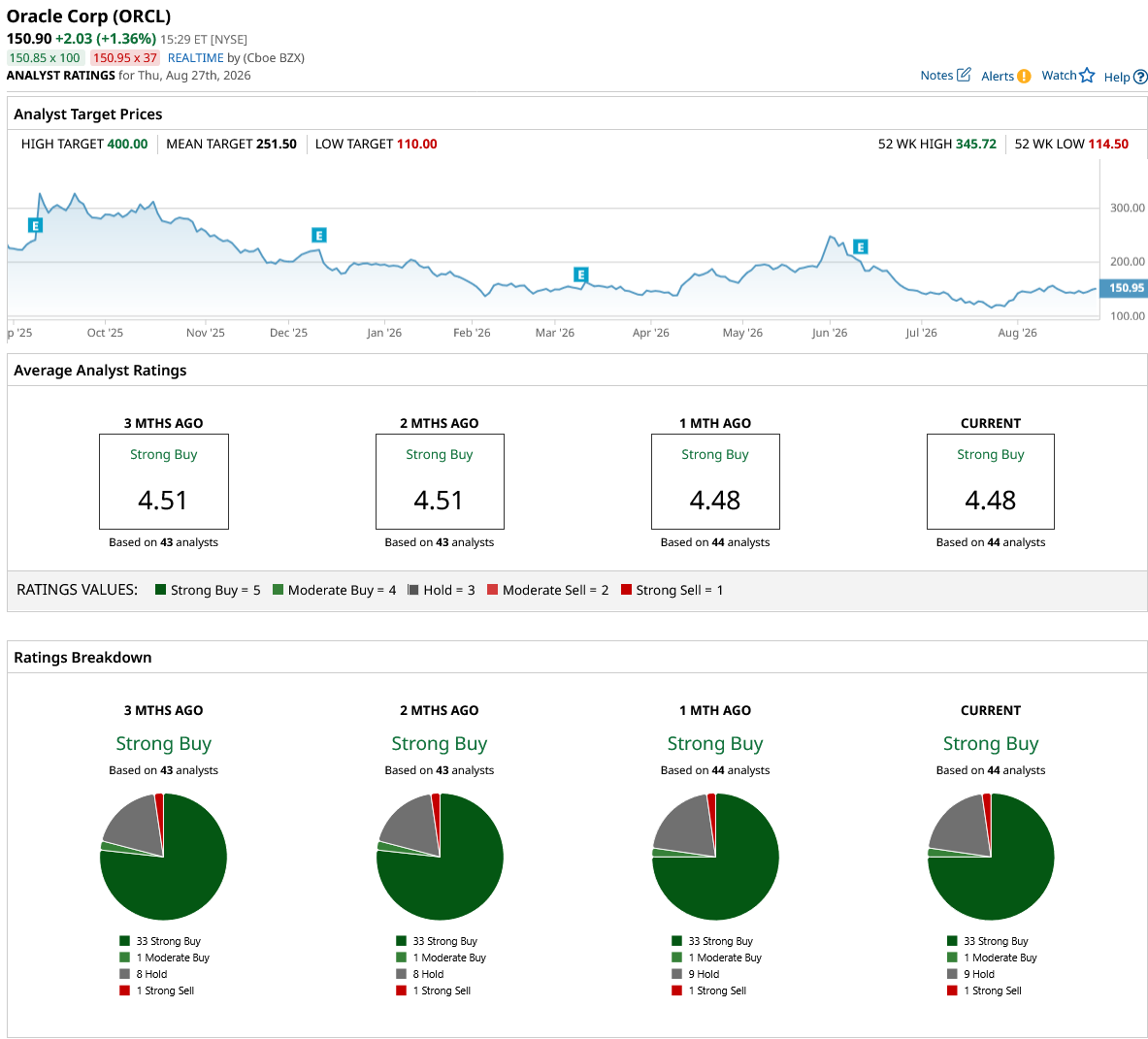
The risk is that the heavy capital requirements have made investors skeptical as free cash flow turned negative, sending ORCL stock down 23% year-to-date (YTD). Nonetheless, Wall Street expects the stock to climb 67% from current levels based on its average target price of $251.50. Furthermore, the most bullish estimate of $400 suggests the stock could potentially increase by 165% over the next 12 months.
Overall, Wall Street rates ORCL stock as a consensus “Strong Buy.” Of the 44 analysts who cover the stock, 33 rate it a “Strong Buy,” one says it is a “Moderate Buy,” nine say it is a “Hold,” and one rates it a “Strong Sell.”
Which Is the Better Buy Now?
Undoubtedly, Microsoft remains the more established AI cloud heavyweight. However, Oracle, with its expanding cloud infrastructure growth, massive RPO, and accelerating AI infrastructure contracts, is no longer watching the AI cloud boom from the sidelines. While both are great AI stocks for the long haul, Oracle still has to prove that it can turn the demand into the scale and profitability needed to challenge the giants already at the top.
On the date of publication, Sushree Mohanty did not have (either directly or indirectly) positions in any of the securities mentioned in this article. All information and data in this article is solely for informational purposes. For more information please view the Barchart Disclosure Policy here.