Nvidia succession uncertainty opens door for Google TPU and Broadcom, analyst says
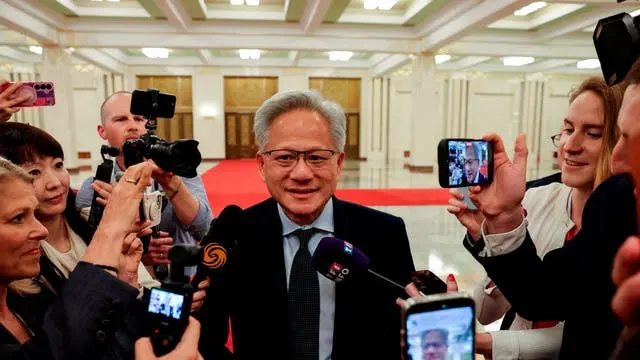
Alphabet’s tensor processing units, alongside key development partners Broadcom and MediaTek, stand to emerge as the primary beneficiaries of the sudden leadership shakeup at Nvidia, according to TF International Securities analyst Ming-Chi Kuo. NVIDIA Corporation (NASDAQ:NVDA) shares dropped 4.9% on Thursday after Chief Executive Jensen Huang resigned with immediate effect, ending his 33-year tenure amid a governance crisis stemming from reports of two extramarital relationships and potential national-security scrutiny.
Kuo noted that succession uncertainty at the artificial intelligence leader creates an immediate opening for Google’s custom silicon ecosystem to "win more trust from customers and the supply chain." Consequently, he indicated that Alphabet’s key design and manufacturing partners, Broadcom and MediaTek, "could be the market’s near-term focus" as hyperscalers weigh alternative compute options.
Market trading reflected this rotation, with Broadcom Inc (NASDAQ:AVGO) gaining 5.8%, Alphabet Inc Class A (NASDAQ:GOOGL) shares advancing 2.8%, and rival chipmaker Advanced Micro Devices Inc (NASDAQ:AMD) climbing 5.4%. By contrast, MediaTek Inc (TW:2454) closed 3.5% lower in earlier Taiwan trading prior to the broader U.S. session reaction.
Turning to Nvidia’s own trajectory, Kuo suggested that Huang’s exit represents "a one-time clearing event" for the stock, meaning near-term negative catalysts are largely priced in. Because the co-founder has formally severed ties with the company, the analyst noted that "Congress summoning him and any follow-up investigations should have less impact on Nvidia’s stock from here."
Inside the chipmaker, Chief Financial Officer Colette Kress has assumed the role of interim chief executive as the board evaluates a permanent successor. Kuo projected that any organizational restructuring stemming from the formal transition "will likely start affecting Nvidia’s product development and competitiveness in 2028 at the earliest."
In the meantime, supply chain checks will center on whether component makers alter their aggressive "capacity pre-booking and spec upgrades," which Huang utilized to maintain rapid commercial iteration. Kuo emphasized that monitoring shifts in capacity expansion and new technology development is critical, as these commitments remain "among the core reasons Nvidia’s supply chain trades at high P/E multiples."
Addressing geopolitical headwinds, Kuo observed that the proportion of AI chip revenue reaching Chinese buyers may exceed official disclosures, though tightening U.S. restrictions are unlikely to erase underlying demand. Even under stricter rules, he noted that "Chinese buyers may still pay the premium, even at several times the price, and get Nvidia chips/racks through indirect routes" so long as overseas resale channels persist.
The leadership vacuum also prompted U.S. President Donald Trump to suggest on social media that former Apple Chief Executive Tim Cook would be a worthwhile replacement to helm Nvidia. While Kuo acknowledged that Cook’s operational discipline would shine in "cost management" given Nvidia’s "clear room for improvement in supply chain and cost management," he maintained that Huang remains uniquely proven in bringing cutting-edge technologies into AI chips while sustaining a "fast pace of commercial iteration."