November is the stock market’s strongest month. Should you care?


November is an outlier when it comes to market returns, but the trend is actually broader.Sébastien Thibault/The Globe and Mail
If sodden, grey November weather is getting you down, I may have some good news for you. Well, for your portfolio, anyway.
While you don layers to guard against the gathering gloom, your investments may be preparing for sunny days, if the historical returns of major indexes are any guide.
Whether you consider only the past few years, or even if you go back decades, November has been an outlier in producing consistently strong market returns. In North America, you can see the pattern in both the S&P 500 and the S&P/TSX Composite, which have both risen in nine of the past 10 Novembers.
The pattern is actually broader than this, and November is just the start.
In a 2021 paper, professors Cherry Zhang and Ben Jacobsen used all historical data available for 114 stock markets worldwide – the British sample starts in 1693 – and found what they called a “remarkably robust” effect: Across the world, returns appear to be consistently stronger in the six months starting in November, with winter returns coming in 4.2 per cent higher than summer returns.
“Mean returns are higher for the period of November-April than for May-October in 89 out of 114 countries,” they wrote, adding that the difference is statistically significant in 42 countries.
To learn more about what’s going on here, I spoke with Brooke Thackray, research analyst at Global X Investments in Toronto, who published Time In, Time Out: Outsmart the Market Using Calendar Investment Strategies, around the turn of the millennium.
Should you swap out your bonds for GICs?
Since the 1950s, the S&P 500 has shown better performance from November to April, he said, adding that this doesn’t mean the other six months are negative. “It just means that they tend to be weaker.”
Mr. Thackray offered a few explanations. Economic activity tends to slow down in the summer months, particularly in Europe. Volatility in September and October tends to fade as investors position for the next year. And seasonality also reflects behavioural trends, with investors wanting to be in sectors that are “poised to make money.”
As an example, he noted that the retail sector tends to do well ahead of Black Friday. Shares may also rise ahead of company earnings releases as investors try to get ahead of the curve.
Every other year in the United States, there is also the impact of November elections, which tend to produce a bump as results ease market uncertainty. While U.S. elections don’t directly affect Canadian stocks, “very strong stock market performance in the U.S. tends to beget positive performance in the Canadian stock market,” he said.
All are reasonable and defensible theories. But as Prof. Zhang and Prof. Jacobsen noted, we don’t know for sure why this seasonal pattern, sometimes called the Halloween effect, really exists.
The question is even more complex than it appears. If you subscribe to the idea that markets are generally efficient – that is, that prices reflect all available information – a seasonal trend that has consistently produced better results around the world over decades should be impossible.
“If there is truly something that is identifiable there, and an edge that can be exploited, then market participants will exploit it and will eliminate that edge,” said Josh Sheluk, chief investment officer and portfolio manager at Verecan Capital Management in Toronto.
Should retail investors avoid individual bonds?
To Mr. Sheluk, the persistence of the Halloween effect suggests that it mostly reflects “statistical noise and randomness,” despite the findings of Prof. Zhang and Prof. Jacobsen.
“I can’t deny the historical numbers. I’m just telling you I don’t think it’s anything that you can make an investment decision off of, and I don’t think it’s something that’s predictive,” he said.
Any correlation, Mr. Sheluk suggested, may be spurious, much as you can find apparent correlations between baby names and Brazilian rainforests (see chart).
Even Mr. Thackray, who runs the Global X Seasonal Rotation ETF HAC-T, said individual investors should approach the Halloween effect with caution.
Investors “shouldn’t be drastically changing their portfolios based upon any type of event,” he said. You may consider making adjustments within sectors or tweaking the amount of risk in your portfolio – a bit more gas or a bit more brake.
“And typically, November is the time to put your foot a little bit more on the gas,” he said.
That’s not to say it will work this time. As we all know, past performance is no guarantee of future returns. Seasonality, Mr. Thackray said, is a “general guide to what tends to do better at certain times,” not a prediction of market behaviour.
For my part, I’ve liquidated a chunk of my portfolio at what historical data may suggest is an inopportune time. Not because of any views on seasonality, but because we’re making a deposit on a townhome. The best investment decision you can make this season is one that supports your long-term goals.
E-mail your questions to agalbraith@globeandmail.com. I’m not able to respond personally to e-mails but I choose certain questions to answer in my column.

2 ’Boring’ Stocks Growing Payouts Up to 358%
Market Analysis by Brett Owens covering: PepsiCo Inc, Allegion PLC. Read Brett Owens's Market Analysis
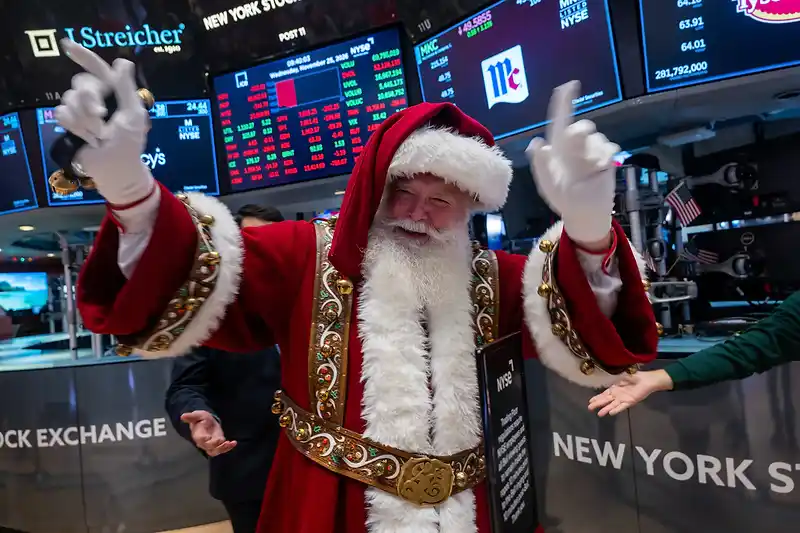
Black Friday in the stock market - but are Britons investing yet?
More British people are opening ISAs but the government needs to do far more to show the virtues of long-term investment


7 Stocks to Watch as Wall Street Attempts to Rebound From Friday’s Sell-Off
Market Analysis by Daniel Pernas covering: Nasdaq 100, S&P 500, Dow Jones Industrial Average, Eli Lilly and Company. Read Daniel Pernas's Market Analysis