Nice earnings forecasts you have. Shame if something happened to them


Equity analysts are a chronically overoptimistic bunch, and their track record for earnings forecasts is never great
The bull case for equities rests on sky-high earnings forecasts. History suggests forecasts typically fail most spectacularly when markets are priced for exceptional future profit growth. That’s exactly where we are right now.
Equity analysts are a chronically overoptimistic bunch, and their track record for earnings forecasts is never great, but that’s especially true at the end of major bull markets. Since 1992, average annual earnings per share (EPS) growth in the S&P 500 was 9.5 per cent. The average EPS growth predicted by analysts was 22.3 per cent, more than double the actual rate.
Unsurprisingly, the gap between forecast and realised EPS growth becomes especially large when realised EPS declines. The largest misses in recent decades came after the 1990–91 recession and during the dotcom bust of 2000–02, the global financial crisis of 2007–09, the 2015–16 earnings recession and the COVID-19 shock in 2020.
In the months when S&P 500 EPS growth turned negative, the rolling 12-month growth rate averaged minus 4.5 per cent. Yet, at the start of those periods, Bloomberg consensus estimates projected EPS growth of 18.8 per cent.
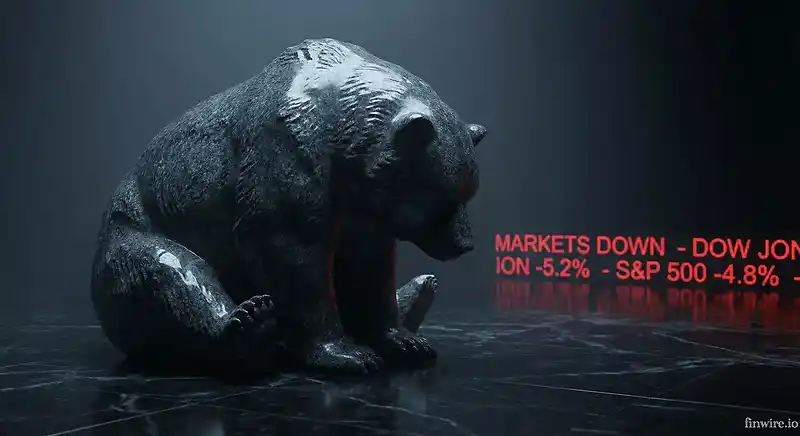
A few weeks ago, my forecast that the S&P 500 could fall to 5,000 points by the end of 2027 made waves. I, like everyone, cannot definitively time the end of the current bull market, but I believe that within the next two years, we will enter a major bear market as the AI investment boom ends. My intention with this end-of-2027 forecast is to warn investors to prepare for such an event today, even if it may not come until 2028.
Strategists at other more bullish banks were quick to reject my call, arguing that investors underestimate future earnings growth and that earnings will “grow into” today’s seemingly high valuations.
To which, I can only respond, “Nice earnings forecasts you have. Shame if something happened to them.”
Analysts today are extremely optimistic about future EPS growth. That means price-to-earnings (P/E) ratios based on 12-month forward EPS estimates can appear more attractive than trailing valuation measures suggest.
The current 12-month forward P/E ratio of the S&P 500 is 18.9x, roughly in line with its 10-year average. But that holds only if we believe EPS will grow by 38.6 per cent over the next 12 months. Meanwhile, the 12-month trailing P/E ratio is 26.2x, about 14 per cent above its 10-year average, indicating a somewhat expensive market.
Backtests suggest trailing valuation measures are a far better indicator of future stock market performance than forward P/E ratios. And the longer a bull market lasts, the more unreliable earnings forecasts typically become.
The most dangerous forecasts, though, are the long-term ones, where scrutiny is weakest.
I started my career in the late 1990s at the height of the last technology boom. One thing we learned once the bubble burst was that analysts often sought to justify extremely high share prices by ramping up their earnings growth expectations. However, as the bubble continued, that became increasingly difficult since even the most gullible investor wouldn’t believe that a large-cap stock with billions in revenue can grow its earnings by 100 per cent or 200 per cent every year.
In these types of situations, analysts will sometimes try to shift excessive EPS growth into the outer years, where there is less scrutiny of their assumptions. Research by Allaudeen Hameed, Massimo Massa, and Zhenghui Ni finds that companies in the decile with the highest long-term EPS forecasts usually underperform the rest by a wide margin over the following year.
Why is this? Probably because it simply becomes challenging for companies to meet these excessively optimistic forecasts. The resulting disappointment, together with large downward earnings revisions, weighs heavily on these firms’ share prices.
So where do we stand today? The long-term EPS growth forecast for the S&P 500 is currently 16.7 per cent, placing it in the top 10 per cent for this century.
S&P 500 constituents with particularly high long-term EPS growth expectations include Nvidia, Advanced Micro Devices, Intel, Broadcom, Palantir and Micron. That leaves their shares more exposed if growth falls short of consensus.
None of us has a crystal ball, and bull runs can keep going longer than logic would deem reasonable.
But investors should be warned.
Joachim Klement is an investment strategist for Panmure Liberum
Related Articles
- Stock Markets News
S&P 500 eyes 4th straight year of double-digit gains, a rare feat in 100 years
- General News
Microsoft’s Earnings Problem: Even Great May Not Be Enough
- Stock Markets News
Chinese equities face prolonged downturn as earnings forecasts tumble
- General News
Wall Street Week Ahead: Earnings Tsunami Meets the Fed
- General News
Earnings Flood and Fed Policy: A Critical Week for Markets Lies Ahead