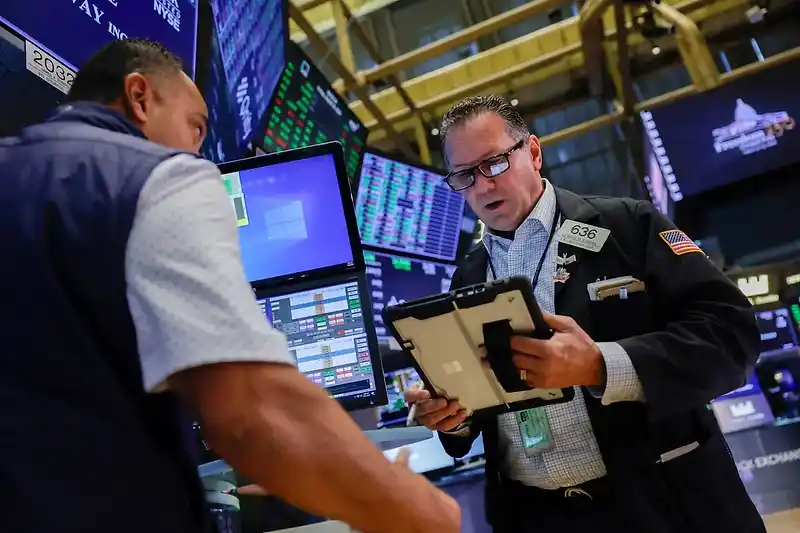
U.S. stocks open lower after in-line PCE data, post-earnings slide in Alphabet


U.S. stocks open lower after in-line PCE data, post-earnings slide in Alphabet
U.S. stocks opened lower on Thursday, remaining subdued after a raft of big-name technology earnings cast fresh doubts on the artificial intelligence trade.
Meanwhile, the Federal Reserve’s preferred inflation gauge matched expectations across the board in September, a day after the central bank held interest rates steady and indicated that it was in a position to wait and judge more incoming data before tightening monetary policy again.
"A more cautious tech mood is the main theme in markets as we go to print, as underwhelming results from Alphabet and Samsung have renewed doubts about the returns on AI spending," analysts at Deutsche Bank said in a morning note.
Alphabet (NASDAQ:GOOGL) was among the worst performers in early trading, shedding more than 13%. Third-quarter profit missed expectations, largely because of disappointing revenue from Google’s services unit.
Google’s typically robust ad revenue grew at its slowest pace in five quarters, exacerbating fears around the possible returns the company will eventually reap from its massive AI spending plans. In a call with investors, Google management said that while users were embracing its "AI Mode" search option, these queries have been monetized at a slower rate than traditional searches.
At the same time, free cash flow fell deeper into negative territory, reflecting a $6.5 billion increase in capital expenditures versus the prior quarter to $51.4 billion. Like its Big Tech peers, Alphabet has invested heavily in rapidly building out its AI capabilities, dedicating hundreds of billions of dollars to the development of the nascent technology.
Meanwhile, Samsung Electronics posted operating profit in its key semiconductor division that fell short of analysts’ lofty expectations. In Korean trading, shares of Samsung retreated by more than 4% -- slightly trimming a meteoric rise in the stock so far this year.
Samsung also offered no new details about a possible shareholder return plan, overshadowing a fourth straight quarter of record group-wide income. Overall operating profit came in at 100 trillion won, or around $74.52 billion.
Microsoft, on the other hand, gained slightly after the opening bell. The software behemoth reported that growth at its all-important cloud division accelerated once again, possibly soothing jitters around returns from massive AI investments.
Underpinned by 48% expansion in the Azure cloud unit, Microsoft logged better-than-anticipated overall revenue growth of 19% to $92.28 billion in the first quarter.
Adjusted profit for the quarter stood at $4.89 a share, also above Wall Street expectations. Earlier this week, Microsoft said that it would offer buyouts to a big chunk of its workforce, with The Wall Street Journal reporting that roughly 60,000 employees may be eligible for the program. Microsoft’s headcount was 223,000 workers at the end of June.
Amazon (NASDAQ:AMZN), another AI hyperscaler, is set to report quarterly earnings after the closing bell on Thursday
Warsh flags impact of higher rates on AI boom
Elsewhere, the Federal Reserve left interest rates unchanged as widely expected, although two of the 12-member Federal Open Market Committee calling for a 25 basis point hike.
Fed Chair Kevin Warsh, speaking after the meeting, highlighted recent strength in the economy and the central bank’s commitment to its 2% annual inflation target level, but declined to provide any forward guidance on interest rates. Markets widely expect the Fed to raise rates at its final meeting of the year in December, after having lifted borrowing costs for the first time since 2023 last month.
Warsh also expressed some doubt over the AI trade’s ability to withstand higher interest rates. He suggested that although there was once a narrative that tighter monetary policy was "not going to have any effect on AI because the returns that investors are expecting are so different," he has been "skeptical of that view."
"Interest rates get in the cracks. Interest rates affect, directly or indirectly, almost everything,” Warsh said.
Against this backdrop, investors received Q3 gross domestic product data and the personal consumption expenditures price index for September, both of which could factor into the Fed’s interest rate trajectory.
U.S. real GDP ticked up 3.4% in Q3, according to the first estimate by the Bureau of Economic Analysis. That was well above the 2.2% growth in Q2 and outpaced economists’ expectations of growth of 3.2%.
Separately, the headline PCE rose 0.5% M/M in September, while core PCE rose 0.3%. On a Y/Y basis, headline PCE climbed 3.6%, while core PCE inched up 3.1%. All four readings came in-line with estimates, while the Y/Y figures showed an acceleration from August and were significantly above the Fed’s long-term 2% target.
Beyond the Fed, the European Central Bank is scheduled to announce its own interest rate decision on Thursday. The ECB is widely anticipated to keep rates steady.
Ambar Warrick and Anuron Mitra contributed to this article
Related Articles
- Economy News
Wall St set for lower open as Alphabet results reignite AI spending fears
- Stock Markets News
Nasdaq futures plunge 260 points: 5 things to know before Wall Street opens
- Stock Markets News
North American stocks indexes fall at open as Alphabet results reignite AI spending fears
- Economy News
Alphabet, Microsoft earnings in focus; Warsh on AI, rates - what’s moving markets
- Stock Markets News
Alphabet shares tumble 10% as search unit slowdown overshadows cloud boom