Martin Pelletier says the best advisor isn’t necessarily the smartest person in the room
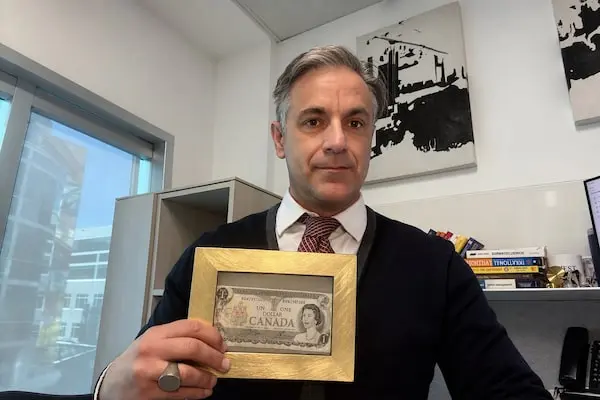

After giving away most of what he owned, Martin Pelletier's grandfather died at 102 with a $1 bill in his pocket. Mr. Pelletier has the bill framed in his office. 'It’s a daily reminder that none of us gets to take any of this with us,' he says.Supplied
In the Behind the Advice series, Globe Advisor asks advisors about their relationship with money from a young age, the lessons they’ve learned over the years, and how those experiences shape the advice they give clients. Behind the Advice is also a podcast: Season Five is now available and you can find all the episodes here.
Martin Pelletier, senior portfolio manager with Calgary-based TriVest Wealth at Wellington-Altus Private Counsel Inc., talks about an early money lesson from his grandfather, his decision to start his own firm and why he thinks Star Trek’s Jean-Luc Picard would make a good advisor. His book, Investing Through the Storm, will be released on Dec 8.
Describe your upbringing and how it influenced your life and career.
I grew up in Legal, Alta., a small bilingual farming town about 40 kilometres north of Edmonton. My dad was a mechanic and later worked in the pipeline industry, while my mom was an entrepreneur who owned her own insurance business.
I had a speech impediment as a kid and doctors cautioned my parents about their expectations for me. Thankfully, they ignored that advice and taught me two things that have stayed with me my entire life: challenge assumptions and respect risk, but don’t be paralyzed by it. Looking back, those lessons probably explain a lot about the person and the investor I became.
What was your first money lesson?
One of my earliest money lessons came from my grandfather. When he died at 102, he had already given away virtually everything he owned. The only thing left in his pocket was a $1 bill. I have that same dollar framed in my office today. It’s a daily reminder that none of us gets to take any of this with us. The real question isn’t how much you accumulate, but what you do with it, whom you help along the way and what kind of legacy you leave behind.
What did you want to be growing up and how did you get into financial services?
I was fascinated by investing from a pretty young age. I wanted to understand how the world worked and what made businesses valuable. I studied commerce at the University of Alberta, spent a term studying in Sweden and then travelled through Europe, which really broadened my perspective.
When I came back to Canada, I worked briefly in personal banking in Edmonton, but that career ended rather dramatically after an armed robbery and a shotgun held to my head. Nobody was hurt, but I quit that job shortly after and decided to change direction.
I moved into capital markets as an oil and gas research analyst, travelling, visiting operations and advising institutional investors in Canada, the U.S. and Europe. Eventually, I moved from analyzing companies to actually managing capital, which is where I found my calling.
What’s the single most important move you made to build your business?
Betting on myself, becoming an owner and building something.
Leaving the treadmill of long hours as an institutional equity researcher and remortgaging my home to co-found TriVest Wealth was a huge personal risk, but it let me and my partner build an investment business around how we believed money should be managed.
Later, we took another major step: moving further away from the conventional model and embracing goals-based investing. Instead of asking, ‘Did we beat the index?’ we started asking, ‘Did we deliver the outcome the client actually needs?’ That’s a very different way of building a wealth business.

Martin Pelletier spends time outside work skiing and mountain biking.Supplied
What do you do outside of work to maintain work-life balance?
I mountain bike, ski tour, practice martial arts and spend time outdoors. Most importantly, I spend time with my wife and kids. As I get older, I’ve become much more deliberate about where I allocate my time because I’ve realized time is the one asset you can’t make back. Markets will open again tomorrow. Your kids don’t stay young, your parents don’t stay around forever and there’s always another investment opportunity. That perspective has probably made me a better investor and a more grounded person.
What advice do you have for someone who wants to enter your business?
Be curious and learn how businesses actually work, not just how securities trade.
Become comfortable saying, ‘I don’t know.’ Then, be passionate about finding the answer.
Experience a few real market cycles before convincing yourself you’ve figured everything out; that means surrounding yourself with the best mentors.
And finally, don’t enter wealth management because you like markets. Enter it because you like people. Eventually, the math becomes easy. The difficult part is earning someone’s trust, understanding what their money is actually for and keeping them grounded when fear or greed takes over.
The best advisor isn’t necessarily the smartest person in the room. It’s the person clients trust enough to call when everything feels like it’s falling apart.
Which famous person or fictional character would make a great financial advisor, and why?
I am not a Trekkie by any means, but I would have to say Jean-Luc Picard of Star Trek, played by the late Patrick Stewart. He’d be a fantastic financial advisor because he rarely makes a decision just to make the discomfort go away.
He gathers information, listens to his team – especially those with different specialties – challenges assumptions, considers the consequences and then makes a decision. More importantly, when something inevitably goes wrong, he doesn’t panic and starts pressing random buttons.
That’s basically great wealth management. You can’t control the universe and you can’t control markets. Build a capable team around you, understand the risks, make the best decision you can with the information available and stay calm enough to adapt when the facts change. ‘Engage.’
This interview has been edited and condensed.