Markets plunge in a dramatic reversal from Wednesday’s stock market rally


Investors may be weighing how a Democrat-controlled Congress could slow down the AI build-out

A television screen shows a news broadcast as a futures-options trader works on the floor at the New York Stock Exchange on Thursday.Jeenah Moon/Reuters
Day one: Cheers for the U.S. midterm results. Day two: Uh-oh.
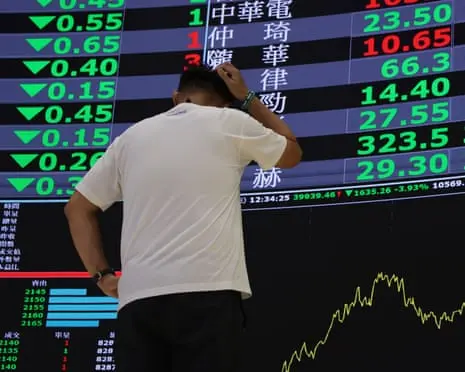
Wednesday’s stock market rally turned into a severe rout on Thursday, led by some of the world’s largest technology companies.
The S&P 500 fell nearly 4.4 per cent, marking its worst one-day decline since April 2025. The Nasdaq Composite Index fell 5.5 per cent.
The sell-off sent the tech-heavy benchmark into correction territory, which is generally defined as a dip of at least 10 per cent. From a high on Oct. 6, the Nasdaq is now down 11.9 per cent.
Many names that are closely associated with artificial intelligence – from chipmakers to hyperscalers that are building expansive data-centre networks – suffered some of the biggest hits.
Nvidia Corp. fell 9.4 per cent, Facebook-parent Meta Platforms Inc. fell 4.2 per cent and Space Exploration Technologies Corp. fell 9.2 per cent.
The sell-off marked a dramatic reversal from Wednesday’s gains – possibly on hopes that new political leadership could lead to peace with Iran and an end to trade disputes.
U.S. stock markets plunge as AI sentiment worsens in wake of Democrats’ election sweep
Now, investors may be focusing on the downside: a fresh appraisal of how a Democrat-controlled Congress could affect the pace of the artificial intelligence build-out, given concerns about electricity and water consumption in data centres.
“There are white-knuckle fears of what this blue wave” – the name given to the sweeping Democratic victory in this week’s midterm elections – “will do to the AI trade,” Dan Ives, partner and analyst at Yorkville Ives & Co., said in an e-mail.
He had previously expected tech companies to continue spending lavishly on AI infrastructure through 2029, given few obstacles to data-centre construction or regulatory roadblocks in a Republican-controlled Congress.
Now, the U.S.-based tech analyst thinks the peak in spending could come as early as next year.
He estimated that at least 10 per cent of the planned 800 to 1,000 AI-focused data centres in the U.S. will now be wiped off the map. He added that up to 20 per cent could face regulatory hurdles that take much longer to clear.
Texas, a state where a Democrat will become the next governor after ousting a three-term Republican, has emerged as a focal point for rattled investors, given its importance to data centres.
“Democrat Gina Hinojosa’s victory increases the likelihood of substantial project delays, given that her campaign platform included a moratorium on new data centre approvals,” Ariana Salvatore, head of public policy research at Morgan Stanley, said in a note.
The tech sector may be reacting to more than political changes, though.
Tech stocks have been at the forefront of investor concerns about rising valuations – perhaps even a speculative bubble – given their outsized role in the U.S. equity landscape.
Just 10 U.S. companies within the S&P 500, including Meta, are expected to produce two-thirds of profit growth in the third quarter of this year, according to a Dow Jones Market Data analysis in October.
What’s more, the top technology companies – colloquially known as the Magnificent Seven – comprised nearly 35 per cent of the S&P 500 last month in terms of their combined value.
This high concentration of winners suggests that investor hopes may be riding on an optimistic bet that the AI trade will continue indefinitely.
It’s a bullish view that is now being challenged, leaving investors with few other attractive choices beyond the relative safety of bonds and cash.
All sectors within the S&P 500 declined, including energy, financials, utilities and consumer staples.
The rout spread to Canada, too, where the S&P/TSX Composite index fell 2 per cent. The decline was similarly widespread, affecting every sector except communications services.
Still, it’s rare for shifting political winds to affect markets for long – a point most recently underscored by the fast recovery from the sell-off that followed U.S. President Donald Trump’s so-called Liberation Day tariff announcements in 2025.
The S&P 500 recovered most of its tariff-related losses within a month and was rallying to record highs soon after.
Some observers can even see an upside to new Democratic leadership in Congress, in that an AI slowdown could ease concerns about massive tech spending on data centres and hyperscaler debt issuance.
“We may be entering an AI Goldilocks zone, with enough restraint to take some air out of the bubble without derailing the boom,” Ed Yardeni, president and chief investment strategist at Yardeni Research, said in a note released before Thursday’s sell-off.
Related Articles
- World News
Global stocks plunge amid AI slowdown fears after Democrats’ midterm triumph
- Business News
AI firms hit in worst stock market crash for 18 months
- Economy News
Trading Day: A November 5 market bonfire
- Stock Markets News
AI boom heading for its dot-com moment? Here's what Jim Cramer thinks
- World News
US tech stocks recover after selloff spooks investors over AI spending