Market Factors: How to find the winners when the AI bubble bursts
Section one of this edition identifies some helpful context for investors and some strategies to start executing. Next we have the dangers of algorithmic selling that loom on the horizon, followed by a diversion outlining an analytical concept I found extremely interesting.
Tech strategies
Rally has room
U.S.-based Ritholtz Wealth Management founder Barry Ritholtz made two important arguments in a recent column. One, that the major tech stocks are not showing signs of an imminent bubble collapse and two, a giant misallocation of capital is likely underway despite that fact. Both arguments imply some work for investors.
Mr. Ritholtz first put S&P 500 market concentration into perspective. The biggest five companies account for 27 per cent of the benchmark, up significantly from the 1990s and 2000s.
Many interpret this as a sign of a market bubble but Mr. Ritholtz cites another reason: a lack of anti-trust regulation. As of 2025, the Magnificent Seven group of stocks had completed 854 acquisitions in the previous 15 years. This, not overly exuberant investors, is what’s causing market concentration.
Before the internet bubble peak, Intel and Microsoft were trading at forward price-to-earnings ratios of 47 and 60 times, respectively. Oracle’s PE was 120, Cisco’s was 130. Now Microsoft is under 20, Google around 25, and Nvidia - as was the case in 2019 - at 18 times forward estimates.
Mr. Ritholtz also argued that whenever a tech market bubble does implode, a massive misallocation of capital will become apparent. In the late 1990s, the overbuilding of fibre optic cable networks, often funded by telecom equipment companies, resulted in excess capacity for decades. The oversupply left network access decidedly inexpensive, and paved the way for Netflix, YouTube, Disney+, Facebook and other streaming applications that would not have been affordable for consumers otherwise.
To my mind, there is little doubt that the capital misallocation this time is, or will be, data centres and AI capacity. When the bubble breaks, the companies with excess AI capacity will be punished in the same way telcos got hammered in 2000. The companies selling equipment for data centres will see demand dry up. Companies benefiting from cheap access to AI applications will arise and prosper.
I found Mr. Ritholtz’s column extremely helpful for context. It suggests that recent volatility in the Nasdaq is just a healthy pullback and reassessment of valuations and scale of opportunity for the AI providers. Investors with overweight positions in AI-related global technology have time to implement a profit-taking scheme. Those holding passive U.S. index ETFs can rest easier for now - but these securities will get beat up as megacap tech stocks decline when the bubble does eventually burst.
Also, in the back of our minds we can start thinking about and watching for companies that will benefit most from cheap AI, with the hope of finding the next Netflix in the aftermath of the current tech rally.

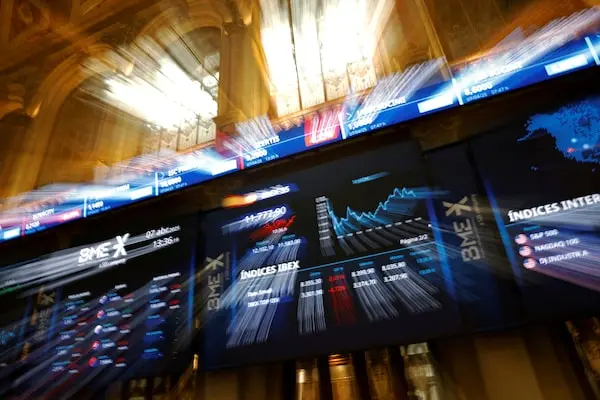
Electronic boards display stock information at the stock exchange in Madrid, Spain.Susana Vera/Reuters
Trends
Algos poised to sell
The fastest of the fast money in markets is beginning to unload equities, a process that could potentially result in US$185-billion leaving stocks for more stable pastures.
BofA Securities equity-linked analyst Chintan Kotecha believes that U.S. equity market volatility late last week triggered the first wave of selling by algorithmic trading funds. He estimates that trend-following funds with the most conservative stop-loss triggers are already out of equities. The fastest moving algorithms, those that analyze technical market factors in time periods measured in seconds, have also likely de-risked by moving assets from growth stocks with failing momentum to more trendy asset classes like gold and oil.
Fixed income is not a favoured destination for investment assets in aggressive funds. Short positions in Treasuries continue to rise along with bond yields. In currency markets, algorithm-driven funds are short Canadian dollars, yen and euros against the greenback.
Large-cap stocks outside of Nasdaq have been mostly spared from heavy selling but that can change.
Diversions
Simpson’s Paradox (nothing to do with Homer)
I learned about Simpson’s Paradox from an Instagram post from venture capitalist Shakib Hammad. The lesson started with 1973 University of California Berkeley data showing 44 per cent of male applicants were accepted but only 35 per cent of females. In Mr. Hammad’s words this was “a lawsuit waiting to happen.”
A data scientist noted that the school had different application methodology for each individual program. Once the admissions data were broken down by program, the bias disappeared. What had been happening was that more women were applying for specialties with extremely low acceptance rates whereas men were applying for programs with more available spots. In the end, once sorted, the admissions data showed a slight preference for women.
The aggregate data showed one thing- discrimination against women - and compartmentalized results showed a completely different result. This is Simpson’s Paradox, and the type of detailed, more in-depth analysis that is often required before investing in individual stocks.
The essentials
Looking for our updates on market movers, analyst actions, stock technicals, insider trades and other daily, weekly and monthly insight? Click here to visit our Inside the Market page.
Globe Investor highlights
Four TSX-listed ETFs - including two featuring REITs - that have been providing surprisingly strong returns so far this year
The Contra Guys’ Philip MacKellar makes the investment case for a 6 per cent yielding Canadian small cap
David Berman on the joys of allocating a small portion of one’s portfolio for more speculative bets
Will high bond yields slam the brakes on the U.S. stock market’s advance? Jamie McGeever on why the answer may be no
Quick hits
One of the stocks I was eyeing as a picks-and-shovels way to play the AI infrastructure buildout was Corning Inc. (GLW-N). It’s lucky I didn’t buy it because it’s been crushed – down 51 per cent from the June 30 peak because of strong earnings results that weren’t quite strong enough. Now I’m caught between liking the price more and following the important don’t try and catch a falling piano investing adage.
Oil refiners, the dominant source of demand, are making big profits according to BMO chief economist Doug Porter. The 3-2-1 crack spread, the profit from buying a barrel of oil and turning into two parts gasoline, one part diesel (or heating oil), is near record levels near US$70. Falling gasoline prices would limit gains.
Scotiabank analyst Kevin Krishnaratne previewed earnings in the domestic tech sector. The analyst noted further evidence that AI is leading to more enterprise software demand and likes Kinaxis Inc. (KXS-T), Shopify Inc. (SHOP-T) and Kraken Robotics Inc. (PNG-X)
Read this week’s earnings and economic calendar here