Many St. Catharines residents with flood insurance still stuck in damaged homes, waiting for help
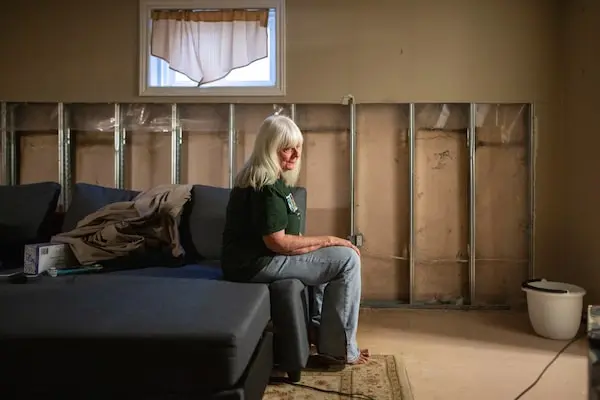

The basement of Heather Gonzales's St. Catharines, Ont., home had to be mostly emptied and a section of drywall had to be removed after a flood earlier in the summer.Nick Iwanyshyn/The Globe and Mail
The stink lingered long after the water was gone. It hung over the neighbourhood as floors were ripped out of homes, walls were torn open, and drywall, cupboards and doors piled up at the curb.
“It smells awful,” said Lori Ruzic, a mother with two young kids at home. “Smells like sewage.”
On an early morning in late July, 6.5 inches of rain and wastewater from an overwhelmed sewer-stormwater system poured into her family’s basement in north St. Catharines, Ont. It destroyed the heart of Ms. Ruzic’s home that brought their family together daily, damaging the rec room, table tennis and pool tables, toys, video games, laundry room and home office.
“We lost everything down there. All the floors have to be ripped out, the walls have to be cut out two feet; any of the furniture that was touching it is no longer good,” she said. “We’re nowhere near done, and already at over $70,000 in contents damage.”
A few blocks away from the Ruzics’ home, retired widow Debbie Costello was spared from wastewater damage, but left without air conditioning. She was also unable to take a warm shower after stormwater flooding damaged her furnace and water tank.
A contractor, sent by the insurance company, assessed the damage to well above $30,000. Then it was “radio silence,” she said.
States of emergency were declared in St. Catharines and Lincoln, Ont., after two storms dumped more than 140 millimetres of rain. The heavy rain also hit Niagara Falls, Ont., where mayor Jim Diodati's own basement flooded.
The Canadian Press
Back-to-back floods wreaked havoc on more than 10,000 St. Catharines homes in July and August, destroying appliances, contaminating walls with toxic wastewater and triggering a state of emergency for the city. Nearly a month afterward, residents are still struggling to get help from insurers, while many are discovering they aren’t covered at all.
The aftermath of the floods have raised questions about whether enough is being done to prepare homeowners for the risks.
“If you’re going to rely on the consumers to make these decisions about how much insurance they should be buying, we should be at least giving them some information to make that decision,” said Jason Thistlethwaite, associate professor at the school of environment, enterprise and development at the University of Waterloo.
As things stand, he said, “it’s buyer beware.”
Ms. Ruzic was aware that the sewer backup add-on is not included in standard insurance policies, and separate from overland flooding coverage. That’s the reason she purchased coverage for that issue with her insurer of two decades for a limit of $20,000, as per the broker’s recommendation.
But that wasn’t nearly enough to cover the basement damage, let alone the contents inside.
Niagara municipalities hit by floods declare emergencies
Ms. Ruzic was later stunned to see federal government figures cited on the insurer’s website, dating back to April, recommending at least $40,000 in basement coverage.
“Why did nobody contact me?” she said. “Why didn’t my broker contact me and say, ‘Listen, you know, the recommendations have changed?’”
According to Statistics Canada, flooding is the primary source of insured losses. Since 2009, insurers paid out an average $2-billion a year in catastrophic weather-related claims, compared with the $400-million paid annually between 1983 and 2008.
Overwhelmed sewers and septic tanks were leading drivers of rising premiums, which have spiked faster than inflation, according to a 2026 report from Rates.ca.
But surveys conducted by Mr. Thistlethwaite’s research team show that only about 6 per cent of property owners were aware of the level of risk they needed to insure for.
Ottawa won’t commit to launching national flood insurance program in near future
Aging infrastructure further compounds flood risk. In St. Catharines, combined sewer-stormwater systems spewed sewage and rainwater through toilets, walls and showers, often requiring extra decontamination. The mayor previously stated only 30 per cent of the city has separate stormwater infrastructure, raising questions about the city’s preparation for what ensued.
City spokesperson Scott Rosts could not immediately confirm the 30-per-cent figure.
Toronto-based Jennifer Hollett went to St. Catharines to help her elderly mom after she discovered 18 inches of water mixed with sewage on a trip to her basement laundry room.
Although her mother’s insurer had been responsive, delays allowed mould to spread, forcing her mother out of the home to stay with a friend, an option many didn’t have. “All the hotels, Airbnbs are full,” Ms. Hollett said.
Broken appliances forced some neighbours to dine in driveways, “with barbecues and teapots out,” 70-year-old resident Heather Gonzales said. She said she still hasn’t received a straight answer on whether her insurer will cover the damage to her flooded basement, where her son was staying, nearly a month after filing her claim.

Ms. Gonzales with the contents from the basement of her home.Nick Iwanyshyn/The Globe and Mail
Prior to 2015, when private companies expanded service in the face of rising severe weather events and regulatory pressure, disaster assistance programs funded by taxpayers often covered damage that was uninsurable.
“Because there is some coverage available in Canada now – both sewer backup and overland flooding – you are no longer eligible for disaster assistance,” Mr. Thistlethwaite said.
Flood-risk responsibility has essentially shifted to individuals without giving them the information, infrastructure or public safety net to manage that responsibility, he said.
In the United States and Britain, consumers can enter their address into a government website and easily see their risk. “You’ll see a map and you’ll even get advice on the type of insurance you need, the amount you need,” Mr. Thistlethwaite said. Canada launched a Federal Flood Risk Finder in April, but no data are currently active, as provinces and territories haven’t chosen to opt in.
Canada is also among the few G7 countries with no federal flood insurance backstop, despite years of promises. In 2019, the Trudeau government vowed to create a national low-cost flood insurance program, eventually pledging as much as $450-million over five years.

Canada's Flood Risk Finder page currently doesn't allow for searches, because provinces and territories haven’t opted in.Supplied
None of these measures alone were guaranteed to prevent the turmoil that followed the record-breaking floods in St. Catharines, Mr. Thistlethwaite acknowledged.
Mayor Mat Siscoe said in an e-mail to The Globe and Mail that the storms that hit St. Catharines were “an anomaly” that “no community could adequately prepare for.”
He has since directed staff to prepare a comprehensive flood resilience plan. On Monday, city councillors also approved raising annual funding for the Emergency Flood Alleviation Program, which offers rebates for flood-prevention measures such as installing sump pumps, from $150,000 to $20-million for this year.
But better information could have encouraged residents to demand infrastructure improvements from governments early on, Mr. Thistlethwaite said. “Information creates accountability.”
However, according to Blair Feltmate, head of the Intact Centre on Climate Adaptation at the University of Waterloo, the most immediate solutions lie with the consumer. Being outside a mapped floodplain doesn’t mean a home is safe from floods, and property owners should be equipped with backwater valves, dual sump pumps and window-well covers. “Think of it not as a cost, but an investment in equity in the home,” he said.
For now, St. Catharines residents are waiting and watching the weather. “Any time reports say it’s supposed to rain, everyone’s holding their breath,” Ms. Costello said.