Israeli stocks fall, currency weakens as Netanyahu bloc projected to win more seats than expected
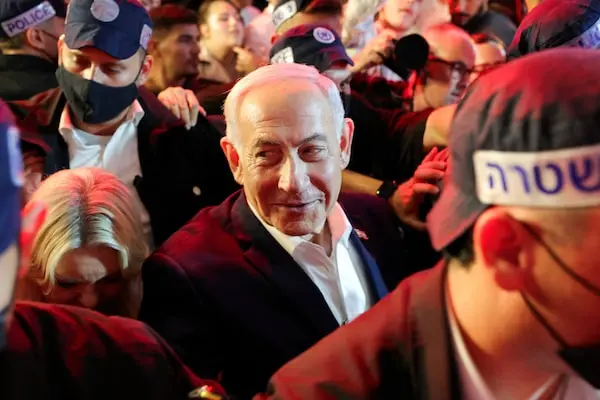

Israeli Prime Minister Benjamin Netanyahu tours the Mahane Yehuda market in Jerusalem last week, ahead of the country's national election.Kevin Coombs/Reuters
Israel’s currency, stocks and bonds came under pressure on Wednesday as initial election results showed Prime Minister Benjamin Netanyahu’s right-wing bloc performing better than expected but falling short of a parliamentary majority.
With some 86 per cent of votes tallied, Israeli media projected Netanyahu’s right-wing bloc to win 53 seats, well ahead of the 48 forecast for rival Gadi Eisenkot’s opposition bloc but short of the 61 needed for a majority in the 120-seat parliament. Arab parties were on course to win 19 seats.
Definitive results were expected on Thursday.
The shekel weakened more than 2 per cent to 3.1208 to the dollar, on course for its worst day since the aftermath of the October, 2023, Hamas attacks and erasing Tuesday’s gains, when high voter turnout had raised expectations of a change in government.
Tel Aviv’s key benchmark stock index was down 2.5 per cent, its worst performance in more than four months. The market had been closed on Tuesday.
Four takeaways from the election
Opinion polls ahead of the election showing Eisenkot in the lead had helped gains, with some investors expecting a change in government to improve relations with Western allies, reduce regional tensions and bring an end to a judicial overhaul that sparked mass protests in 2023.
Longer-dated international debt also came under slight pressure, reversing recent gains and bucking the wider market trend. The 2060 bond slipped nearly 0.4 cents to bid at 62.54 cents on the dollar, Tradeweb data showed.
Yields on the benchmark domestic 10-year government bond rose nearly 5 basis points to 4.13 per cent.
“Israel’s financial markets have reacted negatively to the result,” said William Jackson, chief emerging markets economist at Capital Economics. He said the initial results offered Netanyahu more paths to remain in power, though any government that emerged was unlikely to be robust.
“The next government will probably be fragile,” he said.
If neither Netanyahu nor Eisenkot can form a government, Israel would likely head to another election, with Netanyahu remaining at the helm of a caretaker government in the meantime.
Polling stations in Israel will close on Tuesday evening, but it could be weeks before Benjamin Netanyahu or one of his opponents will be declared the next prime minister, which mi…Full Caption
Israel’s markets have risen strongly despite three years of war and political turmoil, supported by the country’s large tech sector, the AI boom and elevated defense spending.
Since the Oct. 7 Hamas attacks in 2023, the Tel Aviv blue chip index has risen more than 130 per cent, far outpacing a roughly 80 per cent rise on Wall Street, while the shekel has climbed around 25 per cent, one of the world’s strongest currency performances over the period.
Analysts said forming a government could prove difficult, prolonging political uncertainty and raising the prospect of another election in the first half of next year. A major escalation of the conflict with Iran remained another key risk for investors.
Barring such an escalation, however, the market moves reflected sentiment more than a shift in Israel’s economic fundamentals, said Abdalla Saleh, senior analyst for MENA country risk at BMI.
“They reflect investor uncertainty regarding the election outcome and uncertainty regarding its economic implications,” he said. BMI recently upgraded its growth outlook for this and next year, with expansion expected to be driven by domestic consumption and company investment.
“At the end of the day, right now, we don’t have any indication that there will be an unfavorable shift in Israel’s economic fundamentals.”