Investors are moving between DIY and advisor channels, but satisfaction with advice is still high
For financial advisors worried about being replaced by increasingly sophisticated artificial intelligence and self-directed platforms, a couple of recent studies may be reassuring.
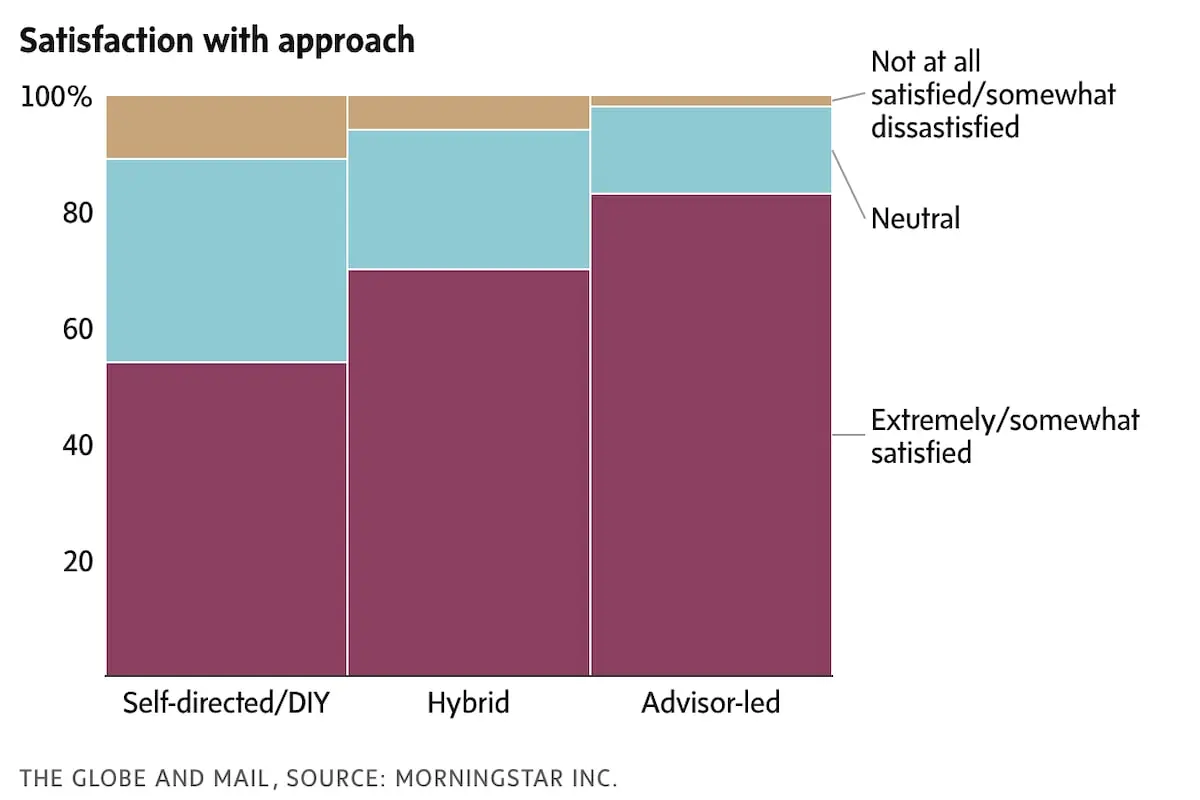
Speaking on a webinar this week to present findings from Morningstar Inc.’s latest surveys of investors, Joe Agostinelli, senior director of market research, said investors who work exclusively with advisors report far higher satisfaction than hybrid and do-it-yourself investors.
That gap has widened year over year, with hybrid and DIY investors reporting slightly lower levels of satisfaction while the advisor-led channel was stable, he said.
Thomas Aviles, head of advisor software at Morningstar, pointed out that for investors to leave advisors, the satisfaction levels of hybrid and DIY investors would need to be topping those of advisor-led investors.
“I consider this piece of research the canary in the coal mine,” he said on the webinar. “And so far, the canary is doing just fine.”
The study also touched on reasons for the satisfaction gap. DIY and hybrid investors cited the same challenges, Mr. Agostinelli said: “[It] always came down to, ‘I don’t have enough time and I don’t feel educated enough to do this justice in the way that I feel it should be done.’”
Meanwhile, a survey of more than 5,000 Canadian investors from the Securities and Investment Management Association (SIMA) found investors moving between advised, hybrid and self-directed investing based on changing needs.
According to the survey released this week, 43 per cent of Canadian investors purchase all their investments from someone who offered advice, while 36 per take a hybrid approach. A little more than one in five (22 per cent) are strictly self-directed.
The survey dug into the motivations for moving between channels. For investors who sought professional advice after starting out on their own, a change in circumstances was the top reason for finding an advisor (34 per cent), followed by bad investment results (27 per cent) and finding DIY investing too difficult or time-consuming (18 per cent). Most of those receiving advice reported high levels of satisfaction.
For investors who moved the other way, bad advice was rarely the reason. Rather, learning to invest or finding outside information or advice were the main reasons (60 per cent), followed by simply wanting to try investing independently (45 per cent) and high fees (23 per cent).
The SIMA survey also found fees weren’t a common topic of discussion: only about half of clients (53 per cent) said they had discussed the management fee for investment funds and slightly fewer (45 per cent) had discussed the fee paid to the advisor’s firm. Around the same percentage (49 per cent) said they read their annual fee and performance statements.
Morningstar’s latest U.S. advisor survey highlighted the connection between fee transparency and client trust. Understanding how advisors are compensated is an important part of the relationship, it said, “especially as investors become more engaged in evaluating the type and level of service they receive.” Yet, the Morningstar survey found fee discussions are becoming less frequent.
With clients in Canada receiving the first CRM3 reports in January, featuring broader fee reporting, advisors should be discussing costs now. Any kind of surprise when those statements land next year could undermine the trust advisors have spent years building.
- Mark Burgess, Globe Advisor assistant editor
mburgess@globeandmail.com
Are you reading us on the web or did someone forward the e-mail version to you? If so, you can sign up for Advisor Weekly here.Most readers are familiar with our Behind the Advice series (which is also a podcast – listen to the latest episode below.) We’re looking for new advisors to feature. If you’re interested in sharing your personal experiences with money and how they’ve shaped your work with clients, email: bbouw@globeandmail.com
Must reads
Tightrope: Advisors must walk a tightrope between following the law and serving their client when they receive a requirement for information from the Canada Revenue Agency (CRA) about a client under audit. That balancing act got a little trickier after the Federal Court of Appeal reaffirmed the CRA’s broad powers to require information from third parties, even when the request is related to unnamed people connected to a client.
Giving early: The idea of transferring wealth to the next generation early has gained traction among Canadians, whether to support a large purchase or to see children and grandchildren enjoy the funds. But giving while living can be complex. Here are four things to consider.
Tax-free annuity income: More Canadians are contributing to TFSAs for retirement savings. Should their tax-free withdrawals be extended to life annuities? A couple of interest groups are making the case ahead of next week’s federal budget.
More from Globe AdvisorThis headhunter says the real transaction in advisor succession is ‘multiples of trust’Money managers look past midterm election uncertainty for longer-term gains on U.S. health careHow advisors can reframe the mutual fund vs. ETF debateThis advisor wishes she had joined an advice-only firm earlier in her careerFavourable policy and business environment boosts optimism for energy investorsHow this $4-billion environmental money manager avoids ESG trendsMore from The Globe
Look away: The U.S. midterm elections are dominating the headlines, with just one more week of rallies, scandals and prognostications before voters decide which party will control the House and the Senate. There is a lot at stake, writes David Berman. But should investors care?
Bank-like: Wealthsimple Inc. has secured a $425-million financing from existing backers to continue building out its banking and investing services to rival the country’s largest financial institutions for size and reach.
Access denied: Bank of Montreal, Toronto-Dominion Bank and Royal Bank of Canada are blocking third-party personal artificial intelligence agents from directly accessing their digital properties, including online banking, joining a growing number of banks restricting agents’ access to customer data.