Intel vs. AMD: Why the Market Share Number Is Misleading


AMD crossed 30% in client CPUs, yet its bigger win over Intel is in the data center that actually drives profits.
AMD (AMD) just hit a milestone that would have seemed unlikely a few years ago. For the first time, it controls more than 30% of the market for x86 client CPUs, the chips that run desktops and laptops. According to Mercury Research, AMD’s share reached 30.3% in the second quarter, up from just 21.1% two years ago. Intel (INTC) still holds the rest at 69.7%, but that share has been dropping lately. AMD gained ground in desktops, laptops, and servers all at once. Although AMD’s desktop share climbed to 34.9%, the desktop market itself shrank more than 20% last year. The fall was primarily due to soaring memory prices that have made new PCs more expensive. AMD gained share because its shipments held up better than Intel’s. So this was a share gain in a shrinking market rather than a demand boom.
The Fight That Actually Matters
The chips for PCs are the least profitable part of this rivalry, and the market is barely growing. The part that actually pays the bills is the data center market, and that is where AMD looks even better. Its data center revenue more than doubled in the second quarter to $6.7 billion, and its server share has climbed to 34.5%. On the other hand, Intel keeps slipping. AMD’s CEO Lisa Su expects data center sales to double again in 2027, with hyperscalers like Amazon (AMZN), Microsoft (MSFT), and Alphabet's (GOOG) (GOOGL) Google expanding their use of AMD’s chips. This ties back to something I covered recently. Agentic AI is driving a fresh surge in CPU demand, and I still think that helps Intel's turnaround. But it is helping AMD even more, turning the data center into the segment both companies most want to win. The 30% client figure also undersells AMD. It sells more premium chips, like its X3D gaming processors and EPYC server parts. So AMD has a bigger share of revenue than its unit count suggests. Intel keeps most of its lead because of how hard it is for customers to switch. Buyers and PC makers built their systems around Intel for years, and switching takes time, testing, and money. That lock-in is a big reason Intel’s share stays as high as it does, even after a decade of losing its performance edge.
Although Intel continues to hold the majority market share, the trend across every segment points one way. AMD keeps winning share, and Intel keeps losing it. And at 30%, AMD is nowhere near its ceiling. Intel just posted its strongest revenue growth in 15 years, so it isn’t finished either. But momentum clearly sits on one side.
About Advanced Micro Devices Stock
Advanced Micro Devices operates as a semiconductor company internationally. It operates in three segments: Data Center, Client and Gaming, and Embedded. It offers AI accelerators, microprocessors, and graphics processing units used in personal computers, data centers, and professional workloads. The company also designs embedded processors and custom system-on-chip solutions tailored to specific customer needs. Founded in 1969, the company is headquartered in Santa Clara, California.
Over the past year, AMD stock has seen outstanding returns, surging around 182%, and it has comfortably outperformed the broader semiconductor sector. During the same time frame, the iShares Semiconductor ETF (SOXX) gained about 107%. The trend has continued this year as well, with the stock up 115%, outperforming the sector’s gain of 64%.
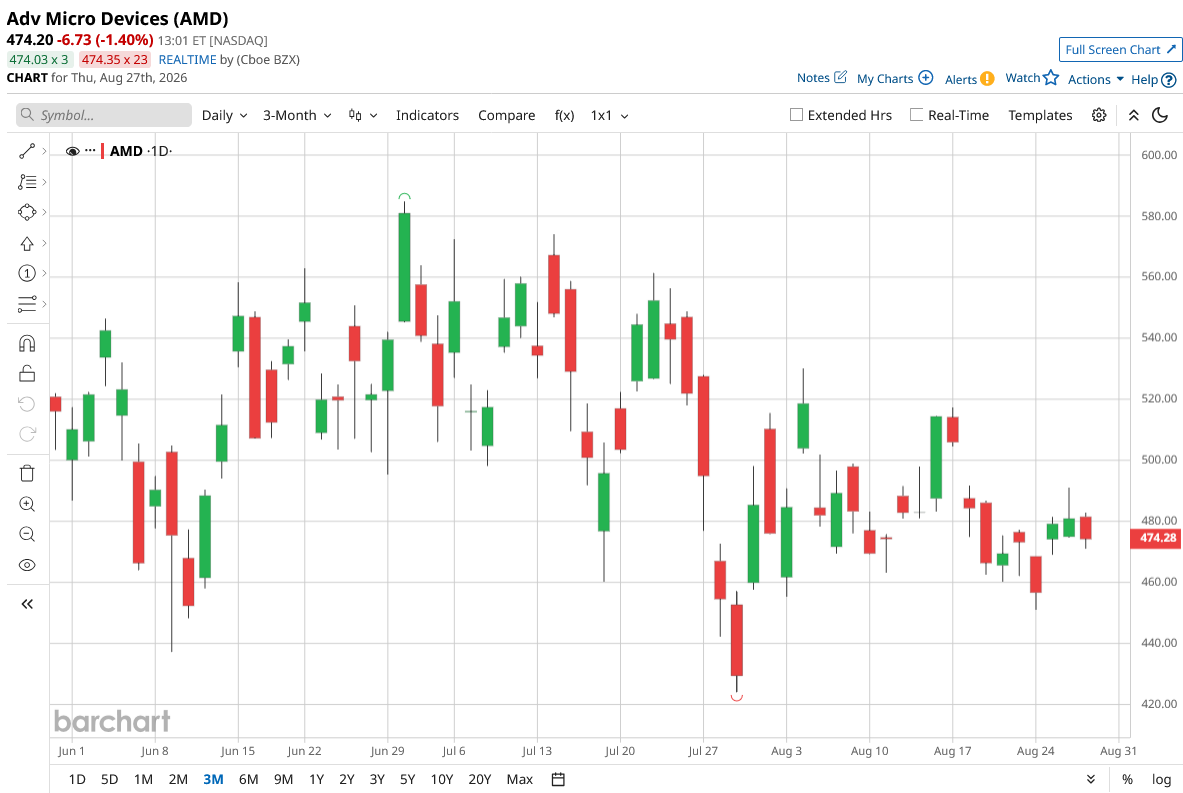
The company posted its second-quarter fiscal 2026 results on Aug. 4, reporting revenue of $11.54 billion, up 50% year-over-year (YoY). The data center division was the main driver. Revenue jumped 107% from a year earlier, helped by EPYC server processors and Instinct AI accelerators. Diluted earnings per share came in at $1.66, beating the Wall Street consensus of $1.60. Its quarterly gross margin was 56%, up 200 basis points YoY. Operating income for the quarter was $3.1 billion, while operating expenses were $3.4 billion, up 40% YoY. Looking forward to the third quarter, AMD expects revenue of about $13 billion, which would represent about 41% growth from a year earlier at the midpoint. The company also guided for a non-GAAP gross margin of about 56%, operating expenses of about $3.65 billion, and a diluted share count of about 1.66 billion.
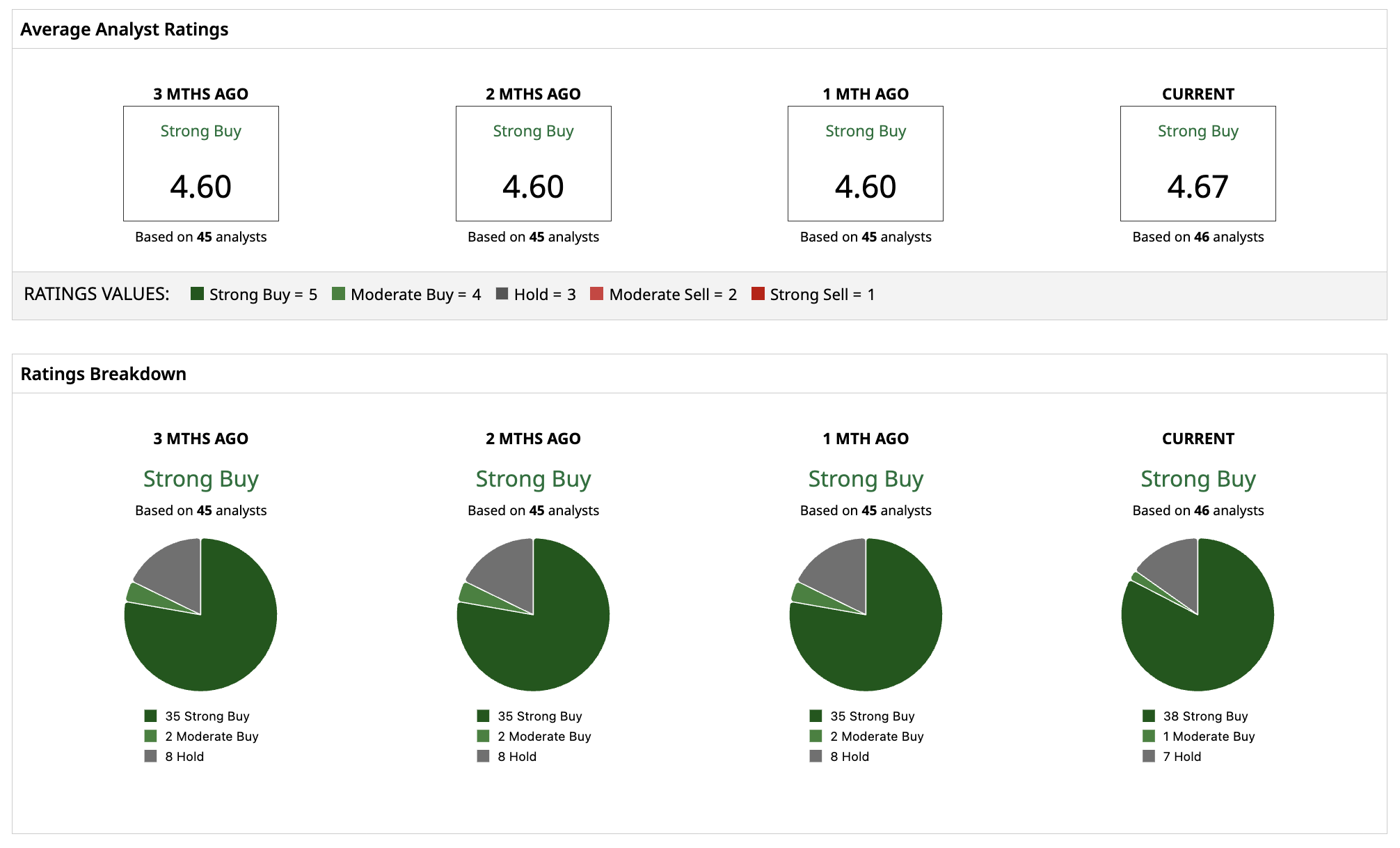
BMO Capital initiated coverage of AMD with an “Outperform” rating and assigned a price target of $550. The firm believes AMD is on the verge of becoming a complete AI infrastructure provider. The Helios AI rack positions the company as the closest competitor to Nvidia (NVDA). Overall, the stock is covered by 46 Wall Street analysts and holds a consensus “Strong Buy” rating. Their median price target of $621.83 reflects an additional 31% upside from current levels. However, the highest price target of $1250 still implies an impressive 164% upside from the current share price.
About Intel Stock
Intel is a semiconductor company. It designs, manufactures, and sells computer chips and related technologies. Its products include processors and graphics chips for personal computers, servers, and data centers, as well as networking and edge-computing solutions. The company also provides semiconductor manufacturing services through its foundry business, producing chips for both Intel and external customers. Founded in 1968, the company is headquartered in Santa Clara, California.
INTC stock posted exceptional returns over the past year, surging roughly 265%. In comparison, the iShares Semiconductor ETF (SOXX) gained around 107% during the same time frame. This highlights growing investor confidence in the stock as it significantly outperformed the broader semiconductor sector.
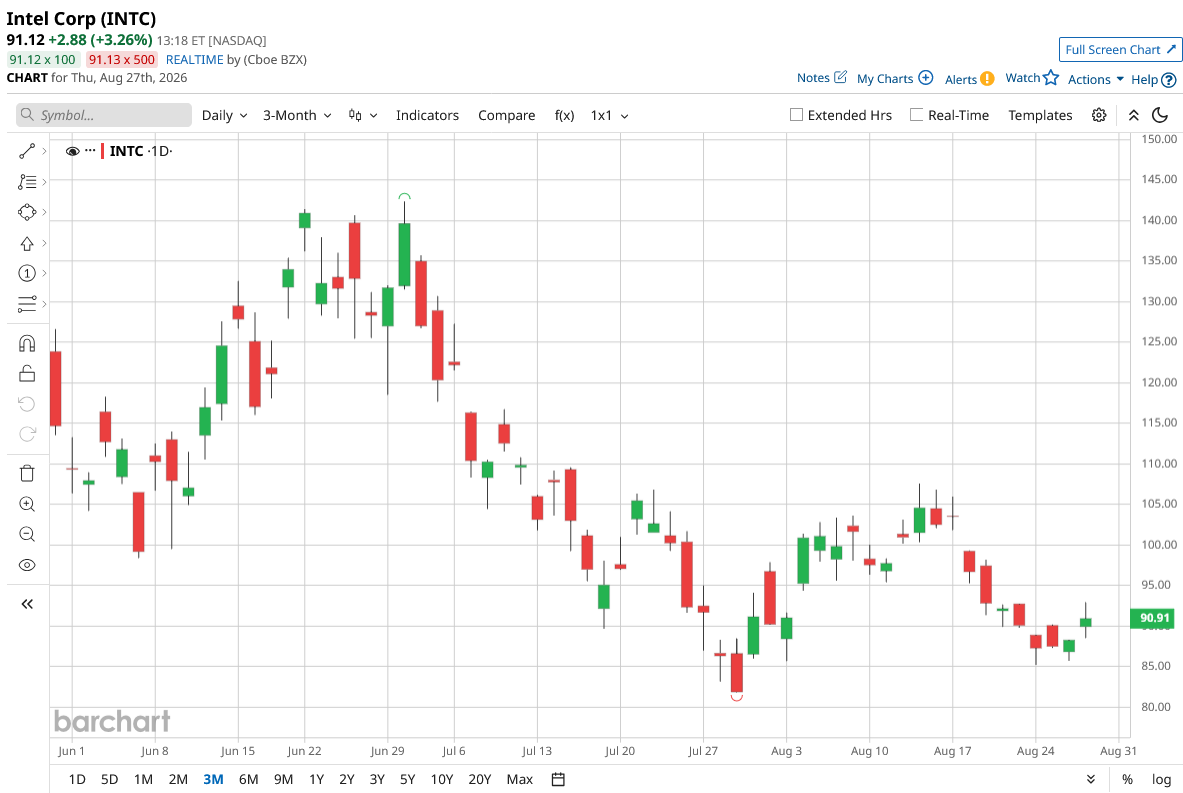
Intel reported its second-quarter fiscal 2026 earnings on July 23. The company reported revenue of $16.13 billion. Its earnings per share came in at $0.42, beating the Wall Street consensus of $0.21. Non-GAAP gross margin was 41.8% for the quarter, helped by higher revenue, better yields, and stronger average selling prices. Operating cash flow was $7 billion, and the company ended the quarter with about $40 billion in total liquidity, including cash and short-term investments. Looking forward to the third quarter, Intel guided for revenue of $15.8 billion to $16.8 billion, with a midpoint of $16.3 billion. The company forecasts an adjusted EPS of $0.38 and a gross margin of 42% at the midpoint. The company raised its 2026 capital spending outlook to more than $20 billion. Management said most of the increase will go toward tooling, including investments in Intel 3, 18A, and 18A-P manufacturing processes.
Bank of America Securities analyst Vivek Arya reiterated a “Buy” rating and assigned a price target of $145. The firm believes the company’s $20 billion equity offering is a sign of growing management confidence in the foundry strategy rather than a defensive move. Arya’s “Buy” rating is based on Intel’s strong positioning to capture a meaningful share of both the global wafer foundry and advanced packaging markets by 2030. He believes this can drive EPS potential above $6 and sustained margin expansion. In contrast to BofA, Raymond James analyst Simon Leopold maintained a “Hold” rating on the stock.
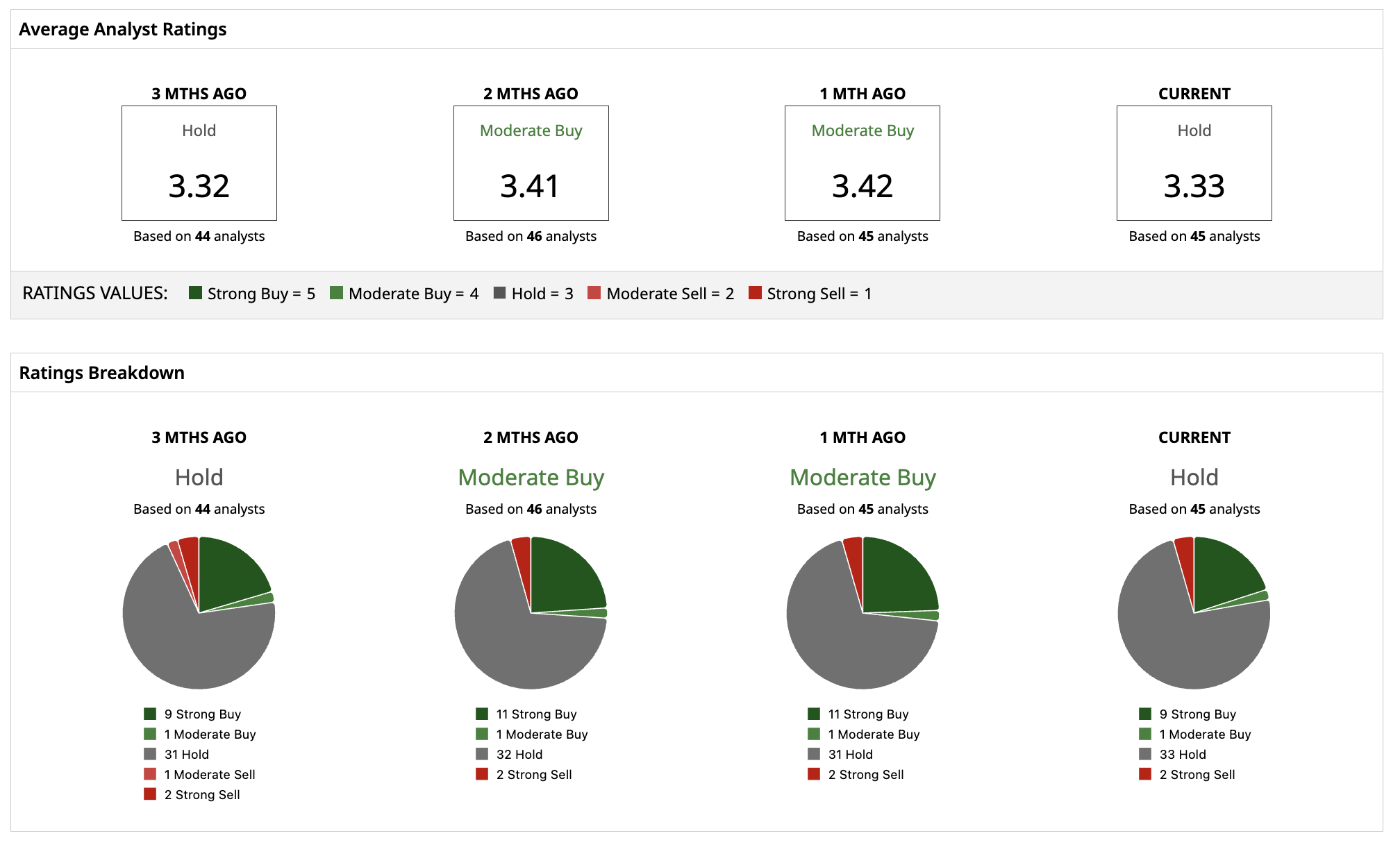
INTC holds a consensus “Hold” rating from 45 Wall Street analysts covering the stock. It has an average price target of $113.87 that suggests a potential growth of 29% from its current price.
On the date of publication, Jabran Kundi did not have (either directly or indirectly) positions in any of the securities mentioned in this article. All information and data in this article is solely for informational purposes. For more information please view the Barchart Disclosure Policy here.