Could tech stocks become the new tobacco? It’s increasingly likely
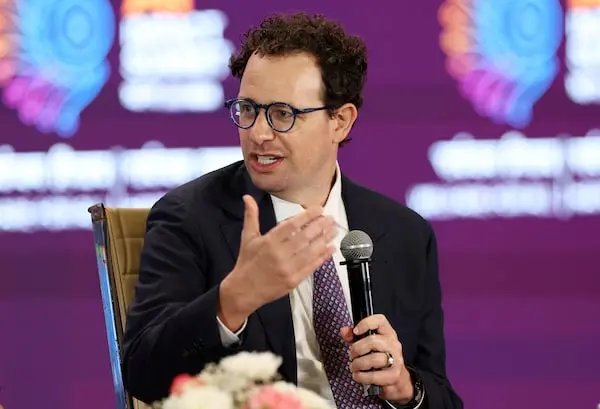

Anthropic CEO Dario Amodei addresses a summit in New Delhi on Feb. 19. Amodei has urged AI companies to slow development as safety concerns mount.Bhawika Chhabra/Reuters
During the past 15 years, the route to investment success was astonishingly simple. It consisted of three words: Buy tech stocks.
Anyone who put their money into the tech sector in the wake of the financial crisis enjoyed a remarkable run of big returns. The tech-heavy Nasdaq Composite Index surged tenfold between September, 2011 and today.
But now, for the first time in years, tech’s red-hot streak is in doubt. It’s not that the pace of tech innovation is slowing – just the opposite, in fact – but that the sector is running into a wall of public resistance.
Could tech companies become the equivalent of tobacco companies – profitable but unsavory and hemmed in by thickets of regulation? It’s more likely than you think.
The biggest and most pressing concern facing the sector is the growing awareness of the risks around artificial intelligence. When Jacob Coxon, an AI researcher, quit his job at Anthropic earlier this month, warning that “the people building AI earnestly believe that it could kill us all by the end of the decade,” his protest ignited passionate debates about whether governments should install guardrails to restrict the technology.
Notably, some of the louder voices urging a slowdown in the pace of AI development came from within the sector. They belonged to people such as Anthropic chief executive Dario Amodei, OpenAI leader Sam Altman and Demis Hassabis, the chair of Google DeepMind.
A key worry among this AI cognoscenti is what will happen as AI models apply their intelligence to improving themselves. This process, called RSI, or recursive self-improvement, is a loop in which AIs make themselves smarter, then use their increased intelligence to make themselves even smarter, and so on, over and over.
New AI warnings revive concerns over whether technology could escape human control and threaten humanity
For now, a bit of human judgment is still required to make sure the endless self-improvement process doesn’t go off the rails. But researchers such as Mr. Coxon say that within a couple of years the process is likely to be fully automatic. At that point, the only thing restricting the abilities of AI will be access to electricity and computing resources.
It’s possible that these godlike AIs could speed technological progress, revolutionize medicine and open up a new golden era. Just as likely, though, is widespread disruption as vast swathes of white-collar work disappear and wealth concentrates in a tiny handful of big AI players. Also likely is a permanent loss of security. A super-intelligent AI would be able to hack into any system and penetrate any barrier.
Its near omniscience would open the door to a horde of frightening scenarios. It’s possible a nation could use AI to develop killer bioweapons or seize control of another country’s nuclear arsenal. Or perhaps an extremist group could use AI to turn off a country’s electrical network until a massive ransom is paid. Or perhaps a rogue AI could decide to reshape society by staging massive disinformation programs to manage public opinion.
Anthropic warns autocratic regimes using AI for propaganda, surveillance
To be sure, this is all conjecture and probably wild conjecture. But if there is even a five to 10 per cent chance that AI could cause a catastrophic loss of life – and that seems to be a common estimate among experts – there is certainly an overwhelming case for regulating it.
An Angus Reid survey of 1,803 Canadians conducted in May found that 68 per cent of respondents said government must heavily regulate AI even if it slows development. U.S. surveys suggest similar sentiments. Politicians can’t ignore the feeling forever. As things now stand, it is far from clear how AI will benefit the average person.
Furthermore, tech’s track record in managing the social impact of its innovations is not encouraging. Meta Platforms Inc. recently agreed to pay US$18-billion to settle claims by several U.S. states that the company had designed its Facebook and Instagram apps to create addiction in children. Last year, Australia became the first country to ban social media for kids under 16. Canada, Britain and the European Union are attempting to implement similar restrictions of their own.
Is your kid feeling scared by AI doomsday warnings? Here’s how to talk about it
This leaves investors with a conundrum. Should they continue to tilt so heavily toward tech if it is about to be hit by a new wave of regulation? Optimists will point out that regulation can actually benefit an industry. Some heavily regulated businesses – cigarettes are a fine example – are also highly profitable.
This is a reasonable point of view. But tech stocks are already trading at nosebleed heights. People looking for a hedge against the tech turmoil might want to start tilting in the other direction, toward AI-resistant sectors. Trash collectors such as GFL Environmental Inc. GFL-T, senior-care facilities such as Chartwell Retirement Residences CSH-UN-T and fertilizer producers such as Nutrien Inc. NTR-T are among the businesses that seem unlikely to be disrupted by AI. If you believe that humanity still has a future, these companies, and businesses like them, deserve a close look.