Broadcom Stock Trades Lower After Earnings. Here’s What Traders Need to Know.

Broadcom (AVGO) reported fiscal third-quarter results after the close on Wednesday, September 2, delivering a beat on both revenue and earnings but failing to impress investors with its forward outlook.
The stock fell more than 3% in after-hours trading, extending what has been a disappointing year for shareholders, with AVGO up only about 1% year-to-date against a 64% gain for the broader PHLX Semiconductor Index.
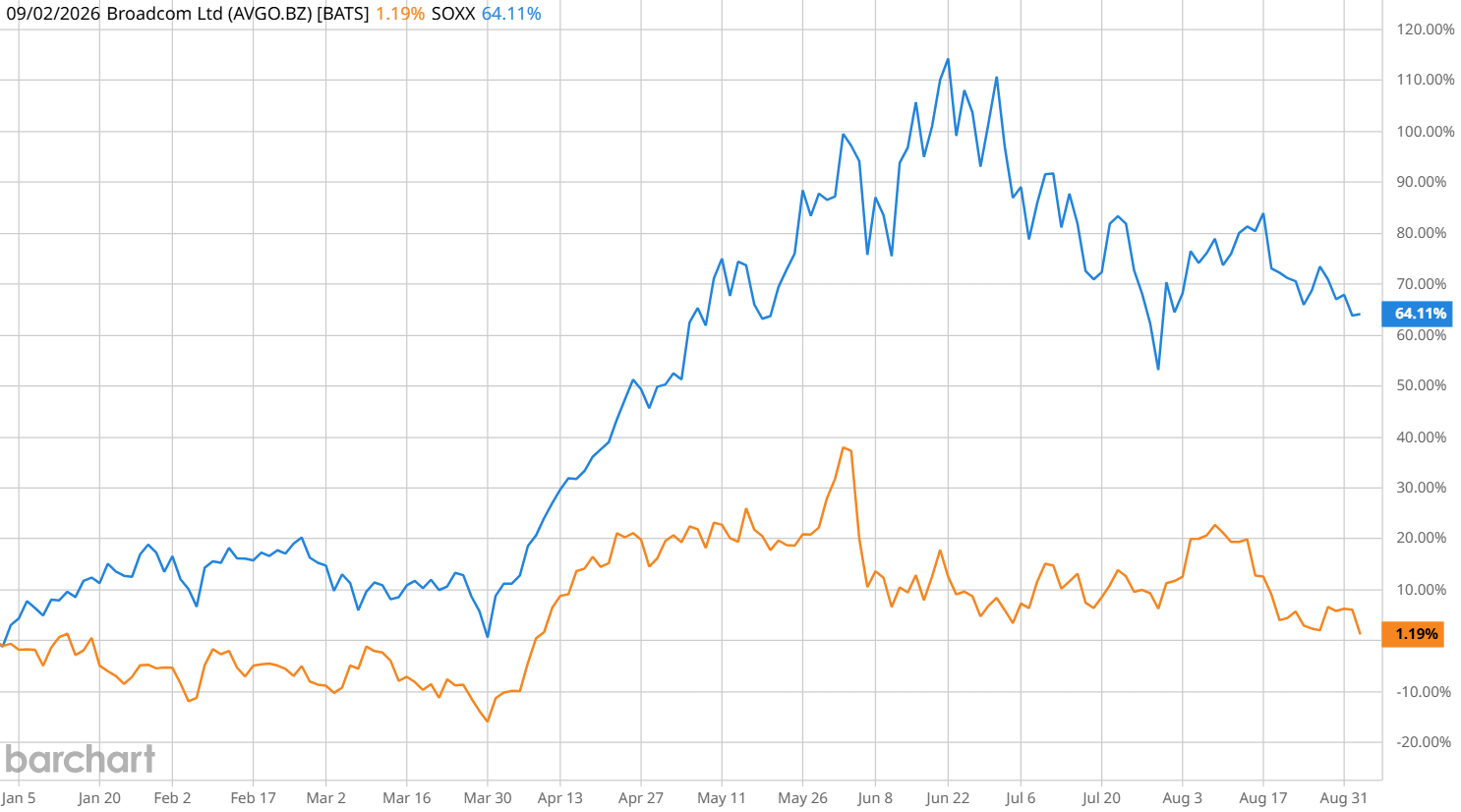
The headline numbers were solid. Revenue came in at $29.59 billion, up 86% year over year and slightly above the consensus estimate of roughly $29.2 billion to $29.5 billion. Adjusted earnings per share of $3.32 also topped the Street's expectation of approximately $3.22.
Artificial intelligence (AI) semiconductor revenue was the standout, reaching $16.7 billion for the quarter – well ahead of the approximately $15.9 billion to $16.0 billion analysts had modeled, representing growth of 221% year over year and 54% sequentially.
Broadcom’s Guidance Falls Short
The problem for bulls was the fourth-quarter guidance. Broadcom projected revenue of approximately $34.8 billion at the midpoint, which fell modestly short of the $35.0 billion to $35.05 billion consensus. This slim miss, in a market that had already priced in aggressive AI-driven growth, was enough to trigger selling.
CEO Hock Tan attempted to reassure investors by highlighting that AI semiconductor revenue is expected to accelerate to $21.7 billion in the fourth quarter, which would represent 236% year-over-year growth.
"Demand for our custom AI accelerators and networking continues to be very strong,” noted Tan in a press release.
However, the market is focused squarely on the top-line guidance gap.
Several competitive and structural headwinds weighed on sentiment heading into the report. Marvell (MRVL) recently closed a custom chip partnership with Google (GOOG) (GOOGL) that could generate up to $120 billion in revenue through fiscal 2033, raising questions about Broadcom's share of hyperscaler spending.
Broadcom itself has been navigating supply constraints and in July signed a multi-year manufacturing agreement with Samsung Electronics valued at more than $200 billion to diversify its production base.
A Deeper Dive Into Fiscal Q3 at Broadcom
The quarterly results showed Broadcom's semiconductor-solutions segment generating $20.8 billion in revenue, up 70% year over year, while infrastructure software contributed $8.8 billion, a 29% increase.
On a GAAP basis, net income surged 216% to $13.1 billion, and the company generated $13.7 billion in free cash flow, representing 46% of revenue. The balance sheet ended the quarter with $24.0 billion in cash, and the board declared a quarterly dividend of $0.65 per share.
Notably, billionaire investor Stanley Druckenmiller had already exited his entire Broadcom position during the second quarter – a move that now appears at least partially validated by the stock's post-earnings decline, though his exit may also reflect a broader reshuffling of AI exposure rather than a bearish call on the company specifically.
The Market’s Negative Reaction to AVGO Earnings, Explained
The broader context matters as well. Rising Treasury yields, with the 10-year reaching 4.80%, have pressured high-multiple growth and technology stocks throughout early September, creating an unfavorable macro backdrop for a stock that needed to deliver an unambiguous beat-and-raise to justify its valuation.
With Broadcom trading at a premium heading into the print, the modest guidance shortfall leaves traders to weigh explosive AI growth against intensifying competition and a market environment that is increasingly punishing anything short of perfection.
here.