Two drones headed to RAF base intercepted, Cyprus says

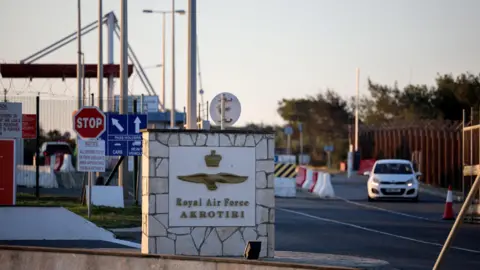
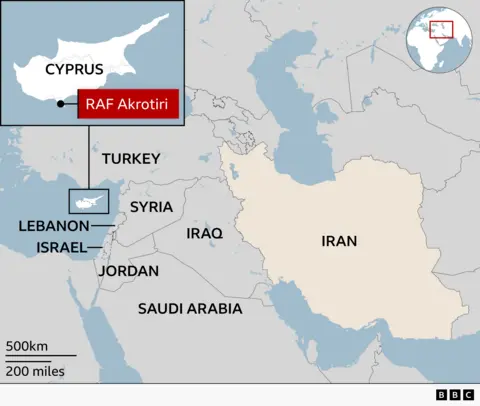
Two unmanned aerial vehicles headed towards RAF Akrotiri in Cyprus on Monday were intercepted in time, a Cypriot government spokesperson has said.
It comes after a drone hit the British base overnight on Sunday with no casualties and "minimal damage".
On Monday, employees received a message warning them of an "ongoing security threat" as sirens were reported in the area.
The UK's Ministry of Defence (MoD) had said earlier that family members would be moved to alternative accommodation as a precautionary measure following Sunday's attack.
It comes after Prime Minister Sir Keir Starmer said the UK had agreed to a US request to use British military bases for "defensive" strikes.
The attack on Sunday, which Cypriot President Nikos Christodoulides said involved an Iranian drone, took place at around midnight local time (22:00 GMT).
The Sovereign Base Areas Administration confirmed afterwards that it was planning the "temporary dispersal of non-essential personnel" from RAF Akrotiri.
On Monday, employees at the base received a message telling them to stay away from windows and take shelter behind furniture.
An alarm was separately raised at Paphos Airport after a suspected drone was spotted in the airspace and evacuation instructions were given.
The US embassy in Cyprus further warned of a possible drone threat in the Paphos region.
President of the EU Commission, Ursula von der Leyen, said she had been briefed on Sunday's attack by the Cypriot president.
"While the Republic of Cyprus was not the target, let me be clear: we stand collectively, firmly and unequivocally with our Member States in the face of any threat," she said in a statement on social media.
UK Foreign Secretary Yvette Cooper told BBC Breakfast the government was still investigating the details of the incident - with the MoD assessing details including the source, locations and timings.
"We have seen the Iranian strikes - drone strikes and missile strikes - across Gulf partners and a whole series of areas that have not been involved in any strikes on Iran and it just really shows the seriousness of the reckless way the Iranian regime is behaving," Cooper said.
Meanwhile, a spokesperson for the Cypriot government said the country would make formal representations to the United Kingdom regarding how Sunday's incident was handled locally - with concerns appearing to centre around information sharing with both local authorities and residents of the wider Akrotiri area.
The latest conflict began on Saturday morning when Israel and the US launched a "massive" and ongoing attack against Iran's leadership and military, with Supreme Leader Ayatollah Ali Khamenei among those killed.
Iran has responded by firing ballistic missiles and drones at US assets and allies across the region, targeting Israel, Bahrain, Kuwait, Qatar, the United Arab Emirates and Jordan.
Defence Secretary John Healey said earlier on Sunday afternoon that British troops and civilians in the Middle East were being put at risk from "indiscriminate attacks" by Iran.
In a separate earlier incident, Healey said two ballistic missiles were fired towards Cyprus although he was "pretty sure" it was not being targeted.
A Cypriot government spokesman later said Sir Keir had "clearly confirmed that Cyprus was not a target" during a telephone call with Christodoulides.
On Sunday, an RAF Typhoon jet operating out of Qatar shot down an Iranian drone in a "defensive air patrol", the Ministry of Defence said.
It was the first time a UK fighter had brought down an Iranian drone since the US and Iran strikes began.
Earlier, a UK counter-drone unit in Iraq took down an Iranian drone that was heading towards a coalition base housing UK service personnel.
However, Sir Keir said the UK had learned lessons from the "mistakes of Iraq", and was not involved in the initial strikes on Iran and would "not join offensive action now".
Sir Keir said the basis of the decision to accept the US request to use British military bases was the "collective self-defence" of allies and protecting British lives, accusing Iran of pursuing a "scorched-earth strategy".
The BBC understands the US is likely to use RAF Fairford in Gloucestershire and Diego Garcia in the Indian Ocean for strikes on Iranian missile sites.
Additional reporting by Chris Graham