How did Republicans lose so badly in North Carolina?
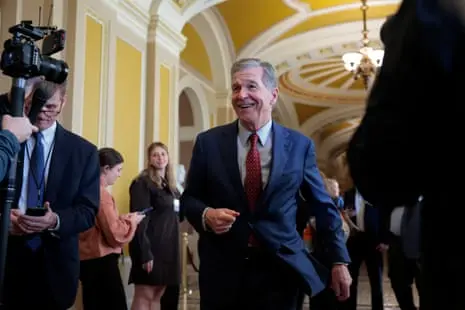
Republicans suffered sweeping losses across the US in the midterm elections, but perhaps nowhere as large as here Republicans suffered sweeping losses across the country in the midterm elections, but perhaps nowhere as large as North Carolina. Democrats flipped a US Senate seat for the first time since 2008, as well as five House seats, one of which Cook Political Report had rated “solid”...
Republicans suffered sweeping losses across the country in the midterm elections, but perhaps nowhere as large as North Carolina.
Democrats flipped a US Senate seat for the first time since 2008, as well as five House seats, one of which Cook Political Report had rated “solid” Republican, and four others considered “likely” Republican. Democrats also held power in the state’s first district, which Republicans had targeted in a redistricting effort.
One of the seats Democrats flipped belonged to Richard Hudson, a representative who led House Republicans’ re-election efforts as the head of the National Republican Congressional Committee. It was the first time an NRCC chair had ever lost a general election.
As of Monday, the Associated Press hadn’t called four of the House races, but two were leaning in favor of Democrats.
North Carolina’s statehouse flipped for Democrats for the first time in more than a decade and Republicans are holding onto the state senate by a one-seat margin – which is currently headed to a recount.
This was all in a state that had only voted for one Democratic presidential candidate since 1980, and hadn’t elected a Democrat to the Senate in almost 20 years. So how did Republicans lose so badly in North Carolina?

“They took voters for granted,” said Anderson Clayton, the 28-year-old chair of the North Carolina Democratic party.
“They thought they could gerrymander themselves into having a seat and not actually have to go out and fight for it, and I think voters looked at them and said: ‘That’s not how we roll. That’s not how it works in North Carolina.’”
Clayton, who has been working to flip North Carolina blue since she was elected in 2023, points to multiple factors this election cycle: Trump’s unpopularity fueling North Carolinians’ frustrations with the current status quo, and a fleet of younger candidates running for office.
But she emphasized Republicans’ failure to address issues affecting voters, especially in North Carolina’s rural districts, as one of the top reasons.
As an example, she pointed to a recent quote from Donny Lambeth, a seven-term Republican state representative, who lost by eight percentage points.
Lambeth told the New York Times that he mistakenly listened to members of his caucus who told him he was in a “safe district” and did not need to spend “any money”. In 2024, Lambeth had won by approximately 14 percentage points.
“I was like: ‘Well, did you go out and talk to any of your voters?’” Clayton said in response to Lambeth’s admission. “‘Like, did you actually speak to somebody on the ground in your district?’”
Felice Pete, an RNC committee member from North Carolina and longtime Republican activist, acknowledged Republicans’ shortcomings.
“You have places where we didn’t think we’re going to lose, like Virginia Foxx, and looking back, people took it for granted. These were safe, red counties. And it’s just getting out the vote effort,” Pete said.
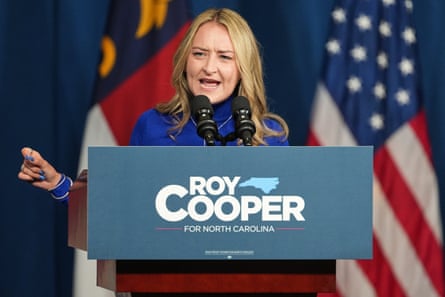
The Associated Press has not called Foxx’s race in North Carolina’s fifth congressional district because of an ongoing recount, but her Democratic opponent, Chuck Hubbard, is ahead by a thin but likely insurmountable margin.
“The 2024 win for Republicans was not done with traditional Republicans,” Pete said. “They were first-time voters, they were independents, there were a lot of young minority men, a lot of young college-aged men.”
“I just think, with redistricting, we just did not have the effort focused with getting out the votes,” Pete said.
Republicans had invested time, money and energy into maintaining their majority through redistricting, under pressure from the US president. They redrew lines to try to flip the first congressional district, but it didn’t work; the incumbent Democrat, Don Davis, held onto his seat.
Clayton accused Republicans of getting “elitist” in the midterms and relying too heavily on consultants – a criticism Democrats often face.
“Instead, you had real grassroots energy from Democrats that won seats that honestly, they shouldn’t have, in some ways, on Tuesday night,” Clayton said.
In parts of the state that are comfortably red, such as Davidson county, located in central North Carolina, the electorate moved 16 percentage points in favor of Democrats compared with 2024, according to NBC’s decision desk.
Christopher Jessup, the chair of the Davidson county Republican party and a longtime Republican advocate, said he wasn’t sure why that happened but attributed it to “probably some voter turnout”.
Jessup highlighted that his county still overwhelmingly voted for the Republican candidates in the midterms, and praised the work his colleagues and teams did. Despite that, the sixth congressional district, where Davidson county is located, flipped for Democrats.
When asked what the top issue for voters in the county was, Jessup said “a very negative view of Roy Cooper”.
Cooper, the former governor of North Carolina, defeated Michael Whatley, the former head of the Republican National Committee and chosen directly by Trump, by nearly 20 percentage points.
Republicans had anticipated Cooper’s win. By October, the top Super Pac for Senate Republicans cancelled remaining ads that it had booked in the state.

Like many Republicans, Pete is still dissecting why messaging that won over North Carolinians in 2024 didn’t resonate in 2026. But she has some theories, starting with the fact that Trump 2024 voters felt “betrayed”.
“The word that I hear over and over is betrayal,” Pete said. “Many of those people felt like voting did not matter because they felt like 2024 was their last hope to have this correction, and then they go, and here we are.”
Pete pointed to Trump’s campaign promise not to start more wars, which he failed to deliver on when he started a conflict with Iran in February. That conflict, which Congress never formally approved, has pushed gas and diesel prices up, causing a chain reaction that has affected other everyday costs, such as groceries.
She added that messaging that won voters over in 2024 “started to shift” or wasn’t being communicated well from “some higher-ups, or even our administration”. That includes mass deportations; during his campaign, Trump promised to target every undocumented immigrant, but administration officials now claim they target undocumented immigrants with violent criminal histories.
Citing a personal example, Pete said the young men that she gathered to go out door-knocking in 2024 did not want to work for the 2026 midterms; she called the experience “a microcosm of what happened”.
“We have to have an honest assessment of that and just the detriment of not fulfilling, or seemingly fulfilling, the promises you make,” Pete said.