Democrats promised to end corruption. Here’s how they can do that | David Sirota


Overturning Citizens United is not enough. Campaigns must be funded with public money rather than private donations Having devoted most of my adult life to reporting on, campaigning against, and exposing the corrosive influence of money in politics, I’m gratified that this cause was – finally – front of mind in a national election. That’s right: in the midterms, corruption topped the list of...
Having devoted most of my adult life to reporting on, campaigning against, and exposing the corrosive influence of money in politics, I’m gratified that this cause was – finally – front of mind in a national election.
That’s right: in the midterms, corruption topped the list of Americans’ concerns, and candidates won by waging campaigns promising to reject corporate Pac money and linking Washington’s pay-to-play culture to the affordability crisis.
Looking ahead to 2028, the Democratic Georgia senator Jon Ossoff is now generating presidential buzz, dripping out clips of his speeches deriding a “coin-operated” government and slamming Citizens United – a ruling he rightly calls “the most destructive supreme court decision in modern American history”.
But as righteous and expansive as Democrats’ anti-corruption jeremiads have been amid billions spent to try to buy the midterm elections, the rhetoric so far has been accompanied by shockingly small proposals for mere nibble-at-the-edges reforms.
Ossoff would have you believe a real anti-corruption agenda is pushing to overturn Citizens United, a congressional stock trading ban and prohibiting traditional corporate political action committees.
Ahead of his likely 2028 presidential campaign, the former Chicago mayor Rahm Emanuel argues the answer to endemic corruption is banning government officials from betting in prediction markets, forcing them to put assets in blind trusts, and prohibiting them from accepting foreign gifts.
Emblematic of most challenger candidates this election cycle, the Democratic Kansas senator-elect Adam Hamilton vaguely insisted to the American Prospect: “What I’d like to do is figure out how we help get money out of politics instead of having it dictating politics” – but he offered only Emanuel’s prescriptions, plus a ban on lobbying by retired members of Congress.
All of those are laudable ideas, but they are the equivalent of pruning a few saplings of corruption – they hardly constitute an agenda that rips up the roots and branches of Washington’s entire forest of graft. Indeed, even repealing Citizens United would unto itself do little to truly corruption-proof the financing of political campaigns.
So what is a real anti-corruption agenda that actually addresses the crisis?
To start, a Democratic Congress must use its subpoena power to build off investigative reporting and expose how Super Pacs have become a key vehicle for quid-pro-quo corruption in both parties. Congressional inquiries exposing these schemes could both boost existing federal legislation to outlaw Super Pacs, as well as a landmark federal court case aiming to limit donations to Super Pacs.
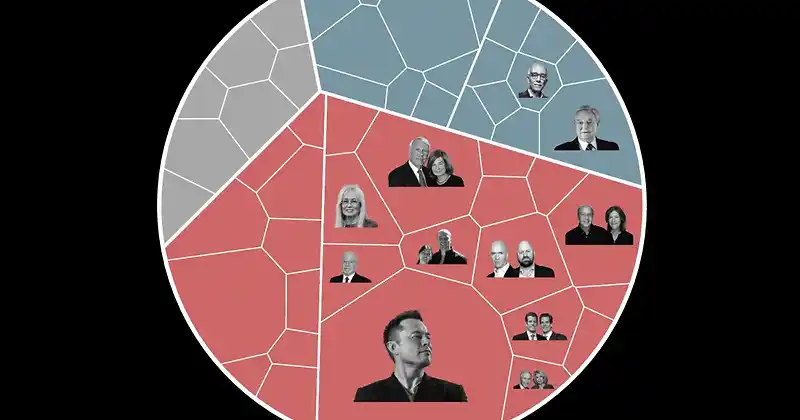
Democrats must also pass their longstanding legislation requiring full disclosure of the sources of $1bn of dark money, and they must pass Senator Chris Van Hollen’s new bill closing loopholes that let federal contractors – and their owners, such as Elon Musk – easily circumvent the existing ban on election spending.
At the same time, Democrats in other states can follow Michigan and pass tough campaign spending disclosure laws – and prohibit utilities and government contractors from flooding money into elections. They can also follow Montana and Hawaii and amend their existing incorporation laws to bar companies from spending in elections. And they can institute new internal Democratic party rules that reward primary candidates for rejecting Super Pac spending, and that punish those who rely on it.
But even if all that happened – and even if Citizens United were successfully repealed and election spending could be restricted – the single most significant problem remains. Candidates will still need resources to run campaigns and communicate their ideas to voters. So where could they find resources that do not come from donors demanding legislative favors in return?
One answer has been small-dollar donors – but save for the highest-profile politicians in the highest-profile nationalized races, most candidates for lower-profile offices will never be able to celebritize their candidacies and tap into national networks of thousands of grassroots contributors. And we shouldn’t want them to – we shouldn’t want the election of your local school board member to be predicated on candidates’ ability to make spectacles of themselves in order to go nationally viral on Instagram.
No, the real answer to the campaign financing problem is not some newfangled innovation. It is an old idea involving public money – an idea that is starting to be mentioned by a handful of insurgent candidates, but you have to listen closely for it, because it isn’t yet generating big headlines or going viral.
How we take action
“There are things that we could do, like publicly fund campaigns, where if there’s a Super Pac that spends on a campaign, then it triggers public funding equal and opposite to that expenditure,” the Michigan Democratic senator-elect Abdul El-Sayed told me earlier this year.
Similarly, Maine’s Democratic senator-elect Troy Jackson says a real anti-corruption agenda “means advocating for publicly financed federal campaigns modeled after Maine’s historic clean-election system”.
Over in the House, the incoming Democratic representative Daniel Biss has touted his community’s local public financing system as a model for Congress, and Denver’s incoming Democratic representative Melat Kiros has said: “We need to have a caucus that is laser-focused on actually pushing through publicly financed elections. That’s going to be one of the first things that I do.”
The call is even coming from a corner of the consulting class.
“The Democratic party should explore the idea of trying to create a system of public financing for elections,” longtime Democratic strategist Tad Devine told me. “We’re going to have to fight within our own party to make it happen, because it’s going to put the Wall Street guys out of business.”
In different ways, they are all referring to what’s known as clean-election systems, which typically match candidates’ small-dollar, private donations with public money at multiples that let candidates run competitively resourced races. The idea is to give candidates a way to run for office that does not force them to finance their campaigns with money that comes with the expectation of legislative favors.
A system of publicly financed federal elections isn’t some pie-in-the-sky idea – such systems already exist in a handful of states and cities across the country. That includes Biss’s hometown of Evanston and Kiros’s hometown of Denver, as well as New York City, where Zohran Mamdani’s historic mayoral campaign against the billionaire class probably would never have gotten off the ground without municipal matching funds.
“It’s incredibly important,” Mamdani told me when I asked him how significant his city’s public financing system was in his campaign. “What it allows is the amplification of the voice of ordinary New Yorkers, as opposed to the billionaires who have grown used to buying our elections.”
Another rare historical moment of opportunity
Proposals to publicly finance federal elections have periodically been considered by Congress – and have gotten extremely close to becoming the law of the land in the aftermath of corruption scandals.
We’re now living in the Trump age of the perpetual corruption scandal – which should once again put public financing back on the agenda in states and in Washington.
For example: blue states can use new majorities from an anti-Trump election wave to start adopting public financing systems. Kiros’s state could be a good test case: after Democrat Phil Weiser won his gubernatorial primary on a promise that “the future of Colorado will not be decided by out-of-state billionaires,” he expressed support for the concept of public financing campaigns. He and the new congresswoman could spearhead a ballot measure asking voters to extend a version of Denver’s public financing system to the whole state.
Meanwhile, at the national level, a Congress and a new president elected on anti-corruption waves in 2026 and 2028 could finally create a long-overdue federal system – one that rebuilds the defunct presidential public financing system and extends a new one to congressional races. Even if Democrats don’t at first pass a universal federal system, they could at least pass legislation allowing the 14 states that have some form of public financing systems to extend those systems to finance their congressional and senatorial races.
How could such a system be funded? That’s the easy part – you get the money from those who exploit the current corrupt system.
How? Here are a few ideas: expand and pass the senator Sheldon Whitehouse’s legislation to end the tax-exempt status of Super Pacs and dark money groups; force corporate vendors to pay a corruption fee on all large federal contracts they receive; impose levies on the lobbying industry; or just enact a surtax on billionaires. You could even assess a tiny tax on all text messages from political groups.
The harder part is finding the political will to do any of this.
In one scenario, you can imagine Democrats touting small-bore proposals such as a congressional stock trading ban in order to look like they are honoring the election’s massive anti-corruption mandate – all while those same Democrats quietly kill an anti-corruption agenda that could actually meet the moment, disempower both parties’ oligarch donors, and deal with the systemic problem.
You can also imagine Democrats citing Donald Trump as a rationale to do nothing – which one of the party’s leaders is already floating.
“I do not think it is time to propose things that the president of the United States is guaranteed to veto,” the Hawaii Democratic senator Brian Schatz recently told CNN. “I think that is somewhat of a bit of wasted energy.”
But when it comes to anti-corruption policy, such complacency misunderstands the anti-Citizens United moment. Legislating a serious anti-corruption agenda forces Trump and the Republican party to either join the cause, or veto it – and stand on the side of the corruption America loathes. Acting now casts Democrats as responsive to voters’ demands, positions their party as the anti-corruption vanguard ahead of the 2028 election, and sets the stage for legislation to pass if they win back the White House.
Symbolic gestures or half-measures, though, will not cut it. The anti-Citizens United zeitgeist is real right now – and it is being used by savvy Democratic politicians as a powerful, algorithm-boosted talking point in the attention economy.
But the challenge isn’t just to go viral and get clicks – the real challenge is turning a talking point and its anti-corruption zeitgeist into something meaningful. Doing that requires a concrete solution that challenges – rather than compromises with – the power of the donor class.
Public financing is that solution. Now is the time for it to be the central focus of America’s anti-corruption insurgency.
David Sirota is a Guardian US columnist and an award-winning investigative journalist. He is an editor at large at Jacobin, and the founder of the Lever. He served as Bernie Sanders’ presidential campaign speechwriter
Related Articles
- Politics News
How you (yes you) can fight dark money in elections | Judd Legum
- World News
How Republicans lost the midterms as Hispanic and young voters fled Trump’s party
- Politics News
We answered your US midterm questions on the economy, the Iran war, immigration and more
- General News
Mamdani weaponizing $1.6M taxpayer-funded ads to push ballot questions that ‘take power from the people’: critics
- World News
Tracking the money: The biggest donors in the 2026 US midterm elections