Can progressives push Hakeem Jeffries to the left? | Norman Solomon
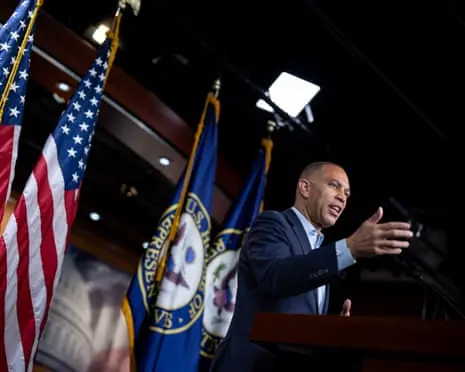
The likely next House speaker has a record of defending corporate interests. His fellow Democrats must fight for Medicare for All and the abolition of ICE On Wednesday, Democrats nominated Hakeem Jeffries to be the next House speaker when they take control of Congress. For progressives, that will mean dealing with a powerful leader who has a record of hostility toward the left. “There will never...
On Wednesday, Democrats nominated Hakeem Jeffries to be the next House speaker when they take control of Congress. For progressives, that will mean dealing with a powerful leader who has a record of hostility toward the left.
“There will never be a moment where I bend the knee to hard-left democratic socialism,” Jeffries vowed five years ago.
Now, looking ahead to the next House term, dozens of progressives who will be in office – including at least eight democratic socialists – will need to figure out how to deal with Jeffries after campaigning against the Democratic establishment that he exemplifies.
Following stints as a corporate lawyer and state legislator, Jeffries quickly ascended Capitol Hill. He was only in his third term, representing a largely working-class district in New York City, when he became chair of the House Democratic Caucus in 2018. At the time, a profile in the Economist called him “nearly as moderate as a safe-seat Democrat gets”.
Meanwhile, the Intercept reported: “Jeffries is heavily backed by big money and corporate PACs. Less than 2% of his fundraising comes from small donors, who contribute less than $200.”
During his eighth year in the House, “Jeffries was the leading congressional recipient of hedge fund money,” the American Prospect pointed out. “He banked $1.1 million from the financial sector, real estate interests, and insurance industry in the 2019–2020 cycle … From the outset, he has governed with those interests at heart.”
In 2022, Jeffries teamed up with one of the most zealous anti-progressive lawmakers in the entire Democratic caucus, Representative Josh Gottheimer, to form Team Blue Pac. Its avowed goal was to defeat leftwing primary challengers of incumbents. A Rolling Stone headline aptly summarized the Jeffries mission: “Top House Democrat Unveils Plan to Beat Back Progressive Rebellion.”
Hours after Jeffries delivered his midterm victory speech two weeks ago, Sludge reported that since early 2025 he has received “financial backing from executives at Anduril and Palantir, cryptocurrency industry interests, and major Wall Street investors – business interests with a stake in how aggressively the new majority pursues corporate beneficiaries of Trump’s presidency. Federal Election Commission filings show that Anduril’s CEO and chief operating officer gave $144,300 to Jeffries’ fundraising committees, while a manager at Palantir contributed another $44,300.”
Jeffries’ importance to donors increased when Democrats lost control of the House in November 2022 and the ousted speaker Nancy Pelosi anointed him to become minority leader. He was instantly a good match with the party’s longtime Senate leader Chuck Schumer, a record-setting recipient of Wall Street donations. But the duo have been a mismatch with most Democratic voters.
Midway through 2025, a Reuters-Ipsos poll found that 62% of self-identified Democrats agreed “the leadership of the Democratic party should be replaced with new people.”
A large majority of Democrats wished for elected officials to reduce “corporate influence”, and a whopping 86% “said changing the federal tax code so wealthy Americans and large corporations pay more in taxes should be a priority”.
At age 56, Jeffries is set to make history as the first Black speaker of the House. His early years in Congress included notable work that challenged police brutality and racism in the criminal justice system.
After unsuccessfully launching a 2015 bill for a national ban on police use of chokeholds, Jeffries had more success when he co-authored the First Step Act – a major reform measure to improve federal prison conditions and reduce sentencing inequities for drug offenses that became law in 2018. Meanwhile, as he climbed through congressional ranks, Jeffries earned a reputation as a fast-rising corporate Democrat.
Over the years, Jeffries has become even more oriented to defending the interests of wealthy Americans and large corporations. His devolving stance on healthcare is a case in point.
The final year that Jeffries supported Medicare for All was 2021. This summer, interviewed on NBC’s Meet the Press, he said: “It’s not legislation that I currently am cosponsoring or that I support.” He completely dodged a direct question: “Will you put Medicare for All up for a vote if you become speaker?”
House progressives should insist that Jeffries make an ironclad commitment to allow a floor vote on Medicare for All, which is now favored by two-thirds of the US public as a whole.
Activists nationwide should also build pressure on congressional Democrats to insist that Jeffries get behind efforts to abolish Immigration and Customs Enforcement (ICE).
He has refused to do so, instead merely declaring: “We’re committed to dramatically reforming ICE.” In contrast, three months ago the Democratic National Committee approved a resolution that called for abolishing the agency.
Jeffries is also out of step with most Democrats on foreign policy. He’s a longtime supporter of huge military spending. His opposition to the Iran war is narrowly tactical. His backing of Israel has remained unequivocal.
He has received a deluge of cash from the Israel lobby. During his first dozen years in Congress, from 2013 through 2024, Jeffries raked in $1,741,230 from pro-Israel groups – making him the fifth-biggest Democratic recipient of such funds in the House since 1990.
During the last two years, Israel backers greatly boosted their largess, with Aipac’s political action committee funneling upward of $427,000 in donations to his campaign and fundraising committees.
Despite the genocide in Gaza, Jeffries has not been swayed while rank-and-file Democrats overwhelmingly favor an arms embargo on Israel.
Four months ago, he sent out a “dear colleague” letter opposing an amendment to block $3.3bn in military shipments and other aid to Israel. The next day, a record 103 House Democrats voted in favor of the measure (while 98 voted against).
Still, some on the left have backed Jeffries. In May, the chair of the Congressional Progressive Caucus, Greg Casar, said he would support Jeffries for speaker. In June, Representative Alexandria Ocasio-Cortez did likewise. Such hasty eagerness to cement good relations with the party establishment was akin to union officials giving away leverage before sitting down at the bargaining table.
Many of the leftists who are about to become congressmembers have remained publicly noncommittal about the speaker choice. Progressives around the country should support them.
Melat Kiros, a 29-year-old attorney, is a democratic socialist on her way to the House from a Denver district.
“I want to see an agenda, an actual plan for how we get things done,” she said, adding: “What’s your plan to actually get Medicare done? What’s your plan to get these data centers under control and rein in these big tech companies, right? That’s what the voters want to see. And if that’s not a priority of yours, then I don’t think you should be speaker.”
A former Capitol Hill staffer, familiar with the thinking of current and soon-to-be House members on the left, told me days ago: “Many progressives and incoming socialists are far from sold on Hakeem Jeffries. They’re making clear that it’s not personal or hostile, but they want real evidence that he’s willing to fight for their priorities, rather than defaulting to the traditional Democratic leadership approach.”
A political culture clash over Jeffries is just around the corner on the left. The party’s base has a very different view of Jeffries’ fitness to be speaker compared to the outlook that prevails among Democrats at the Capitol.
During the first two days after the election on Tuesday, more than 750,000 people signed a petition stating: “The speaker should represent the Democratic voters, not just the Democratic establishment”, and: “Hakeem Jeffries is simply not the right choice.”
Looking for silver linings, a senior Democratic aide recently told me that Jeffries “has had a relatively light touch” compared to Pelosi and “could be amenable to significant and valuable concessions”. That might provide openings for the left.
The stakes are huge. The House speaker can largely determine committee assignments and, except in rare instances, prevent specific bills from ever getting to the House floor for a vote.
Massive pressure and systematic organizing from grassroots progressives will be essential to stop Congress from continuing to be a stronghold of corporate power and unhinged militarism.
Norman Solomon is the director of RootsAction and executive director of the Institute for Public Accuracy. His latest book is The Blue Road to Trump Hell: How Corporate Democrats Paved the Way for Autocracy