Hedge Funds Retreat as AI Trade Loses Momentum


Market Analysis by Stephen Innes covering: Nasdaq 100, S&P 500, Intel Corporation, SPDR® S&P 500® ETF Trust. Read Stephen Innes's Market Analysis
Indeed, the selling has gone from selectively dumping the AI high-flyers to carpet-bombing anything with a ticker symbol.
Takeaways
• The post-election reversal has caught the Street badly wrong-footed, with the S&P 500 suffering its worst decline since the April 2025 tariff shock.
• Hedge funds are unloading AI exposures into a market where liquidity is disappearing faster than the bids, while long-only investors appear reluctant to defend even their favourite names.
• The AI investment debate has shifted from semiconductor demand to whether enough land, electricity and data-centre capacity will exist to accommodate the chips already being ordered.
• The market may be pricing a severe slowdown in the AI buildout before anyone knows how restrictive the new political landscape will become, although the absence of dip buyers makes that distinction rather academic for now.
What a Difference a Day Makes
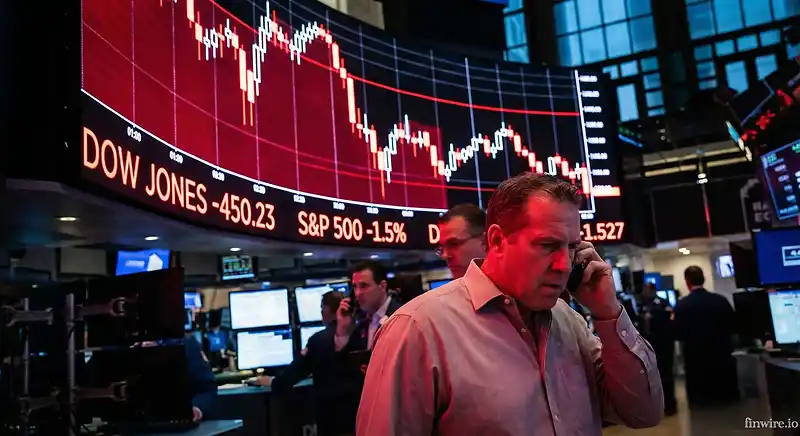
These are the days when trading-desk phones ring off the hook, with clients demanding colour on what has suddenly become a rather ugly tape. Unfortunately, when sales turn to the traders for an explanation, they’re often greeted with the institutional equivalent of a blank stare and a shrug.
Nobody has a particularly elegant answer beyond the obvious: the blast radius is enormous, the selling is feeding on itself, and nobody on the Street seems terribly interested in buying this puke. Which brings me to that old trading-desk chestnut, particularly fitting as I fire up my screens at 3:30 a.m. here in Bangkok to survey the carnage: it’s always darkest before dawn. Although looking at this tape, someone might want to check whether the sun still intends to come up.
Yesterday’s post-election sea of green has turned into a technology bloodbath. The S&P 500 plunged 4%, its worst session since the April 2025 tariff meltdown, while the Nasdaq 100 lost 6% and the semiconductor complex was taken to the woodshed with an 11% decline. The rotation-driven recovery that looked so promising after the Democratic sweep has been swallowed whole by a delayed reaction to what a change in Washington could mean for the AI investment cycle.
And there’s the rub. Wednesday’s rally was driven by collapsing oil prices, falling yields and the prospect of a less inflationary economic backdrop. Those were legitimate reasons to buy equities. But Thursday’s market decided that cheaper money wasn’t much consolation if the industry’s future earnings estimates were about to be put through the wood chipper.
The long-only community appears frozen once again. After substantial de-risking ahead of the midterms, Wednesday’s recovery dragged reluctant investors back into the market, only for Thursday’s selling to turn their newly acquired positions into another round of unwanted inventory. Hedge funds are now dumping pockets of the hyperscaler trade they were buying barely 24 hours earlier.
That’s the sort of round trip that makes even seasoned portfolio managers question whether they should have stayed in bed.
Carpet Bombing Algos Run Wild
The most troubling feature isn’t simply the size of the decline. It’s the absence of anyone willing to defend the market.
Indeed, the selling has gone from selectively dumping the AI high-flyers to carpet-bombing anything with a ticker symbol.
Retail-heavy brokers are reporting a second consecutive day of unusually pronounced selling, while institutional flows suggest the pressure is increasingly coming through broad macro instruments rather than individual stock decisions.
SPY volumes are running around 160% above their 20-day average, QQQ volumes are up 100%, and semiconductor ETF activity is roughly 150% above normal. DRAM-related turnover is also elevated by 75%. When that much money is being pushed through index and sector products, the distinction between a good company and a bad one can become a luxury the market temporarily stops paying for.
That’s how a sector correction turns into a market-wide liquidation. Portfolio managers don’t necessarily sell what they want to sell; they sell what they can.
Qualcomm (NASDAQ:QCOM) and Arm Holdings (NASDAQ:ARM) added fuel to the fire with disappointing outlooks, while Intel (NASDAQ:INTC) continued falling despite already having suffered a decline approaching 30% since Friday. Tesla (NASDAQ:TSLA) and SpaceX (NASDAQ:SPCX) lost at least 8%, and even the recovery in the broader risk complex couldn’t prevent Bitcoin from surrendering another 5%.
Apple’s (NASDAQ:AAPL) successful $7.5 billion bond offering provided evidence that well-capitalised technology companies can still attract financing. But access to the bond market isn’t the issue for the strongest balance sheets. It’s whether investors will continue paying yesterday’s earnings multiples for tomorrow’s increasingly uncertain capital spending.
Even Michael Burry, whose reputation was built on spotting the housing-market collapse, disclosed that he had reduced his semiconductor ETF put positions by 25%. That’s an interesting footnote in a market where short sellers are taking some money off the table while the long-only crowd is still looking for a place to hide.
The volatility complex has responded accordingly, with the sharpest jump in almost two years. Correlations are rising, defensive sectors are losing their ability to provide sanctuary, and the selling has begun to resemble a liquidation of risk budgets rather than a considered reassessment of individual companies.
When the market starts trading the portfolio instead of the stocks, fundamentals usually have to wait their turn.
VIX Legend

Too Many Chips, Not Enough Places to Plug Them In
The deeper problem is that the AI investment story has developed a potentially serious mismatch between the speed of semiconductor production and the physical infrastructure needed to put those chips to work.
For much of the boom, investors concentrated on GPU demand, memory shortages and the breathtaking capital expenditure plans of the hyperscalers. The operating assumption was that if the money was available, the data centres would get built.
Now the market is discovering that you can’t simply plug a trillion-dollar investment cycle into an extension cord.
Land, power connections, permitting and completed data-centre shells have become the potential choke points. By 2028, the concern is that the industry could have more semiconductors ready for deployment than physical facilities capable of housing and powering them.
That prospect is particularly uncomfortable for memory producers, where extraordinary supply-demand imbalances have supported significant increases in average selling prices. DRAM, NAND and hard-disk suppliers have benefited from customers racing to secure capacity ahead of the AI buildout. If construction schedules stretch while semiconductor supply keeps arriving, the shortage premium embedded in those earnings estimates could disappear rather quickly.
And the market isn’t stopping with the chipmakers.
Engineering and construction companies tied to data-centre projects, independent power producers with exposure to Texas, Georgia and Ohio, and the increasingly fashionable neocloud operators are all being caught in the downdraft. Their business models may differ, but each depends on some part of the physical AI infrastructure chain progressing at the pace investors have been promised.
The political change has thrown another spanner into that machinery. Democratic victories, particularly in states where data-centre development has become contentious, have increased concerns about permitting, electricity costs and the willingness of local authorities to accommodate another enormous wave of construction.
Until recently, investors were contemplating data-centre power capacity and capital spending growing by more than 30% year over year in 2028. The darker scenario now being discussed has gigawatts added in 2028 running little better than flat against 2027.
That’s not a rounding error in a spreadsheet. It’s a fundamental change in the capital expenditure trajectory underpinning some very generous earnings assumptions.
And when the earnings denominator becomes uncertain, the market rarely waits politely for analysts to finish recalculating their models before adjusting the multiple.
The Earnings Estimates Are Now in the Firing Line
This is where the selloff becomes more complicated than a conventional technology valuation correction.
There has been plenty of concern about the cost of financing the AI boom, but Thursday’s liquidation suggests investors are increasingly questioning the pace at which that investment can actually be deployed. If infrastructure constraints delay construction, semiconductor deliveries and associated revenue streams may be pushed further into the future.
That is a different problem from simply paying too much for a good business.
The bullish case has relied on an extraordinary combination of accelerating earnings estimates and premium valuations. When investors start questioning the estimates themselves, the market has to reassess both sides of the equation.
And nobody appears particularly confident about where those estimates will settle.
The JonesTrading view that the political shift could produce a genuine data-centre slowdown captures the concern now spreading across trading desks: the earnings forecasts supporting current valuations may no longer be reliable, leaving investors reluctant to commit capital until the new development timetable becomes clearer.
Yet there is an important distinction between a permanent reduction in demand and a delay in the industry’s ability to satisfy it.
The demand for computing capacity hasn’t suddenly disappeared because Democrats won an election. Companies still need infrastructure, and the economic incentive to build viable projects remains substantial. Political opposition may make expansion slower and more expensive, but it does not follow that every proposed data centre will be cancelled.
Indeed, statewide moratoriums have historically proved difficult to enact, even where local opposition has grown. Much will depend on negotiations around permitting reform, electricity infrastructure and the terms under which developers are allowed to proceed.
The ultimate outcome could be an AI boom that becomes more expensive, more concentrated among the companies with the deepest pockets and less accommodating to the highly leveraged newcomers that have flourished during the investment frenzy.
That would leave the investment cycle intact but radically alter who captures the profits.
The Market Is Pricing the Worst Before the Politics Are Settled
There is a peculiar irony in watching the entire AI complex get marked down as though Washington had already issued a formal eviction notice to the data-centre industry.
The election has changed the political landscape, but it hasn’t resolved the regulatory one. The extent of additional restrictions, the possibility of permitting compromises and the willingness of individual states to accommodate commercially viable projects remain open questions.
Markets, of course, have never been particularly patient when faced with uncertainty over earnings.
The concentration problem doesn’t help. When a relatively small collection of technology companies accounts for such a large share of index performance, a simultaneous reduction in their valuations can turn an otherwise contained sector problem into a very uncomfortable day for the S&P 500.
That doesn’t make every company in the AI ecosystem equally vulnerable. The strongest balance sheets can absorb delays, finance infrastructure and potentially benefit from industry consolidation. Companies dependent on uninterrupted access to cheap capital, rapidly rising memory prices or aggressive construction schedules have much less room for disappointment.
But those distinctions become easier to make once the selling stops.
For now, the market is behaving as though every shareholder has been handed the same exit ticket, and the door is considerably narrower than anyone remembered.
Darkest Before Dawn, Perhaps. But First Someone Has to Find a Bid.
I’ve spent enough years around trading floors to know that some of the best opportunities appear when the market looks completely untradeable. Capitulation has a habit of producing extraordinary prices, particularly when forced selling overwhelms the underlying investment case.
But there’s a difference between recognising that a market is becoming cheap and volunteering to be the first buyer in front of a liquidation machine.
Thursday’s action has all the hallmarks of a disorderly position unwind: extraordinary ETF volumes, hedge funds reversing yesterday’s purchases, long-only managers refusing to commit and volatility spreading across sectors that have little direct exposure to the original catalyst.
It may well be darkest before dawn, but the absence of any meaningful recovery after such severe declines suggests investors are still more interested in reducing exposure than searching for bargains.
The more intriguing question is whether the market is correctly anticipating a structural slowdown in AI investment or simply applying an excessively punitive discount to a political outcome whose practical consequences remain uncertain.
If the physical infrastructure bottlenecks prove temporary, and permitting negotiations preserve the industry’s longer-term expansion plans, some of the earnings destruction currently being priced could turn out to be premature.
If the bottlenecks persist, however, the industry’s capital expenditure assumptions will need a serious haircut, and the market may have to get comfortable with the idea that AI demand and AI infrastructure revenue don’t always arrive on the same timetable.
The AI revolution hasn’t been cancelled, but Wall Street is discovering that even a technological revolution needs somewhere to park its chips and enough electricity to switch them on.
And until someone on the Street is prepared to put real money behind a bid, the only certainty is that the phones will keep ringing.
Related Articles
- General News
The Bulls Get Off the Canvas, but Wall Street Is Still Seeing Stars
- General News
Asia Open: The Fed Gives, Big Tech Takes as Alphabet Face-Plants
- General News
Nasdaq, SMH: Have We Found a Major Top on the AI Trade?
- Stock Markets News
Brutal AI selloff stirs recession fears
- Business News
AI firms hit in worst stock market crash for 18 months