Fewer Tugs on White Collars During Atkins First Year at the SEC as Enforcement Hits Decade-Plus Low


Not one defendant had an admission of guilt for the first time since 2021, compared to an average of 21 from 2022 to 2025. The post Fewer Tugs on White Collars During Atkins First Year at the SEC as Enforcement Hits Decade-Plus Low appeared first on The Daily Upside.
If Wall Street white collars are feeling a tad less tight lately, it must be the absence of regulatory heat.
The Securities and Exchange Commission, the financial industry’s top regulator, took the fewest actions against public companies in at least a decade and a half in the most recent fiscal year, according to new data.
Lights, Camera, Less Enforcement Action!
SEC Chair Paul Atkins was nominated by President Donald Trump last year on the expectation that he would take a light-touch approach to enforcement and regulation. Since being confirmed by the Senate in April 2025, he has moved to do away with quarterly reporting requirements, expand 24/7 trading and make it easier for crypto firms to raise money through token sales.
His latest move came Friday, when the SEC announced it wants to relax executive compensation disclosure requirements for publicly traded companies. Under proposed new rules, most companies would have to disclose the pay packages of just two executives, down from five, and wouldn’t have to report workplace perks totaling less than $150,000, compared to the current $10,000 threshold. Atkins said these changes “are central tenets of my agenda and focus on transforming the SEC’s public company disclosure regime to one rooted in materiality.”
In addition to favorable rule changes, the latest annual analysis of SEC enforcement activity by Cornerstone Research and the NYU Pollack Center for Law and Business shows the Wall Street watchdog has been more puppy-like when it comes to enforcement under Atkins:
- The SEC brought just 16 actions against public companies and subsidiaries in the fiscal year ended Sept. 30, the fewest since Cornerstone and NYU began tracking data in 2010 and a 71% decline from FY 2025. The $184 million in penalties obtained from these actions also marked the lowest level since at least 2010, more than $600 million less than in the 2025 fiscal year.
- Not one defendant had an admission of guilt for the first time since 2021, compared to an average of 21 from 2022 to 2025. “The decline in both enforcement actions and monetary settlements was broad and significant,” Stephen Choi, the NYU law and business professor who co-authored the report, said. “But based on Chair Atkins’s statement that the SEC will emphasize quality enforcement over quantity, these results are not entirely surprising.”
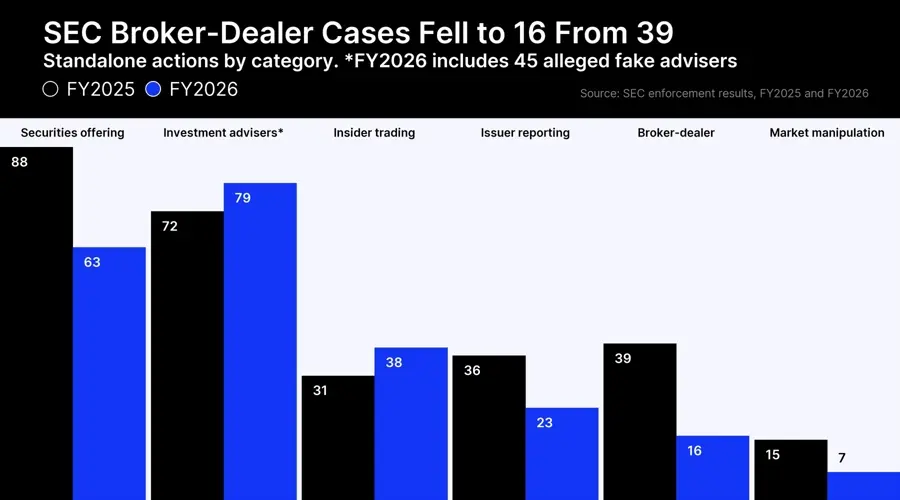
The SEC published its own enforcement data last week, which includes actions against private companies and individuals. The 348 enforcement actions it filed were about half the SEC average of the last decade, and the $1.1 billion in penalties obtained was the least since 2008.
Under the Microscope: The SEC may have to alter its Atkins diet when Democrats take control of Congress next year. Massachusetts Sen. Elizabeth Warren, who is set to chair the upper chamber’s Banking Committee, said she is concerned about a “precipitous drop in SEC enforcement against Wall Street crooks” and that “the new Democratic majority in Congress will closely scrutinize whether the Atkins SEC is protecting the American people.”