California’s most dangerous death row maniacs spared by Gavin Newsom — from child killers to mass murderers


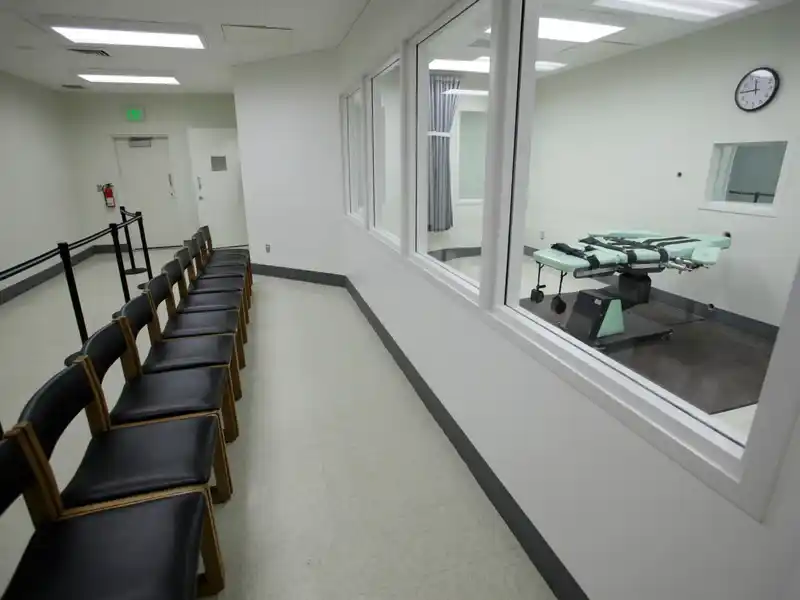
Gov. Gavin Newsom dropped a bombshell move on Thursday to commute all 548 death-row inmates in California.
In his final weeks as governor, Gavin Newsom has made a major change to California’s correctional system — one that will be felt deeply by families of victims across the state.
Newsom dropped news on Thursday that he will be commuting the death sentences of all 548 people on death row across the state. These inmates will now face life in prison.
“I take this action because I firmly believe that state-sanctioned killing is incompatible with California’s values, undermines the foundations of our legal system, and diminishes each of us,” Newsom wrote in a letter to Californians.
Calling the decision one of the “most difficult” of his career, Newsom acknowledged victim families while reinforcing his belief that this is a “righteous action.”
But furious advocates for victims blasted the decision and told The California Post they will challenge it in court.
“He talks about the importance of California values. Where do those California values come into play when we’re talking about the mothers of murdered children, murdered police officers, victims that are school shootings?” said Anne Marie Schubert, a former district attorney who now leads the Criminal Justice Legal Foundation.
With California’s death row housing over a quarter of the nation’s condemned inmates, some of the “worst of the worst” in the United States will no longer face the death penalty.


Some of these heinous killers include Richard Allen Davis — who kidnapped, raped and murdered 12-year-old Polly Klaas in 1993 and is now housed at Avenal State Prison.
Lonnie Franklin, nicknamed the “Grim Sleeper,” killed nine women and one teenage girl in Los Angeles, yet is now believed to have as many as 25 victims. He will now avoid death.
Among these malicious murderers is also Cary Stayner, the former Yosemite motel handyman who murdered four women near the national park in 1999.

Also from the northern half of the state is Joseph Naso, infamously known as the “Alphabet Killer,” who was sentenced to death in 2013 after killing four women with matching initials between 1977 and 1994.
With victims all across California is Wayne Adam Ford, the truck driver sentenced to death in 2006 after killing four women; known for cutting up his victims’ bodies, Ford surrendered to authorities in 1998 with a severed breast in his jacket pocket, according to the Los Angeles Times.
Convicted alongside an accomplice, Charles Ng was accused of killing 11 people at a cabin in the Sierra Nevada foothills during the 1980s. Ng’s prosecution cost California approximately $20 million, at the time the most expensive trial in state history.

The governor said he believes the state “cannot morally kill” these inmates for their horrendous crimes.
“We can now let these offenders die in obscurity while we forever remember and honor the victims,” Newsom wrote.
But advocates said that victims they’ve talked to feel that their blood is boiling.
“This is one man espousing his religious beliefs over the sentence of a jury and a judge, and the will of the voters, as the voters in 2012 and in 2016 voted to keep the death penalty,” said Topo Padilla, president of Crime Victims United.
Padilla said he felt especially upset over the timing of the announcement — right after the midterm elections ended — which made him feel Newsom mass commuted for political reasons.
“What does he politically think this is going to do for him on the national landscape outside of New York and California? I promise you, the balance of this country supports the death penalty as voters,” he said.

Schubert said in the past few days, with news of the potential mass commutation out there, victims’ family members have told her they’re dealing with anxiety and stress reliving events from decades ago.
“Some of them are losing sleep. It all floods back the memories of their little boy that was kidnapped, horribly sexually assaulted, and stabbed to death,” she told The Post.

Schubert noted that a mass commutation like this has never been done before, calling into question how it conflicts with the normal process of looking at things case by case.
“The practice is to individually look at every one of those cases to determine if there’s an abuse of discretion in giving a commutation,” she said.
“There’s going to be a number of arguments that we will make, but at the end of the day, we are doing this on behalf of crime victims and the rule of law,” she added on her organization’s anticipated legal challenge to the commutations.
California Post News: Facebook, Instagram, TikTok, X, YouTube, WhatsApp, LinkedIn
California Post SportsFacebook, Instagram, TikTok, YouTube, X
California Post Opinion
California Post Newsletters: Sign up here!
California Post App: Download here!
Home delivery: Sign up here!
Page Six Hollywood: Sign up here!
Surviving relatives of victims before Thursday were already pleading for the governor to not go through with it.
In 1996, Robert Boyd Rhoades, then 43 years old, kidnapped, sexually assaulted, tortured and stabbed Michael Friend to death. Rhoades was sentenced to death in 1999.
“The justice system asks families to trust the process, but changing the rules decades later shatters that trust completely,” Michael’s mother, Sandy Friend, said.
Related Articles
- General News
Dozens of child killers spared by Gov. Gavin Newsom’s mass commutation
- World News
California governor commutes sentences of more than 500 people on death row
- General News
Gov. Gavin Newsom reveals the moment he decided to spare all of California’s 548 death row inmates
- Politics News
California prosecutors slam Newsom's death row commutations, accuse governor of putting 'politics over people'
- Politics News
Newsom’s death row commutations spark DA revolt; prosecutors warn of legal fight