Would Be a Worrisome Sign for the Bond Market if Treasury Yields Turn Higher Next Week


Next week is loaded for the bond market: Two key inflation reports and the 10-year & 30-year Treasury auctions.
Next week is loaded for the bond market: Two key inflation reports and the 10-year & 30-year Treasury auctions.
On Friday, the day of the strong jobs report, Treasury prices fell, and yields rose. The Treasury market had been rallying for a month through Thursday, and yields fell substantially over that month (when bond prices rise, yields fall).
The recent high in yields occurred around the 10-year and 30-year Treasury auctions in early October. In the secondary market, the 10-year yield had closed at a high of 5.31% on October 5. At the October 7 auction, 10-year Treasury notes were sold at a yield of 5.30%, the highest auction yield since November 2000. The 30-year Treasury yield closed at 5.71% on October 7, and the next day, 30-year Treasury bonds were sold at a yield of 5.618%, the highest auction yield since August 2000, but already down by 10 basis points from the close the day before.
The market breathed a sigh of relief that Treasuries weren’t going to heck in a straight line, or whatever, and that was the beginning of the Treasury rally.
Short-term Treasury yields didn’t budge much over that month. The action was at the longer end of the yield curve.
Declines in yields from October 5 through Friday’s close (yields rose on Friday, so the declines were bigger through Thursday):
- 2-year yield: -33 basis points.
- 3-year yield: -38 basis points.
- 5-year yield: -42 basis points.
- 7-year yield: -45 basis points.
- 10-year yield: -45 basis points.
- 20-year yield: -41 basis points.
- 30-year yield: -40 basis points.
But how much of a rally (decline in yields) is this compared to prior periods?
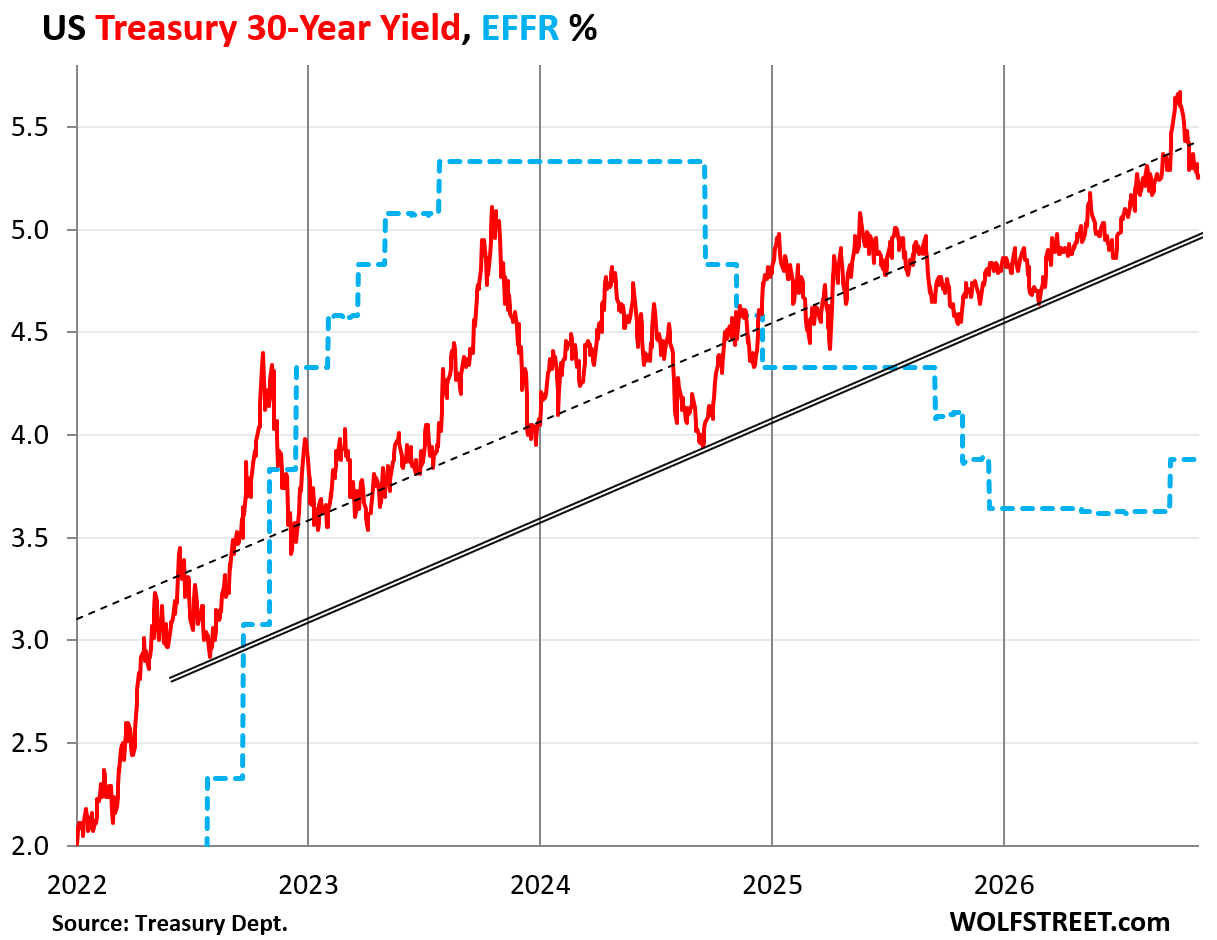
The 30-year Treasury yield dropped by 40 basis points through Thursday and ticked up 1 basis point on Friday, to close at 5.26%.
This has become my favorite 30-year Treasury chart. I’ve shown it for quite a while. Every single rally since 2023 was defeated by the black double-line or before it even got there, and yields then bounced back as prices fell back again. Some day in the future, the yield will break through that line substantially enough. But that hasn’t happened yet. The current rally (yield -40 basis points) would have to push the yield below 5%, so a drop of another 30 basis points or so to get the yield to break through the double-line.
The dotted black line shows the trend, calculated from the yields in the time frame of the chart going back to 2022.
Prior rallies during which yields fell a lot more:
- Late 2022 (-100 basis points)
- Late 2023 (-114 basis points)
- Mid-2024 (-86 basis points)
- Early 2025 (-58 basis points)
- Mid-2025 (-53 basis points).
So the market was due for a big rally, and so far, the rally hasn’t been that big.
If the rally ends here with a 40-basis-point drop, and yields turn higher from here, that would be another worrisome sign for the bond market, because it would show that it can’t even get a decent rally together.
The dotted blue line represents the Effective Federal Funds Rate, which the Fed targets with its short-term policy rates.
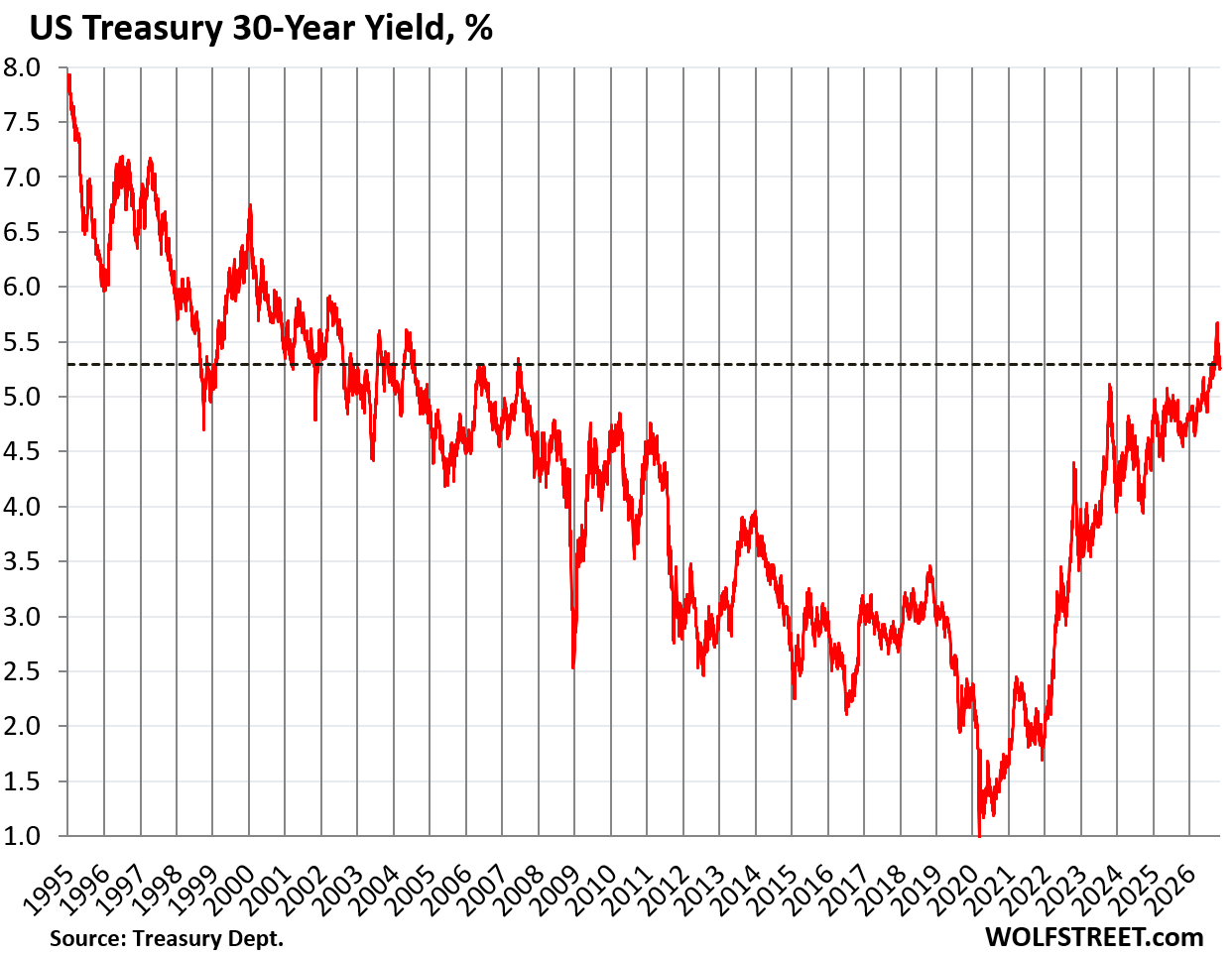
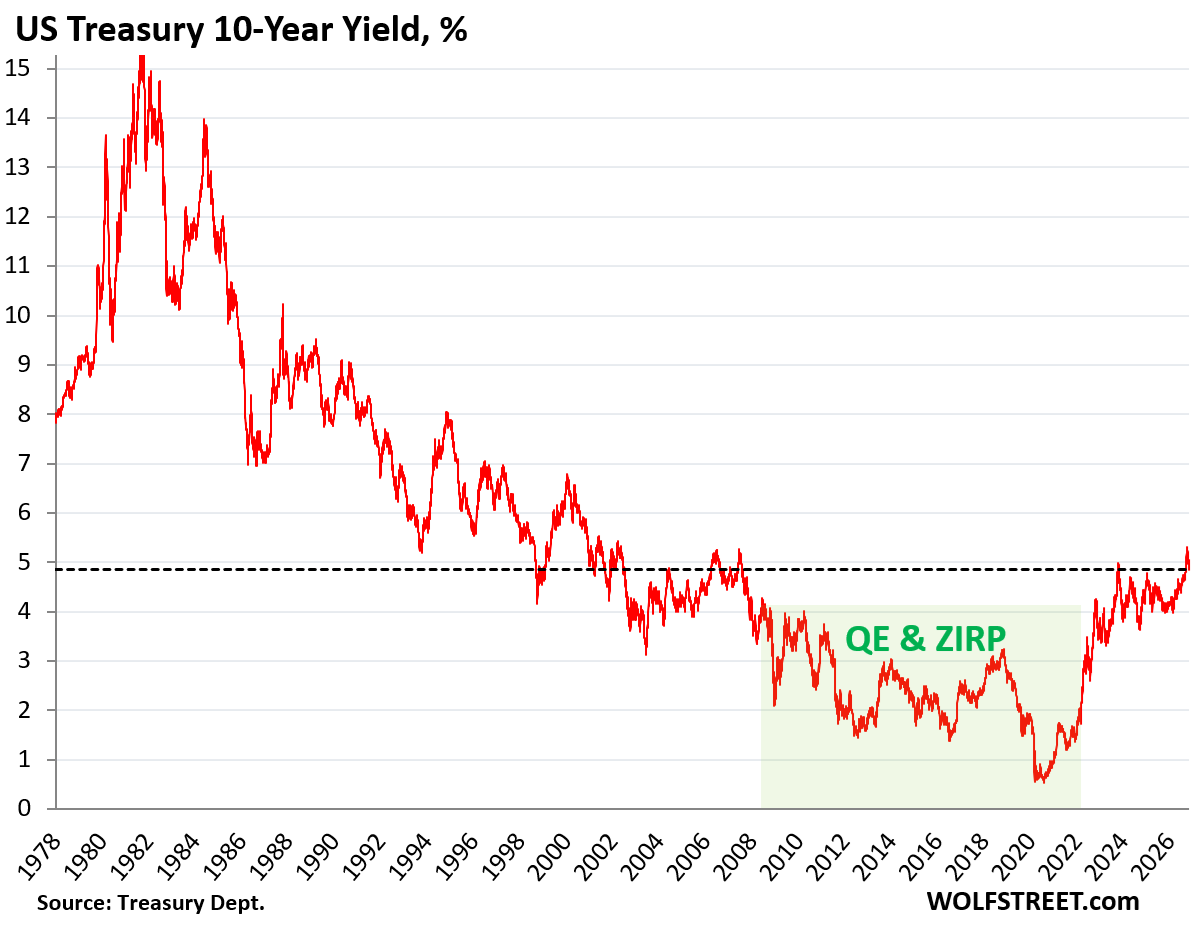
The long-term context shows just how puny that current rally has been so far. The 40-basis-point decline barely registers amid many massive drops. If the rally ends here and yields bounce higher, it would be a bad sign for the bond market pointing at the possibility of a significant selloff, and yields starting the next phase higher.
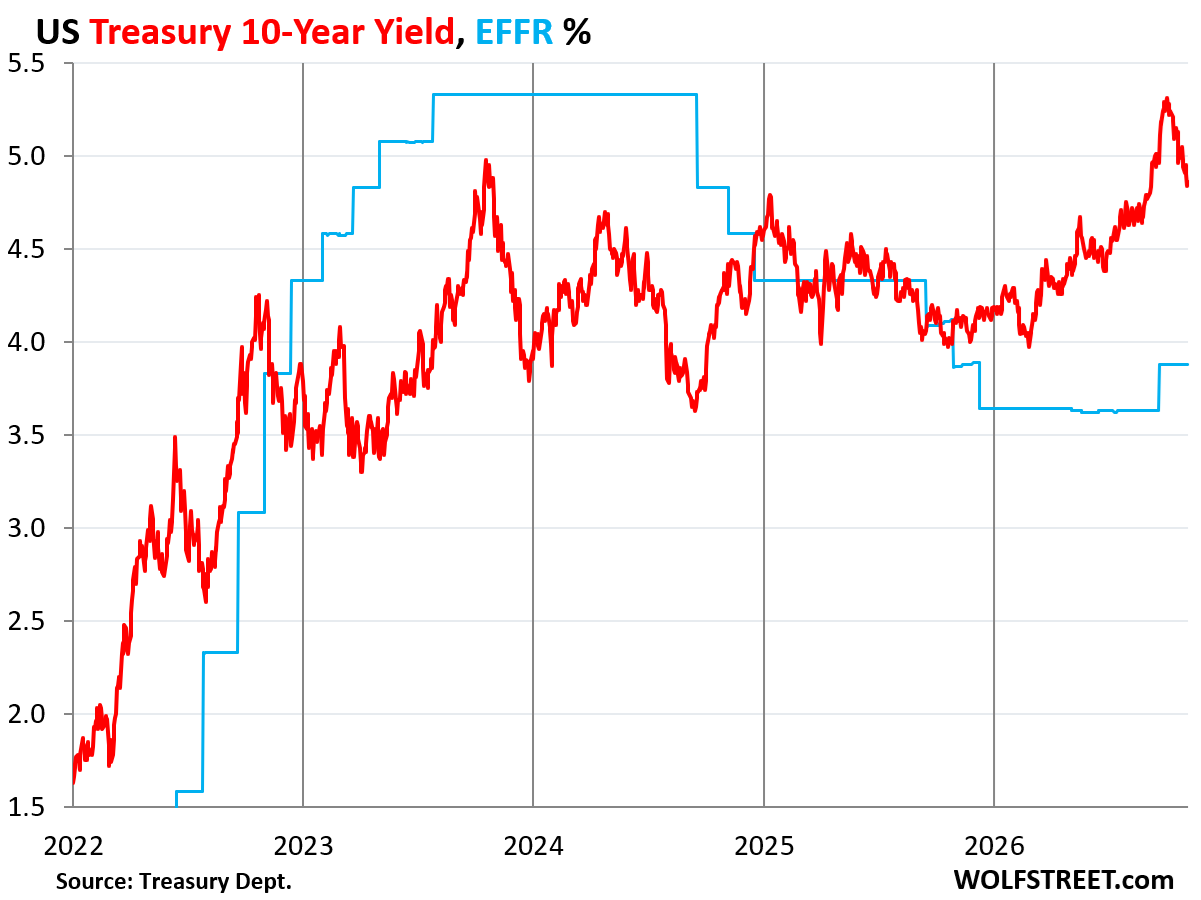
The 10-year Treasury yield shows a similar picture of a relatively small rally, with the yield dropping by 45 basis points through Friday at the close – after ticking up 2 basis points on Friday.
Every year from 2022 through 2025 had bigger drops in yields, including a 121-basis-point drop in late 2023 and a 105-basis-point drop in mid-2024. And those yield declines were, with hindsight, just relief rallies in the years-long selloff. The 10-year yield would have to drop by another 60 basis points to be in their category.
It could do that. And theoretically, it should do that, as it had done before, because the really hasn’t been big enough yet for a relief rally.
But if it doesn’t, if the 10-year yield heads higher from here, that would be another bad sign for the bond market.
On the long-term chart, the 40-basis-poiont decline of the yield barely registers amid huge declines.
Next week is loaded for the bond market.
Two big inflation reports get thrown into this mix next week: On Tuesday, November 10, the Consumer Price Index for October (consumer-facing inflation), and on Friday, November 13, the Producer Price Index (business-facing inflation). And they could move Treasury yields in either direction.
Higher inflation than expected would add to the stronger-than-expected jobs report that was released on Friday and caused yields to turn around and rise on Friday.
For long-term Treasuries, hot inflation is a scourge because it whittles away at the purchasing power year after year, and yields need to be high enough to compensate for the loss of purchasing power, plus some.
According to FactSet’s average of the economists it polled, the month-to-month inflation readings should be cooler than the hot readings in August and September: +0.24% month-to-month for the all-items CPI and +0.2% for the Core CPI.
But there is a wrinkle. The Bureau of Labor Statistics will not publish a year-over-year increase since there was no CPI reading in October last year due to the government shutdown, and so there will not be a base for the year-over-year calculation. The annual all-items CPI in October rose by 3.7%.
Three longer-term Treasury auctions will also take place next week: The 3-year note auction on Monday, the 10-year note auction on Tuesday a few hours after the CPI release, and the 30-year bond auction on Thursday.
So next week could turn out to be the crucial moment when the bond market decides that this rally was good enough, and the selloff starts all over again; or that the rally would go on for a while longer.
Not appetizing at this yield. Long-term yields have fallen back into the range where this observer (and buyer at the 10-year and 20-year auctions in October) finds them unappetizing and will not be nibbling at the auctions.
Related Articles
- Forex News
Treasury Market Gets to Breathe: AI Companies Front-Loaded Debt Sales and, Loaded with Massive Cash to Spend, Step Back from the Bond Market
- Stock Markets News
Bond market tensions ease but Treasury yields near 5% and France's debt risks keep investors on edge
- General News
The Stock Market May Face Another Liquidity Test as Treasury Borrowing Surges
- Stock Markets News
Bond investors are thinking less about the Fed and more about AI, deficits
- Forex News
U.S. Treasuries fall as blowout payrolls lift yields across the curve