UK Regulator Misses Its Own Targets on Nearly Half of Retail Investment License Bids
The Financial Conduct Authority (FCA) met its own service standards on only 54.5% of consumer investment applications, against 92.0% across all sectors, an FM Intelligence analysis published today (Wednesday) shows. The median case took 285 days....
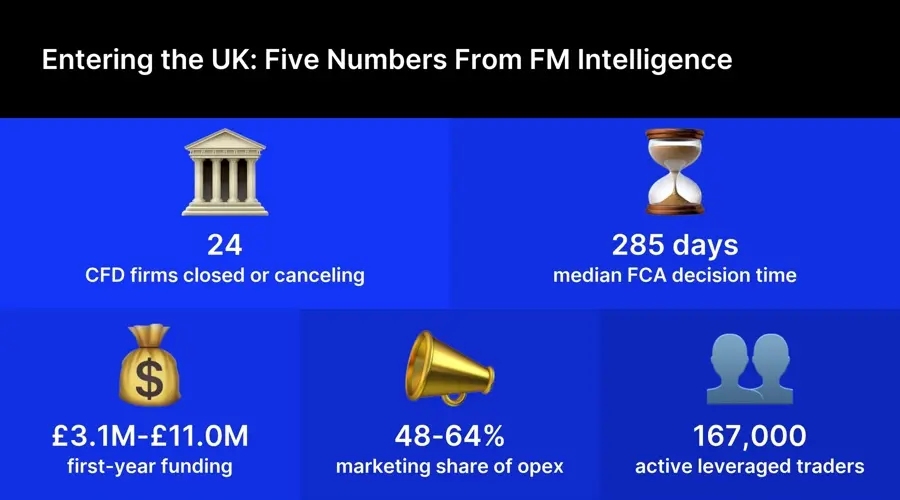
The Financial Conduct Authority (FCA) met its own service standards on only 54.5% of consumer investment applications, against 92.0% across all sectors, an FM Intelligence analysis published today (Wednesday) shows. The median case took 285 days.
The figures cover April to June 2026. Consumer investment is the FCA category closest to a new retail CFD broker, so that wait sets the start date for any firm entering Britain.
The FCA aims to decide 95% of cases within four months, or 10 if incomplete, against legal limits of six and 12. HM Treasury said in May 2026 it would cut the legal limits to match, though the legislation is not yet in force.
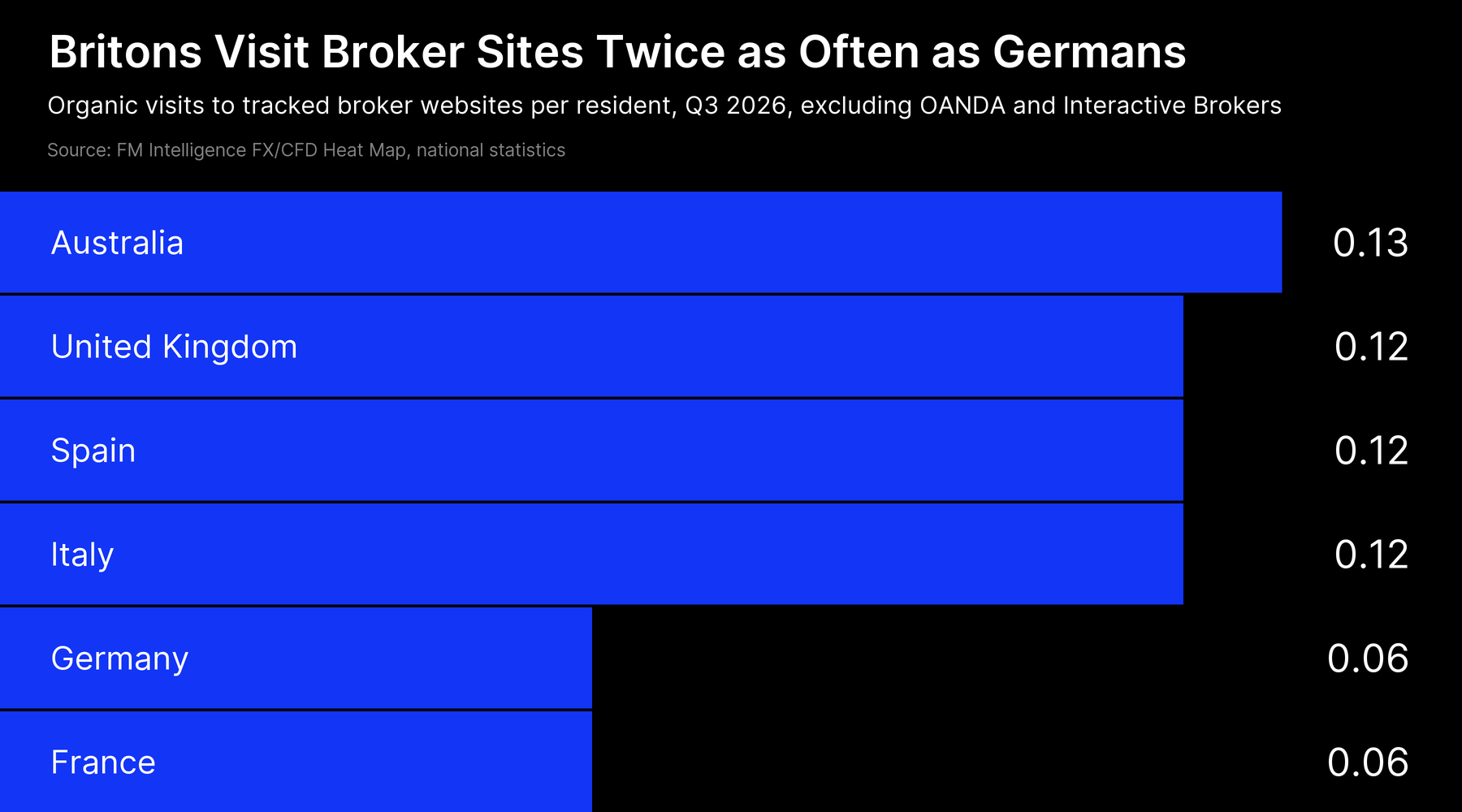
The market at the end of the wait is still large. The UK drew 13.9 million organic visits to broker websites in Q3 2026, more than any other European country, according to FM Intelligence's FX/CFD Heat Map.
Britons visited tracked broker sites about twice as often per person as Germans, the Featured Country: United Kingdom analysis finds.
London's trading industry is coming home!
Nine Months for a Typical Case
A quarter of consumer investment cases took more than 344 days, the regulator's service metrics show. Across all 287 new-firm cases closed in the quarter, the median was 131 days.
The wait carries a payroll, because an applicant has to show its senior managers and systems before approval. FM Intelligence's scenario keeps three to five key staff on the books for six to 10 months before launch, at £0.24 million (about $0.32 million) to £0.70 million.
Twenty-Four Firms Lost the FCA Halo
Buying a dormant UK firm is no shortcut. In December 2024 the FCA said about 20% of firms in its CFD portfolio did little or no business and served as "halo" entities for offshore groups. It said a change in control of such a firm would get the same scrutiny as a new application.
The same letter said none of the 100 CFD firms from the European Economic Area (EEA) that entered the post-Brexit temporary permissions regime in January 2021 had obtained full authorization.
On September 25, 2026, the regulator said 21 such firms had closed since 2025 and three more were canceling their permissions. It opened enforcement investigations in the two most serious cases and named none of the firms.
The 24 equal about a third of the 74 firms that held permission to sell CFDs to retail clients on December 1, 2025. The FCA did not say how many had retail permissions.
Some firms buy clients instead. Trade Nation agreed on October 6 to take over FXCM's UK client book, a deal for customers rather than for a license.
Marketing Is the Largest Cost
FM Intelligence puts first-year funding for a new UK broker at £3.1 million to £11.0 million before regulatory capital. The range compares a 10-person firm on coworking desks with a 15-person firm in a City office, and it is a planning scenario, not a quote.
Marketing makes up 48% to 64% of those first-year operating costs, including VAT. Plus500 and IG spent roughly £960 to £1,050 per new client in 2025.
The pool those budgets chase is smaller than it was. Investment Trends counted about 167,000 active UK leveraged traders in 2025, down from a peak of about 275,000 in 2021. The Heat Map tracks attention, not accounts, and does not cover IG or Spreadex.
The full FM Intelligence analysis sets out how many active clients a newcomer needs to cover its first-year costs, how IG's UK revenue splits between leveraged traders and investors, and the tax, staffing and capital lines behind the range.