The US Labor Market Confounds with its Countercurrents. It May Be the New Normal Labor Market

The Fed has also struggled in dealing with this labor market.
On one side, there are the tech layoff announcements, often to clean up what tech CEOs widely called “over-hiring” to describe what they’d done in 2020-2022, when their payrolls exploded; Block CEO Jack Dorsey was the latest on X, “yes we over-hired during covid…,” after Block announced that it would lay off nearly half its staff, which had more than tripled in 2020-2022 (from 3,900 to 12,500).
At the same time, there is helter-skelter hiring for AI-related jobs with huge compensation offers leading to what’s locally called a “mansion shortage” in AI epicenter San Francisco.
And there is very tepid hiring in other parts of the private sector, accompanied by massive layoffs at the federal government, and job reductions at state governments.
These currents come amid a crackdown on illegal immigration and the tightening up of some legal immigration that have led to a drop in the total supply of labor.
This is not a labor market the US is used to. It’s a labor market of low unemployment despite low job creation in the private sector and job destruction at the federal government.
Job creation in the private sector is low because there is less demand for labor in some industries, including because AI is being deployed to do things that college graduates entering the labor market would have done, making this job market very difficult to enter for recent graduates.
And job creation is also low because of labor shortages in other industries, such as skilled labor in the trades, including those needed in construction, which has started a whole discussion of how it would have been better for some young people, instead of going to college and loading up on student loans, to go to trade school and then train to be auto technicians or electricians or HVAC technicians or carpenters or welders.
The latest piece of the puzzle in these countercurrents: The four-week average of initial applications for unemployment insurance benefits in the week through Saturday ticked down to 210,500, according to the Labor Department today.
There were only a few weeks in the decades from the 1970s till the pandemic when the four-week average was even lower.
What this shows is that, despite all these announcements, relatively few employees in the US are actually getting laid off without already having another job in the same company or elsewhere lined up:
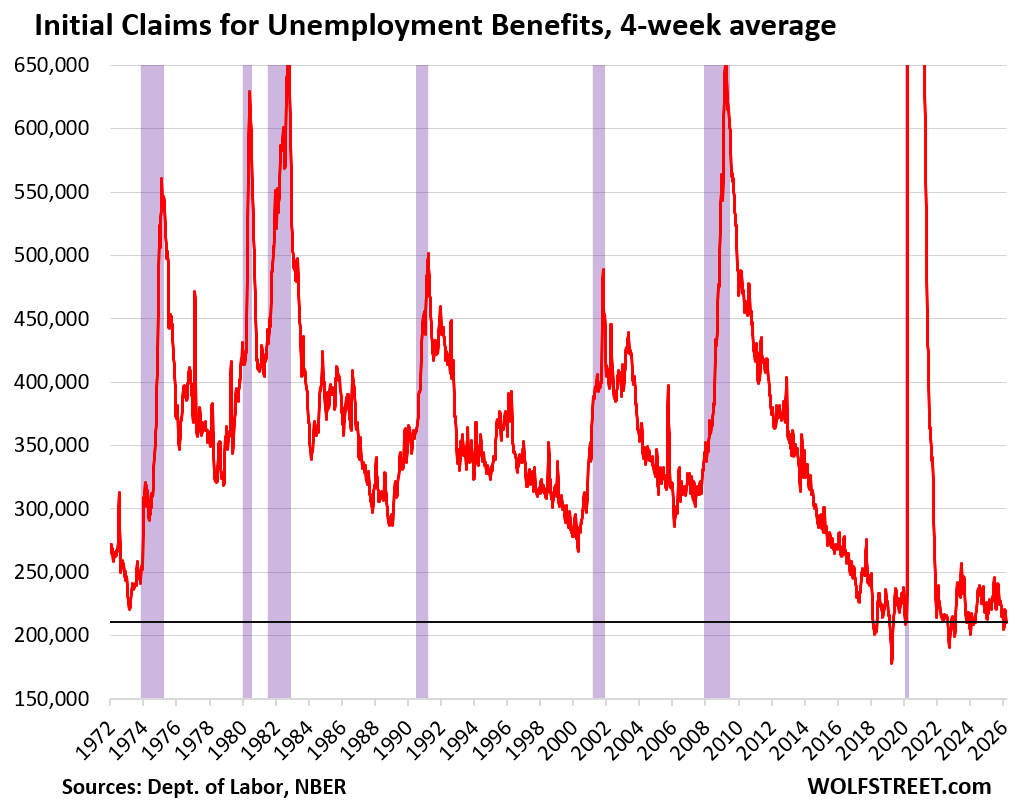
These historically low figures track freshly discharged people who filed for unemployment insurance compensation at their state unemployment agencies. The agencies then report them to the US Department of Labor by the weekly deadline, which then publishes it. This is not survey-based.
And here is another piece of the puzzle: The four-week average of continued weekly claims for unemployment insurance benefits fell to 1.847 million, according to the Labor Department today.
Over the past five decades, it’s only during the tight labor market in 2018 and 2019 and in the years of the labor shortages in 2022 through early 2023, that the level was ever lower.
This reflects the total number of people who’d initially applied for unemployment insurance at least a week earlier and are still claiming unemployment insurance because they still haven’t found a job.
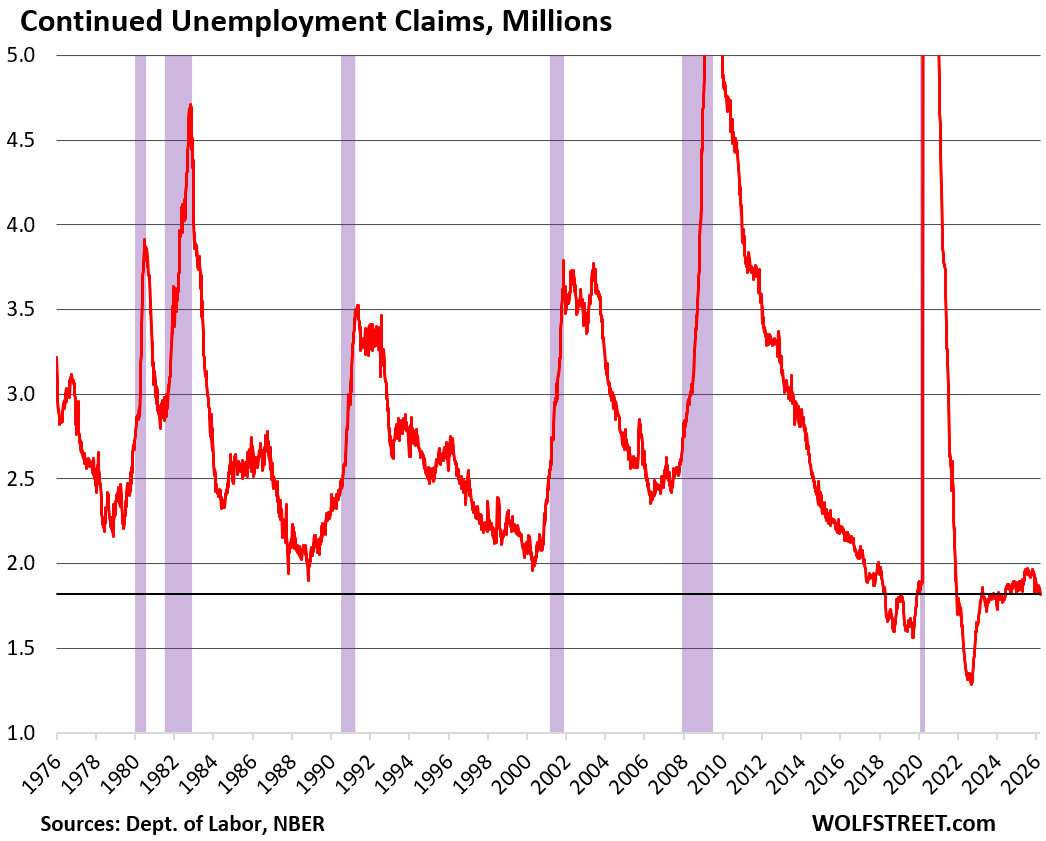
It shows that overall, private-sector employers are hanging on to their workers despite some global layoff announcements at some big companies, though these announced layoffs don’t all happen in the US, and some don’t lead to actual layoffs, but elimination of “roles” with workers shifting to different jobs in the same company. And some of these layoffs hit remote jobs, while workers for in-office jobs are getting hired.
The convoluted strength of this labor market amid the crackdown on illegal immigration and the drop in the supply of labor shows up in the prime-age labor force participation rate (25-to-54-year-olds), which has been running at 25-year highs, lower only than during the extraordinary period of the Dotcom Bubble (data via the BLS on March 6).
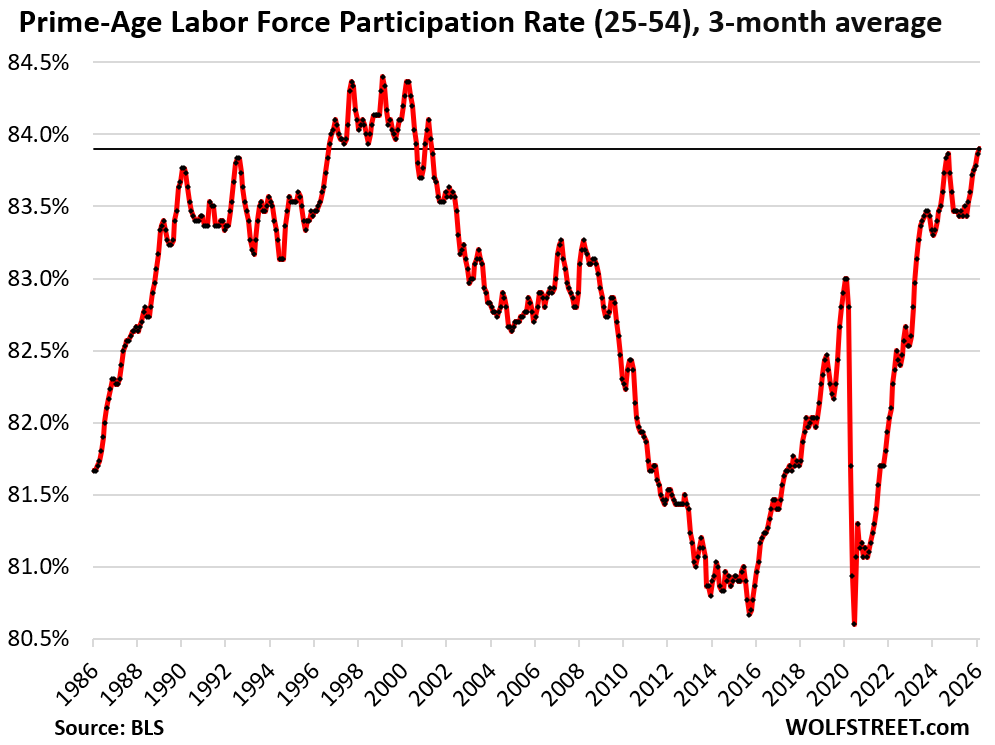
The prime-age labor force participation rate eliminates the issue of the retiring boomers. The overall labor force participation rate shows the percentage of the population that either has a job or is looking for a job. When people retire, they’re no longer “participating” in the labor force but remain in the population until they die. The surge of boomer retirements, which started about 15 years ago, has pushed down the overall labor force participation rate, as these retired boomers are still in the population but no longer “participating” in the labor force.
The Fed has also struggled in dealing with this labor market. And Powell expressed those struggles during the last FOMC press conference. It’s not a weak labor market in the typical US sense with big layoffs and a rise in unemployment; and it’s not a strong labor market in the typical US sense with lots of job creation either. But it may be the new normal labor market.