Tech, Science, Social Media Jobs in San Francisco & Silicon Valley Plunge to 2019 Level: AI Magic-Money Boom Is Paper Thin

The local economy and housing market have become immensely dependent on unsustainable AI magic-money.
San Francisco is the epicenter of the AI boom. OpenAI and Anthropic, both headquartered in the City, have hired aggressively and rewarded their employees with huge salaries and stock compensation packages whose values have been rocketing to the moon. Anthropic is targeting a $2 trillion valuation for its IPO, and OpenAI is targeting a valuation in the $1.2-1.5 trillion range. In terms of hiring, those two are just the tip of the AI iceberg. Countless smaller AI-related companies have piled into AI related activities, and hiring in the AI sector overall has been brisk. But the AI-related hiring in terms of total payrolls is small.
For the rest of the payrolls in tech and engineering, in other professional services, and in finance, the situation has resembled that of a continued bloodbath.
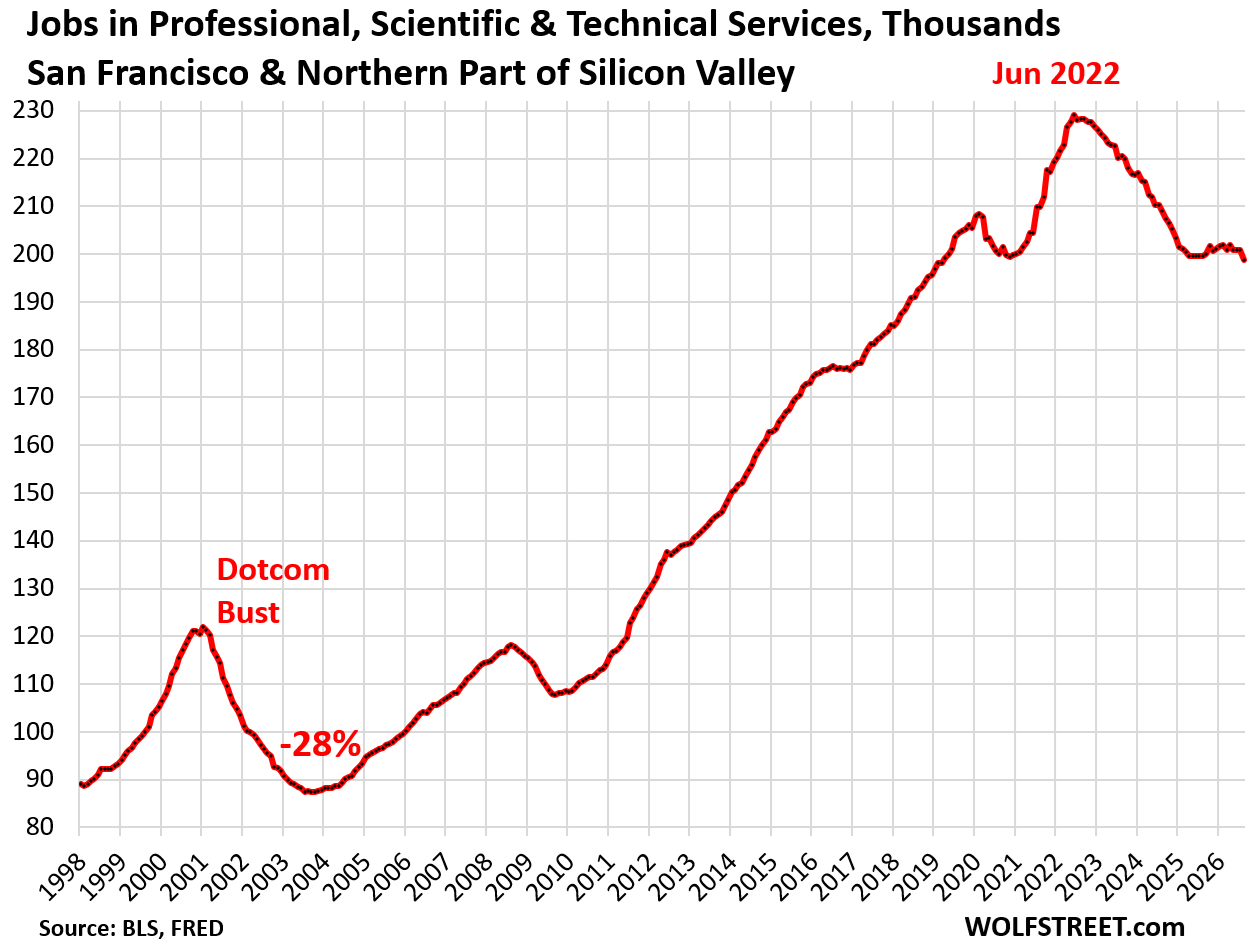
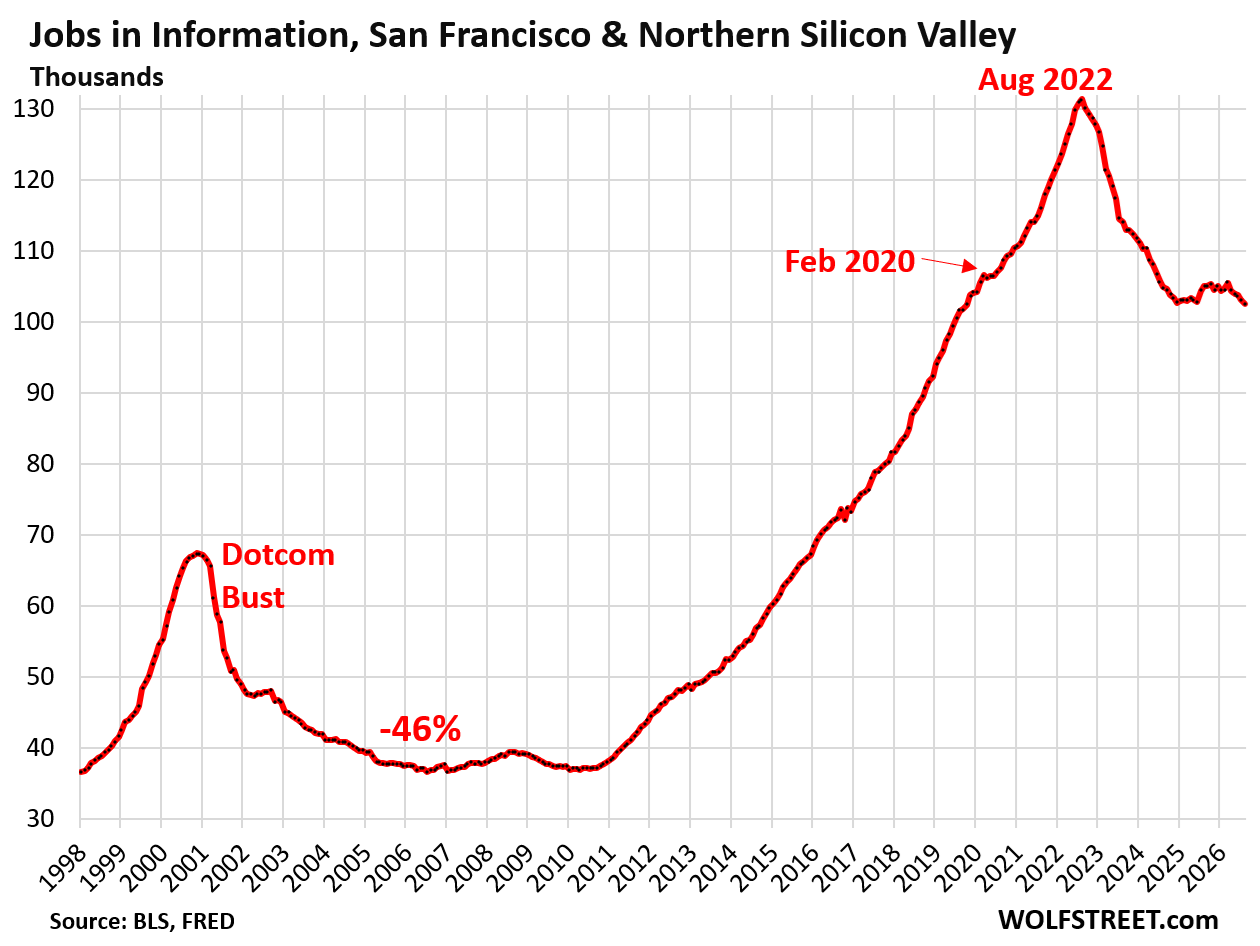
In San Francisco and San Mateo County (northern part of Silicon Valley), massive years-long job losses continued in the categories of “Professional, Scientific & Technical Services” and in “Information,” which is where most of the big tech, social media, and bio tech companies are.
Employment in those sectors had dropped to the lowest since 2019.
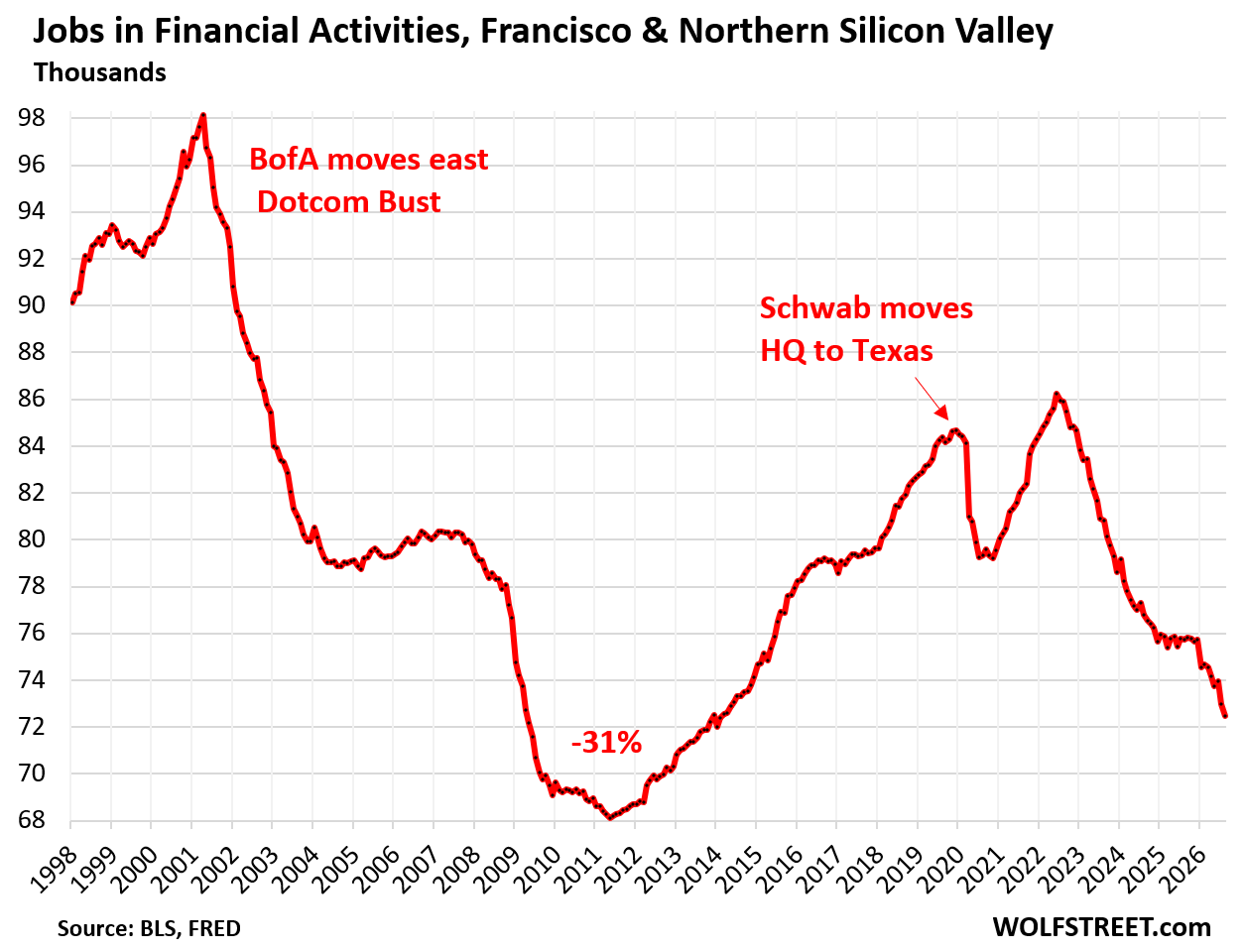
And job losses accelerated in “Financial Activities,” and employment in that sector dropped to the lowest since 2014.
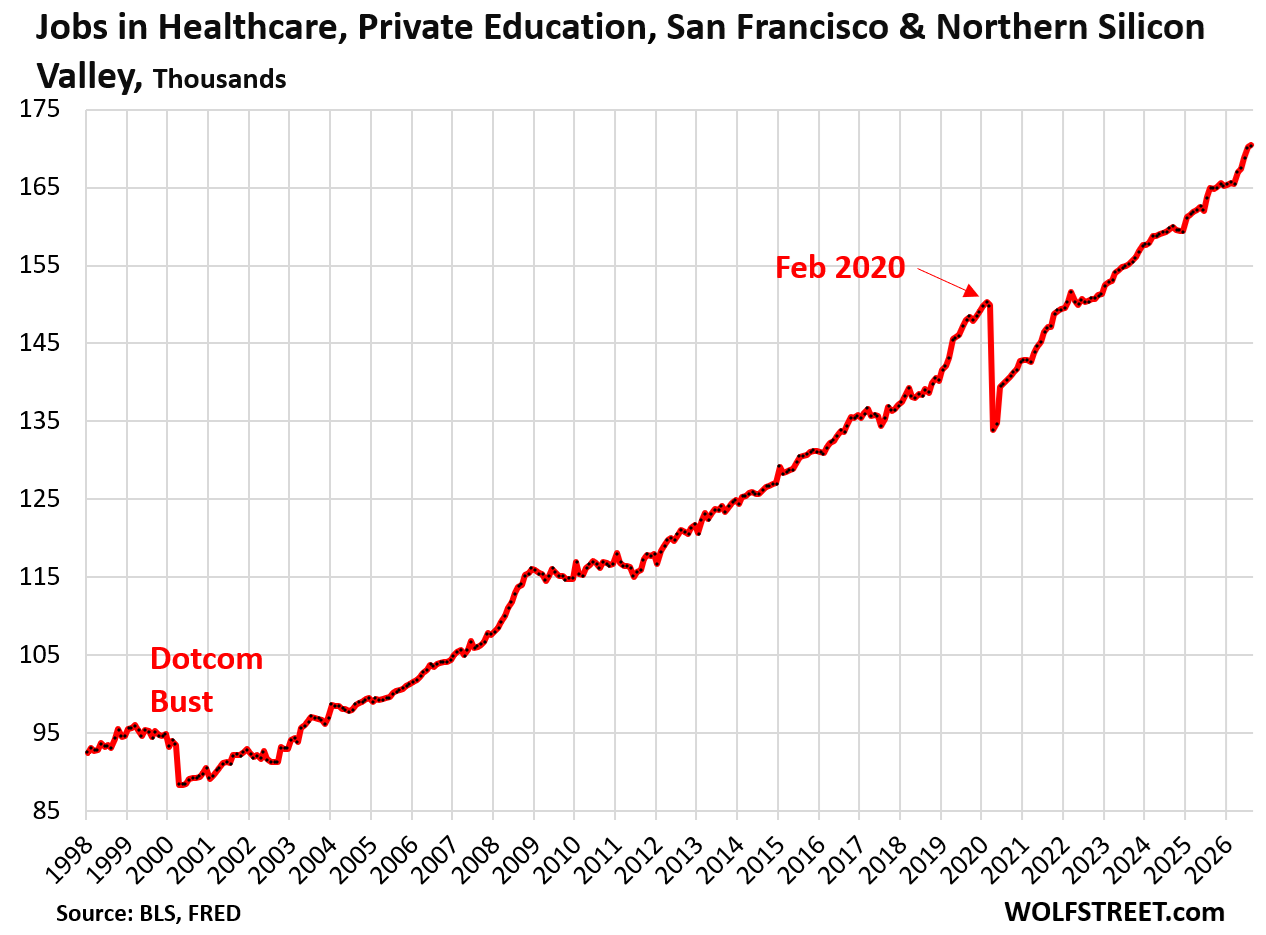
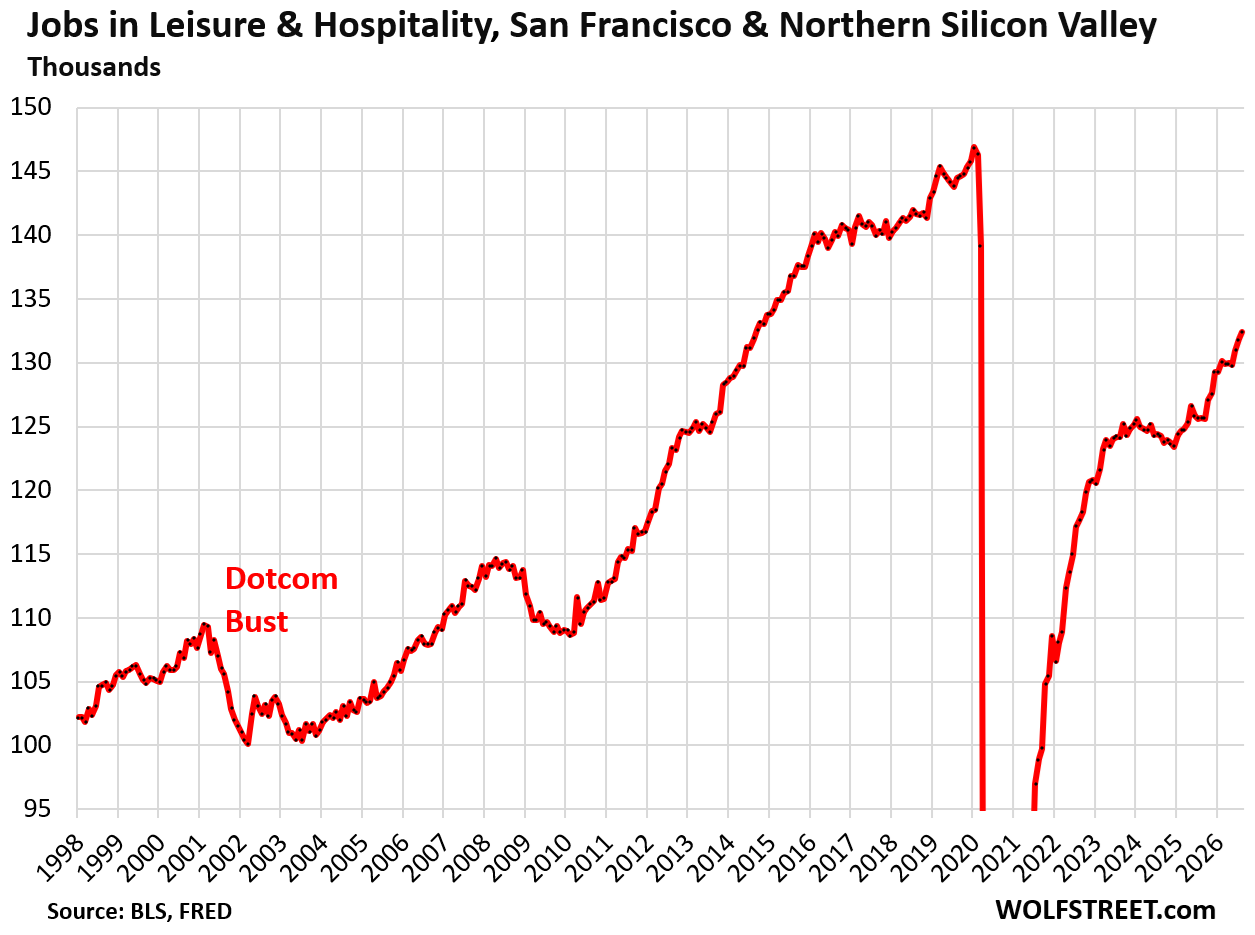
In “Leisure & Hospitality,” payrolls have been rising at a brisk clip, but they’re still far below where they had been before the pandemic. The only major private-sector category where employment has been growing from record to record is in the category of “Healthcare Services and Private Education.”
This is how the booming economy in San Francisco, along with its re-spiking home prices and rents, has become dependent on the newest gold rush, the breathless and ridiculously unsustainable AI-money boom.
The jobs bloodbath amid the AI-money boom.
There is no official industry category for “AI.” Jobs in AI are spread over numerous industries, with a concentration in the huge and broad sector, “Professional, Scientific, and Technical Services” and in the “Information” sector. The general bloodbath in those sectors overpowered the specific AI hiring boom in those sectors.
“Professional, Scientific, and Technical Services” include architectural, engineering, and design services; computer services; consulting services; research services; legal advice and representation; accounting, bookkeeping, and payroll services; advertising services; and many other professional, scientific, and technical services.
Companies in this category in San Francisco and San Mateo County have shed 35,500 jobs since the peak in June 2022, or 13.2% of their employment.
Payrolls in the sector dropped to 198,800 in August, the lowest since March 2019 and below the lockdown lows, according to the Bureau of Labor Statistics.
This sector accounted for 17.6% of all payrolls in the two-county area in August.
During the Dotcom Bust through October 2003, the sector lost 28% of its jobs – it is now roughly halfway there.
This metro-level data on nonfarm payroll jobs from the Establishment Survey was released by the Bureau of Labor Statistics on Friday. These jobs are tracked by business location to which the employee is assigned, regardless of where the employee lives. If a worker commutes 60 miles to an office in San Francisco, it counts as a job in San Francisco. Same with remote employees who are assigned to offices in San Francisco but live far away.
Jobs in “Information” fell to 102,530 in August, the lowest level since October 2019, having undone the entire hiring boom plus some in that industry during the pandemic. That hiring boom had peaked in August 2022.
Since that peak in August 2022, the Information industry has shed 28,900 jobs, or 22% of its total jobs.
During the Dotcom Bust, the Information sector lost 46% of its jobs in San Francisco and San Mateo, beginning in late 2000 and bottoming out in mid-2006 – an industry depression. The job losses now are nearly halfway there.
These jobs are at facilities where people primarily work on web search portals, data processing, data transmission, information services, software publishing, motion picture and sound recording, broadcasting including over the Internet, and telecommunications.
Information still accounted for 9.2% of total payrolls in April. For the US overall, jobs in Information account for only about 2% of total nonfarm payrolls. That’s how tech-heavy employment in the area is, compared to the US overall.
It could be that part of the jobs that got axed in those two sectors were held by remote workers assigned to offices in San Francisco or San Mateo County, but living on a Thai beach. Those job losses wouldn’t be felt in the local economy, though they would show up in the numbers here. But even if there were a meaningful number of those remote jobs that got axed, it would not explain payrolls dropping back to 2019 levels.
“Financial Activities” include finance and insurance, real estate (commercial and residential), and rental, and leasing.
Payrolls in that sector dropped to 72,500 in August, the lowest since January 2014.
Since mid-2022, payrolls have plunged by 13,780 jobs, or by 16%. And they zigzagged down by 26% since the absolute peak in 2001, before Bank of America moved its headquarter to the other side of the country. Schwab moved its HQ from San Francisco to Texas in 2019. Wells Fargo’s corporate HQ is still in San Francisco, but its executive HQ, where all the action is, moved to New York City in 2019.
Where employment is growing:
Jobs in “Healthcare services and private education” have been rising from record to record and rose to 170,400 in August, up by 5,500, or by 3.3%, from a year ago. Over the past two years, the sector has gained 10,680 jobs.
Jobs in “Leisure and hospitality” rose by 5.4% year-over-year and by 6.6% from two years ago, to 132,400. They’ve spiked up from the pandemic lows when local lockdowns crushed this industry, but remain 9.5% below the February 2020 high.
The sector includes Arts, Entertainment, and Recreation; and Accommodation and Food Services.
Total private-sector payrolls edged up by 7,000 jobs year-over-year in August, or 0.7%, with the strength in healthcare services and leisure and hospitality barely making up for the bloodbath in the other sectors.
But since the peak in February 2020, private sector payrolls are still down by 87,600 jobs, or by 8.2%.
During the Dotcom Bust, the area lost 17% of its private-sector payroll jobs, a depression-type decline.
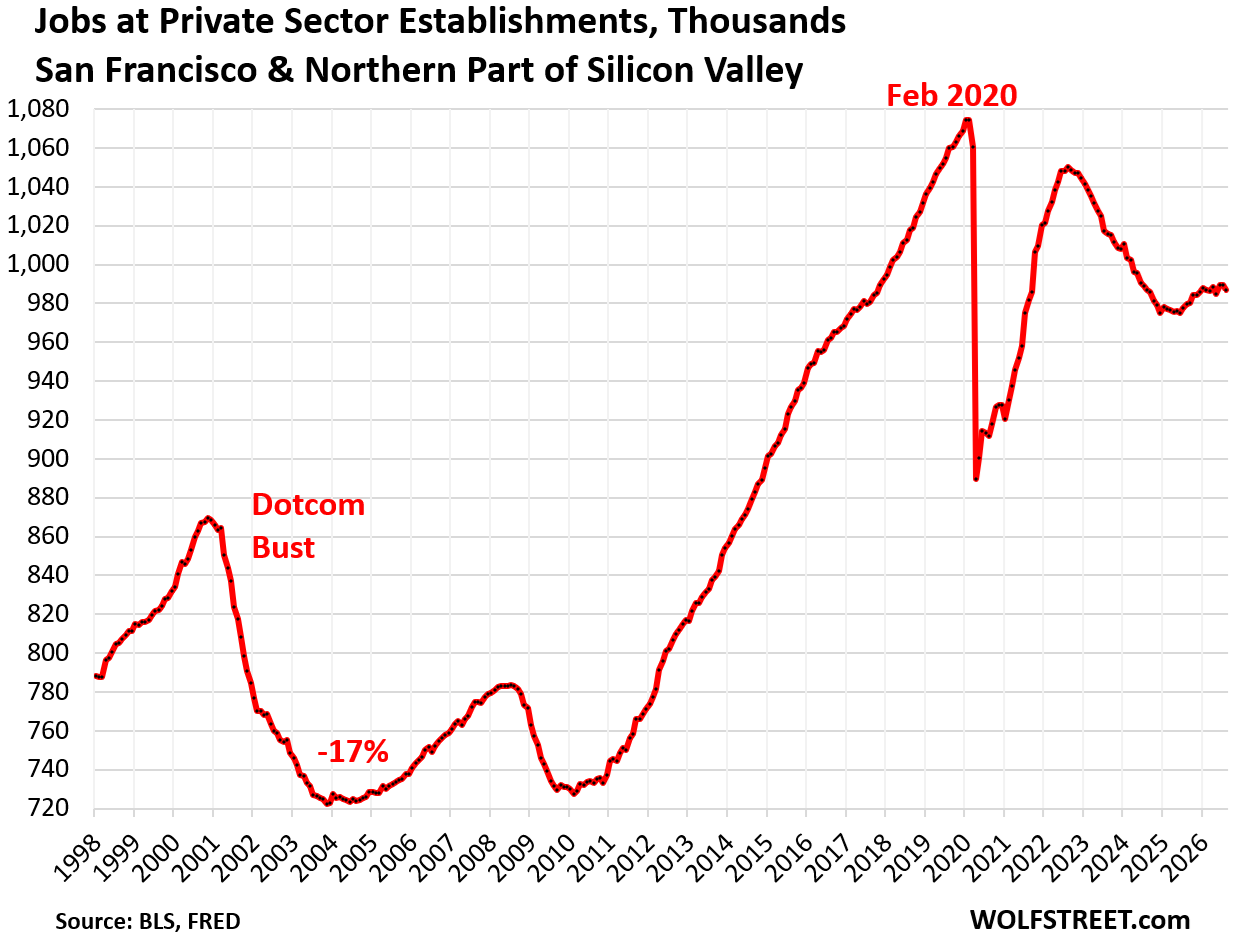
This is how the AI boom, with its huge pay packages and exploding stock-based wealth, but relatively small number of workers, has been papering over the broader tech and finance employment situation in San Francisco and San Mateo County.
The incorporation of AI into everyday-jobs over the years may have accelerated the job losses in “Professional, Scientific, and Technical Services,” “Information,” and “Financial Activities.” At the same time, AI-related activities have created only a relatively small number of jobs, but with huge pay packages and stock-based wealth that the relatively small number of workers are now out there spending.
This is how the economy, including the housing market, in San Francisco and San Mateo County, has become immensely dependent on the ridiculously unsustainable AI money.