Oil Jumps, but It’s Not the 1970s anymore: US Crude Oil Production Hits Record, Net Exports Soar, Imports Decline

The US has become a large exporter of value-added petroleum products, including diesel and gasoline.
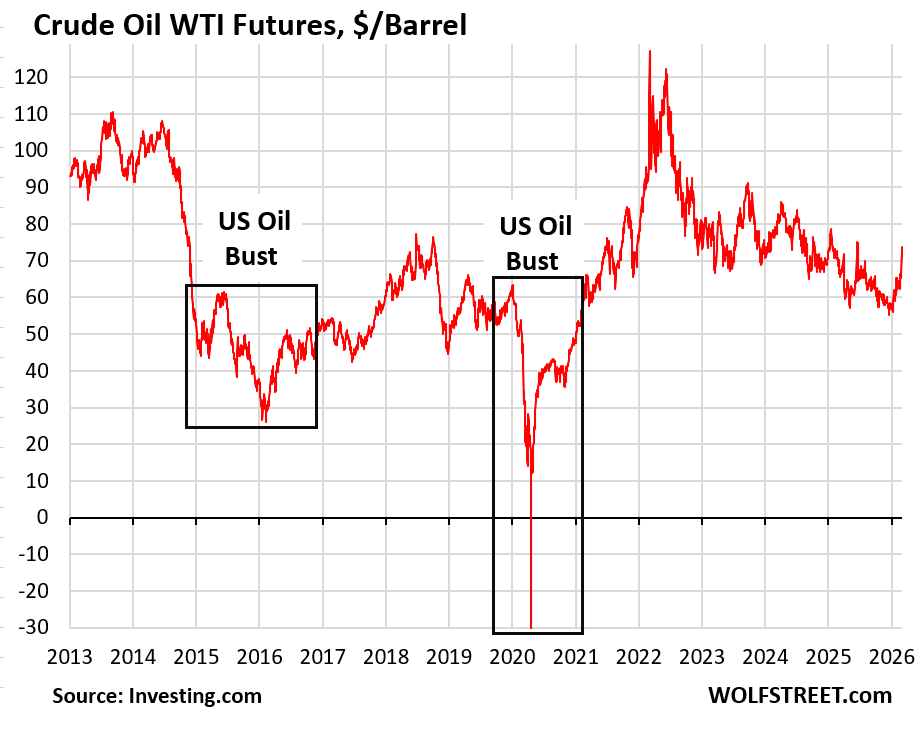
The price of the crude-oil grade West Texas Intermediate (WTI) spiked to $75 per barrel over the weekend following the beginning of the Iran war, and to nearly $78 earlier today, and currently trades just below $73. The last time WTI experienced a spike like that was in June 2025, after the US bombed Iran’s nuclear facilities, before prices replunged.
The #1 worry for US oil and gas drillers is overproduction. Frackers can ramp up production far faster than demand can increase, as has been learned painfully twice since fracking took off. Overproduction by US frackers started pulling the rug out from under prices in mid-2014; WTI crashed from over $100 a barrel to below $30 a barrel by early 2016. During that Oil Bust, many dozens of oil & gas drillers filed for bankruptcy. Then in 2020, it started all over again; overproduction caused the price to collapse, and dozens of oil and gas companies filed for bankruptcy that year. Drill Baby Drill, but not too fast.
“Discipline” in production has since then been the guiding principle of the industry in order to keep the price from collapsing once again. At today’s prices, drillers are now aggressively hedging their future production, according to Bloomberg. This locks in that price, at which fracking is very profitable. And this hedging activity by US producers is also a force that is keeping a lid on the price.
This isn’t the 1970s anymore.
Back in the 1970s, during the two Oil Shocks, the US was dependent on oil imports from OPEC, and OPEC ran the show. Now the US is the largest oil producer in the world and has become a major exporter of crude oil and petroleum products (gasoline, diesel, jet fuel, pet coke, propane, ethane, etc.), exporting substantially more than it imports.
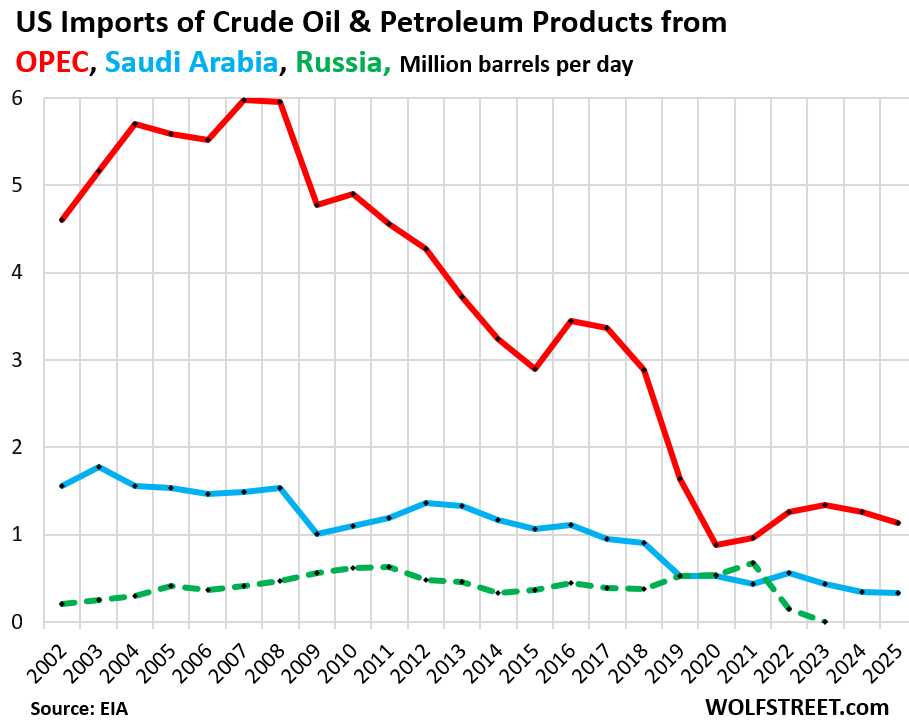
Imports dropped further in 2025, and 57% of those imports came from Canada, and they also dropped. Only 14% came from OPEC.
A big part of the oil trade is to import crude oil, refine it, and export the value-added products, such as gasoline and diesel, a big trade even for California refineries, which are not connected via pipelines to the producing regions east of the Rockies and struggle with declining demand for gasoline in the state. They get California’s production plus import crude oil, and then export diesel, gasoline, and jet fuel, and other petroleum products to Latin America.
Oil & gas is a huge thriving industry in the US, with massive global trade. As a large net exporter of petroleum and petroleum products – exporting more than it imports – it will benefit from those higher energy prices rippling out from the Middle East.
The US is also the largest natural gas producer in the world, and a huge exporter of natural gas, including via pipeline to Mexico and Canada, and has become the largest exporter of LNG in the world. The biggest customer of US LNG in 2025 was by far Europe.
And the US and Canadian energy markets are joined at the hip. The electricity grids are connected, allowing the US to fill in gaps in Canada by selling more electricity to Canada than it imported from Canada as needed recently due to BC Hydro’s issues. The US imports more natural gas from Canada than it exports to Canada, a function of where producing areas, pipelines, and population centers in both countries are. In terms of petroleum imports by the US, Canada is its largest source, providing 57% of total US imports. So this isn’t the 1970s anymore.
Production hit record, despite efforts to not overproduce.
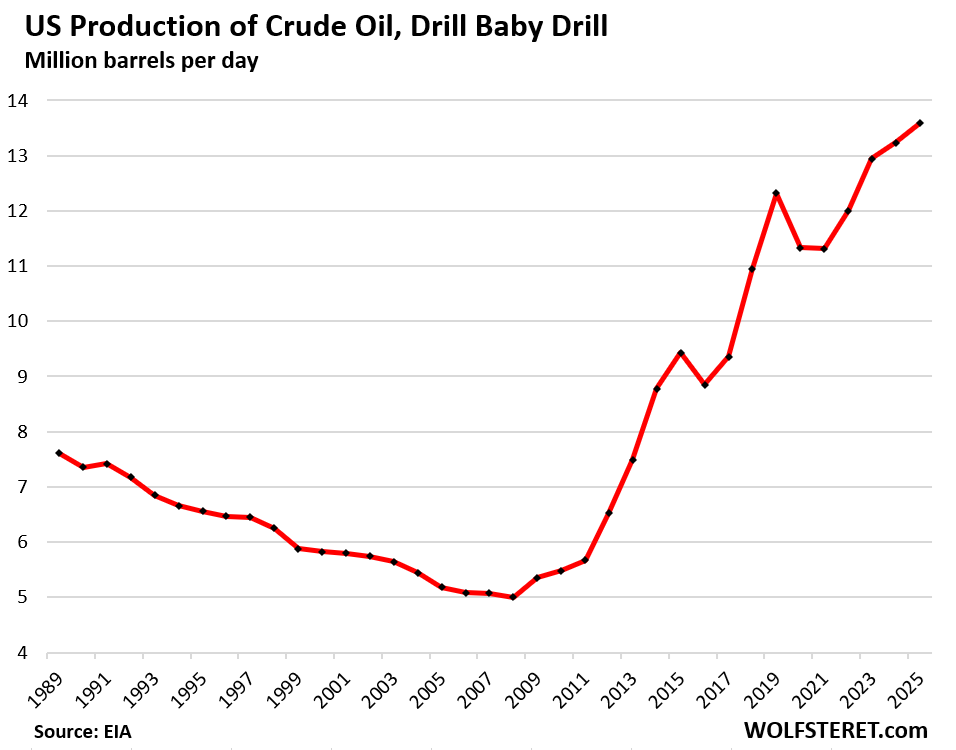
Crude oil production in the US rose by 2.7% in 2025, and by 172% since 2008, to a record 13.6 million barrels per day (MMb/d), according to EIA data.
US oil production rejiggered the global energy dynamics. And for the US economy, it created the advantages of relatively cheap and reliable energy for transportation and commercial uses, and as feedstock for the vast US petrochemical industry.
The two kinks in the chart in 2016 and then again in 2020-2021 were the results of Oil Bust 1 and Oil Bust 2 when overproduction caused the price of US crude oil to collapse. Oil-and-gas drillers filed for bankruptcy in two big waves, which reduced production, which allowed the price to rise again into a survivable range.
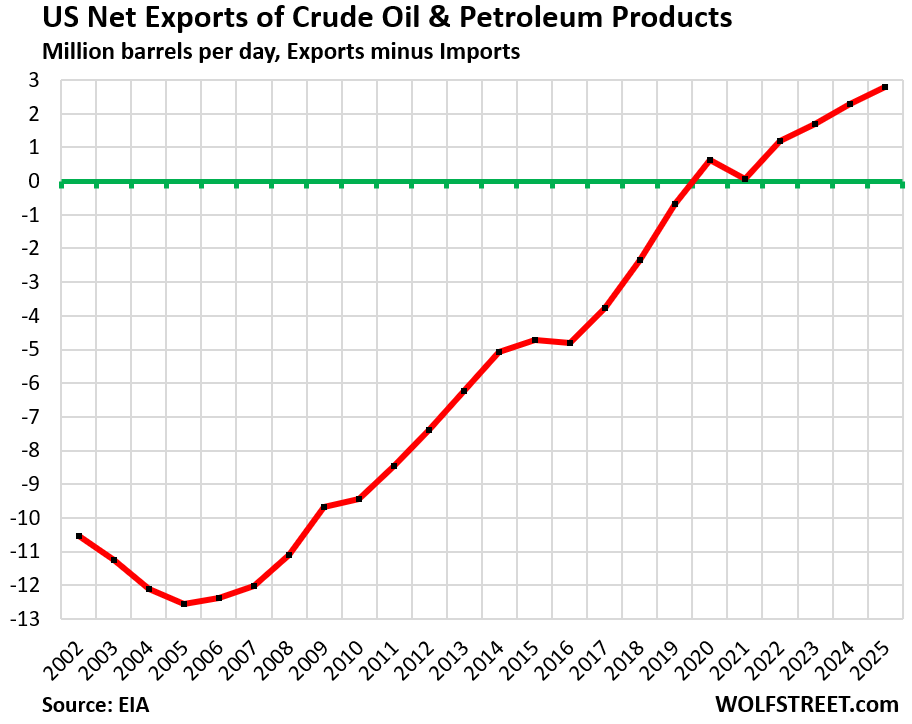
Net exports (exports minus imports) surge.
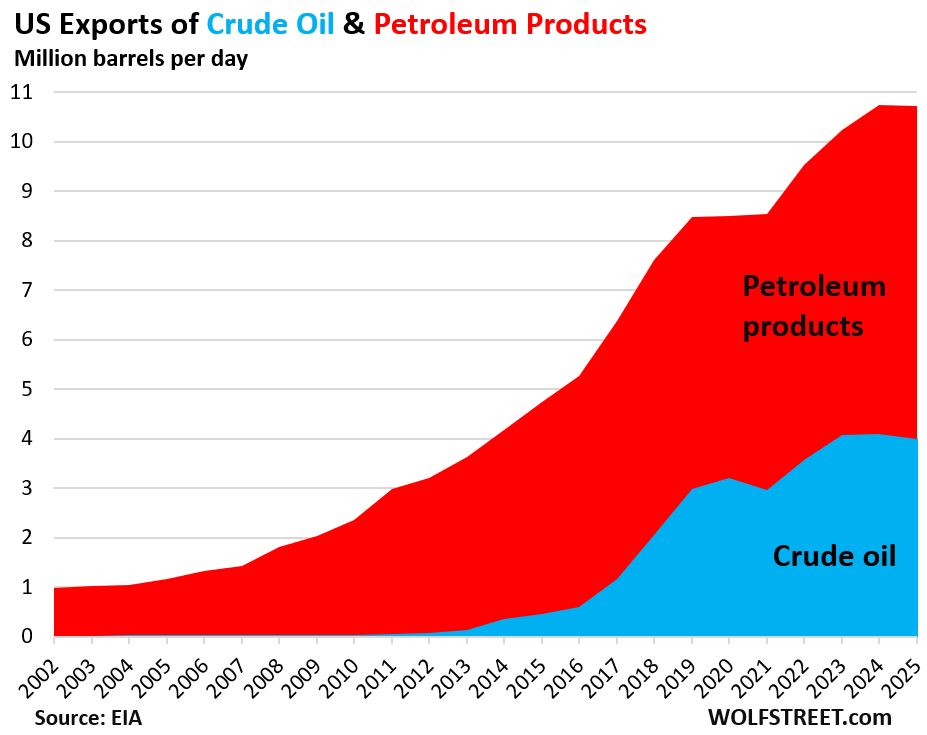
Exports of crude oil and petroleum products were roughly stable in 2025 at 10.7 MMb/d and up by 495% from 2008 (red line in the chart below).
Imports declined to 7.9 MMb/d, far below the levels in the prior decades, which had peaked at nearly 13.7 MMb/d in 2005 (blue line).
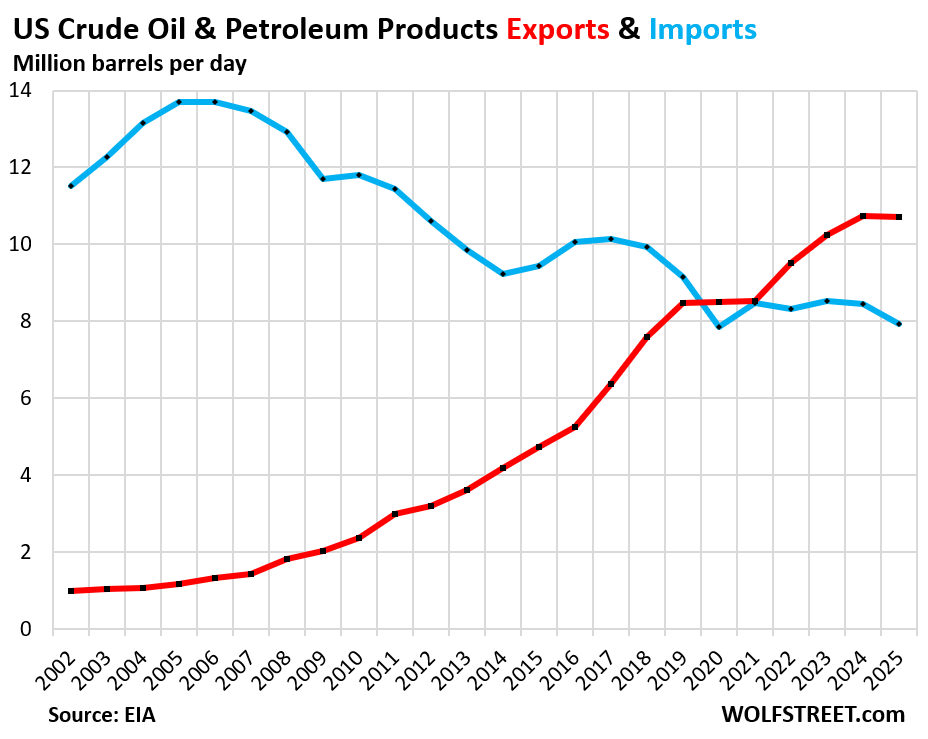
In 2020, when the red line in the chart above surpassed the blue line for the first time, the US became a net exporter of crude oil and petroleum products, exporting more than importing.
In 2025, net exports of crude oil and petroleum products rose to a record 2.8 MMb/d. In 2005, before fracking took off, the US had a deficit in net exports of 12.6 MMb/d. This is how US oil production rejiggered the global energy dynamics.
Exports of petroleum products.
Exports of petroleum products rose by 1.4% to 6.73 MMb/d, accounting for 63% of total exports. This includes 2.8 MMb/d of finished motor gasoline, distillate (such as diesel), and jet fuel.
Exports of crude oil declined by 2.9% in 2025, to 3.99 MMb/d, accounting for 37% of exports.
Even refineries in “oil island” California are in on the deal. They’re not connected via pipelines to US producing regions. California produces some of its own crude oil, and imports crude oil from Alaska and foreign countries. Some crude oil arrives by oil train across the Rockies. But it’s also a large exporter of gasoline, distillate, and jet fuel, mostly to Latin America. West Coast (PADD 5) refiners exported 0.41 MMb/d to other countries in 2025.
Importing crude oil, refining it, and exporting the value-added product is a huge profitable business for refiners in the US, which explains in part why the US imports crude oil: Refiners sell the refined products to foreign customers.
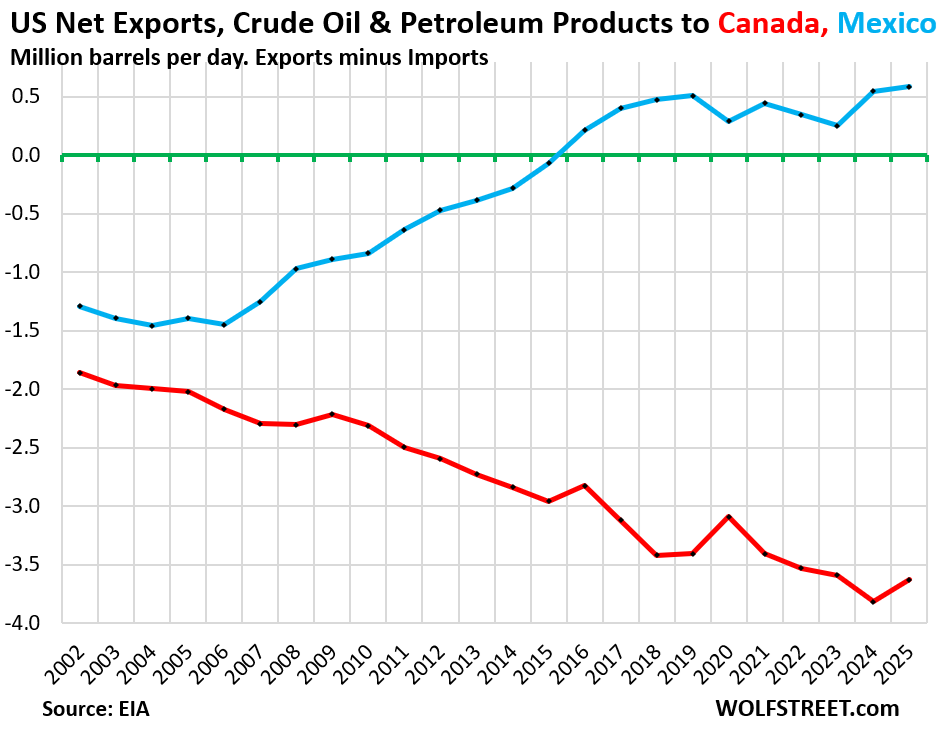
For example, the US imported 0.50 MMb/d of crude oil from Mexico in 2025 and exported 1.1 MMb/d of petroleum products (largely gasoline and diesel) to Mexico. And net exports (exports minus imports) to Mexico rose to a record 0.59 MMb/d.
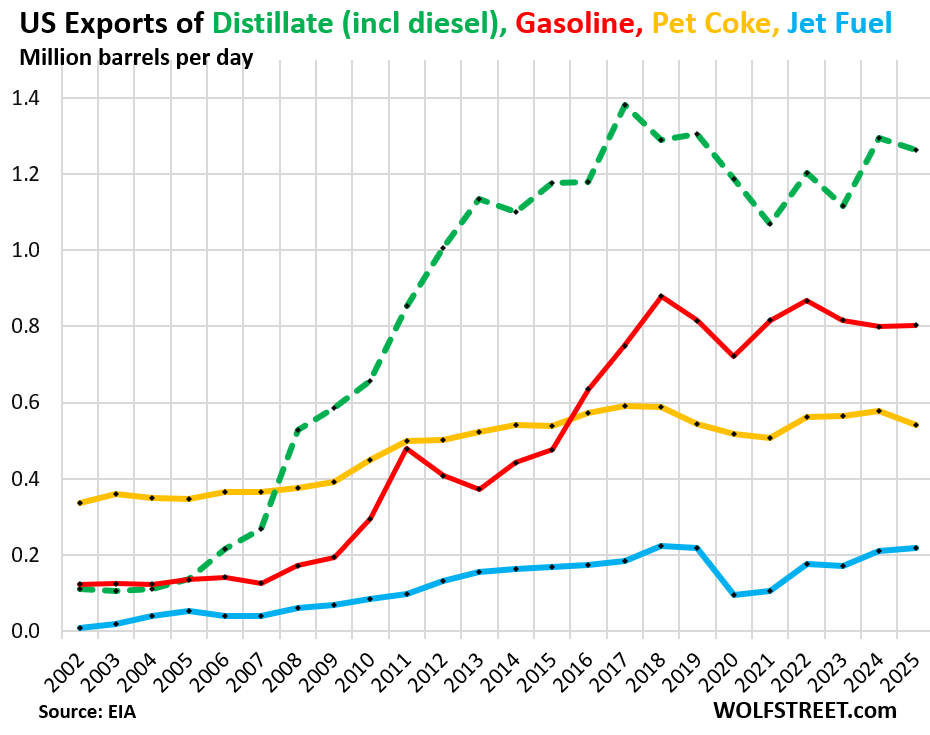
Among the many petroleum products that the US exports are finished petroleum products, the largest categories of which are by export volume:
- Distillate: 1.26 MMb/d
- Gasoline: 0.80 MMb/d
- Petroleum coke: 0.54 MMb/d
- Jet fuel: 0.22 MMb/d
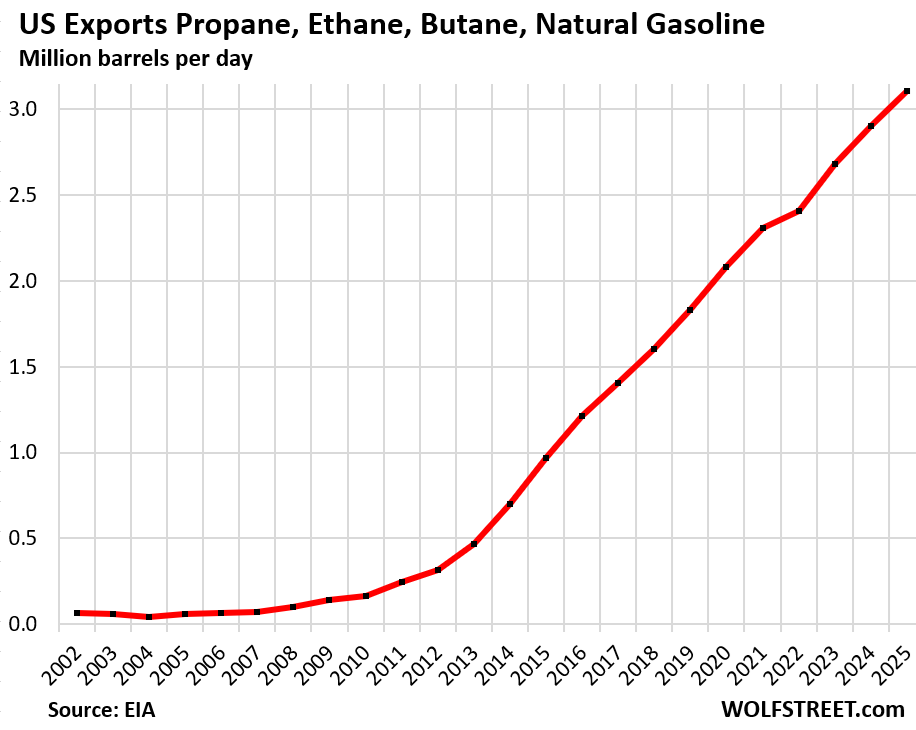
Exports of propane, ethane, butane, and natural gasoline soared by 7.0% to 3.1 MMb/d in 2025, up from near zero in 2008, an astounding export boom:
Net exports to Canada and Mexico.
Net exports to Canada are negative: US exports to Canada rose to 0.87 MMb/d in 2025. Imports from Canada fell to 4.49 MMb/d. And net exports to Canada were negative, but that deficit became smaller in 2025, 3.63 MMb/d (red line in the chart below)
Net exports to Mexico rose to record 0.59 MMb/d, as imports from Mexico fell to 0.50 MMb/d, the lowest since 1979, and exports to Mexico dipped to 1.09 MMb/d (blue).
In other words, the US has surplus with Mexico and a deficit with Canada.
Imports from Others.
Imports from Saudi Arabia declined to just 0.33 MMb/d in 2025, down from the 1.5 MMb/d range before fracking took off on a large scale (blue in the chart below).
Imports from OPEC overall fell to 1.1 MMb/d, down from the 5-6 MMb/d range in the years before fracking took off (red).
Imports from Russia dropped to zero in mid-2022 and stayed there (dotted green).