New Zealand Jobless Rate Jumped in Q3: Next RBNZ Hike in Doubt?


A surprise drop in jobs during Q3 2026 puts the RBNZ in a bind and shows new traders how one jobs report can reshape rate expectations.
New Zealand’s unemployment rate rose to 5.7% in the September 2026 quarter, according to Stats NZ, above the 5.5% economists expected. Employment shrank 0.1% when forecasts called for a 0.4% gain.
Here’s what this could imply for RBNZ December policy bets and the Kiwi’s direction.
What Happened to the New Zealand Unemployment Rate in Q3 2026?
Stats NZ published the Household Labour Force Survey for the September quarter, and here are the seasonally adjusted numbers:
- Unemployment rate: 5.7%, up from 5.6% in Q2 (5.5% forecast)
- Employment change: -0.1% q/q (+0.4% forecast)
- Participation rate: 70.4%, down from 70.6% (70.7% forecast)
- Unemployed people: 174,000, up from 171,000
- Wage growth (Labour Cost Index): 2.1% y/y
 The participation rate measures the share of working-age people who have a job or are looking for one. People who stop looking drop out of the unemployment count, and that usually pulls the jobless rate down.
Q3 delivered both at once: fewer people in the labour force and a higher jobless rate. Hours point the same direction, as Stats NZ counted 17,000 fewer full-time workers and 15,000 more part-time workers, while total actual hours worked fell 1.6%.
One caveat, however, is that the Matariki public holiday landed in the September quarter this year after falling in June in 2024 and 2025, so holidays may explain part of that hours drop.
Why Does a Weak Jobs Report Matter for an RBNZ Rate Hike?
The Reserve Bank of New Zealand (RBNZ) faces a problem with two sides. Inflation runs hot. Jobs look soft.
Stats NZ puts annual CPI inflation at 3.7% for the year to September, above the RBNZ’s 1% to 3% target band. To fight it, the RBNZ raised its Official Cash Rate in July and again in September, lifting it to 2.75%.
But for their October announcement, the RBNZ surprised markets. Policymakers held the OCR at 2.75% in a 4-3 vote when traders had priced a hike to 3.00%. All seven committee members agreed further tightening would likely be needed, and the RBNZ lifted its Q4 inflation forecast to 4.4% from 3.9% on higher fuel costs, keeping the December 9 meeting open for a hike.Wages tie the two sides together. Central banks worry about second-round effects (workers demand higher pay to keep up with prices, then businesses pass those costs on through higher prices). Salaries rose 2.1% while prices rose 3.7%, so paychecks are losing the race to the checkout counter. Workers with less bargaining power seem less likely to start a wage-price spiral, and that could give the RBNZ room to wait.
The case for a hike hasn’t vanished. Fuel prices and inflation expectations could still push policymakers to act.
What Does the Jobs Data Mean for NZD/USD?
Interest rate expectations drive a lot of currency demand. A higher expected rate tends to attract investors hunting for yield, and a lower one tends to push them elsewhere. The jobs report weakened the case for a December hike, and that shift in expectations probably played a role in the kiwi’s drop.
Within hours after the numbers were printed, NZD/USD was trading about 0.6% lower near 0.5583 after the release, its lowest level since mid-October. The pair gave back most of its climb from the October 14 low just above 0.5550.
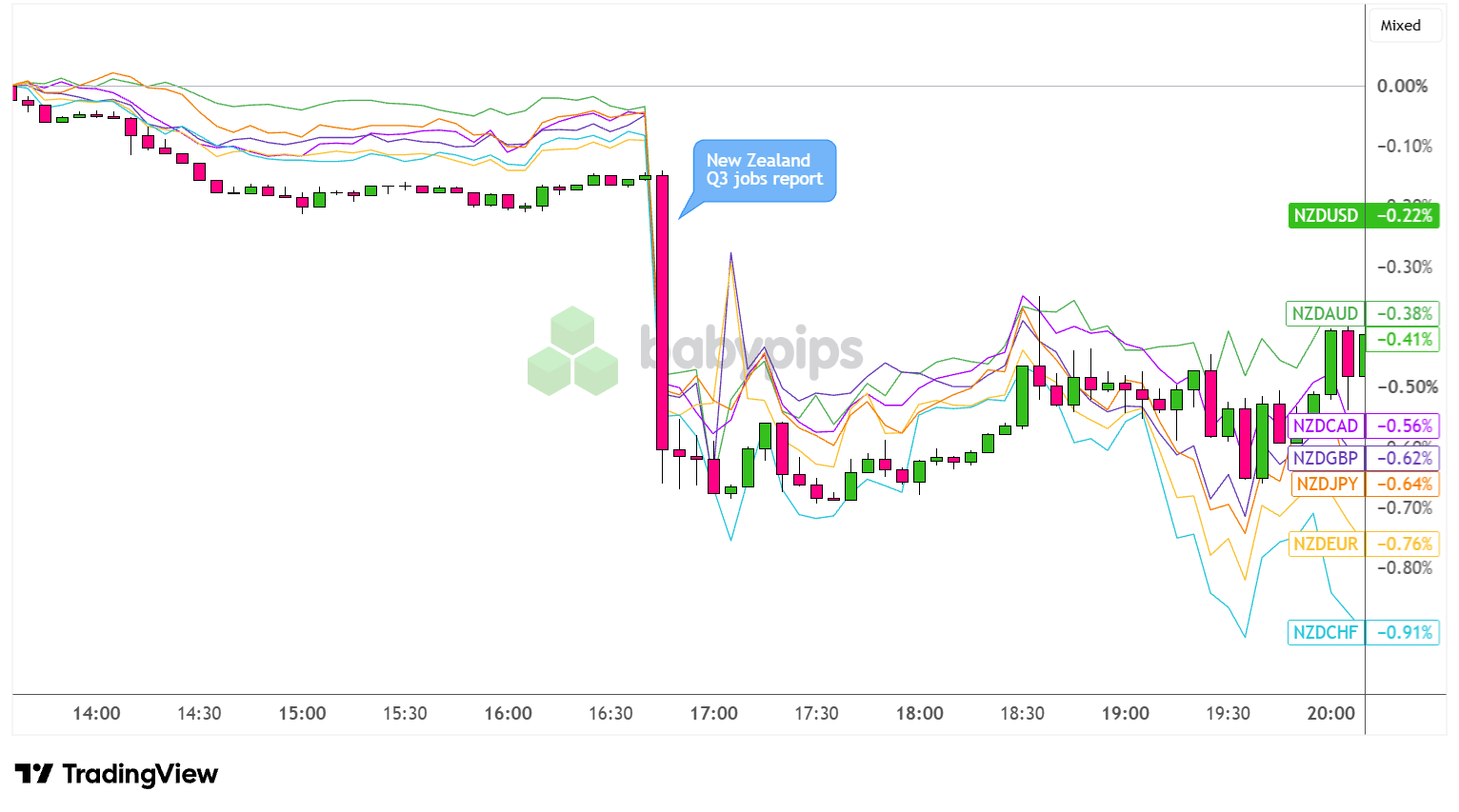
Other forces leaned on the kiwi, too. On Tuesday, China’s central bank raised its FX reserve requirement ratio and set a weaker-than-expected yuan fix. Since the New Zealand dollar often trades as a proxy for China’s economy, those moves may have added pressure. A strong U.S. JOLTS report also firmed the dollar ahead of the release.
The reaction could still fade down the line. Hot readings in upcoming RBNZ inflation surveys would revive the hike case since inflation remains the RBNZ’s main job. Still, a run of weak data could lead some traders to price a shorter hiking cycle, and that kind of shift tends to weigh on a currency over months.
Key Takeaways for New Traders
- Surprises move markets. NZD/USD reacted to the gap between the 5.7% result and the 5.5% forecast. The number alone told traders less.
- Read past the headline. Falling participation alongside rising unemployment suggests soft hiring, a weaker signal than the headline rate shows on its own.
- Wages link jobs to inflation. Pay growth of 2.1% against 3.7% inflation points to limited wage pressure, which central banks track when deciding on hikes.
- One report rarely settles a debate. The RBNZ will weigh this New Zealand unemployment rate reading against fuel prices, inflation expectations and global risks before December 9.
What Should Traders Watch Next?
- November 6, 1:30 pm GMT: U.S. Non-Farm Payrolls, a driver for the USD side of NZD/USD
- November 7: New Zealand general election
- November 17: RBNZ Survey of Expectations, a read on where businesses see inflation heading
- December 9, 2:00 pm NZDT: RBNZ Monetary Policy Statement and OCR decision
This article is for educational purposes only. It does not constitute financial advice. Trading involves substantial risk, and past performance is not indicative of future results. Always do your own research and consider consulting with a qualified financial advisor.
Related Articles
- Stock Markets News
NZ Q3 Unemployment rate 5.7% (expected 5.5%, prior 5.6%)
- Stock Markets News
Recap: New Zealand jobless rate hits 11-year high, kiwi slips as RBNZ hike bets fade
- Economy News
New Zealand jobless rate hits 11-year high in run-up to polls
- Economy News
RBNZ unexpectedly holds rates at 2.75% in split vote, signals further hikes likely
- Stock Markets News
investingLive Asia-Pacific market news: Oil eases on Vance’s Iran outreach