My Take on Auto Sales in March – Come to Think of it, My Take on the Tough & Ugly US Auto Market

GM, Ford, Honda in a quagmire. Tesla now like GM & Ford. Stellantis & Nissan try to exit a death spiral. Toyota gains. Hyundai-Kia rocks from record to record.
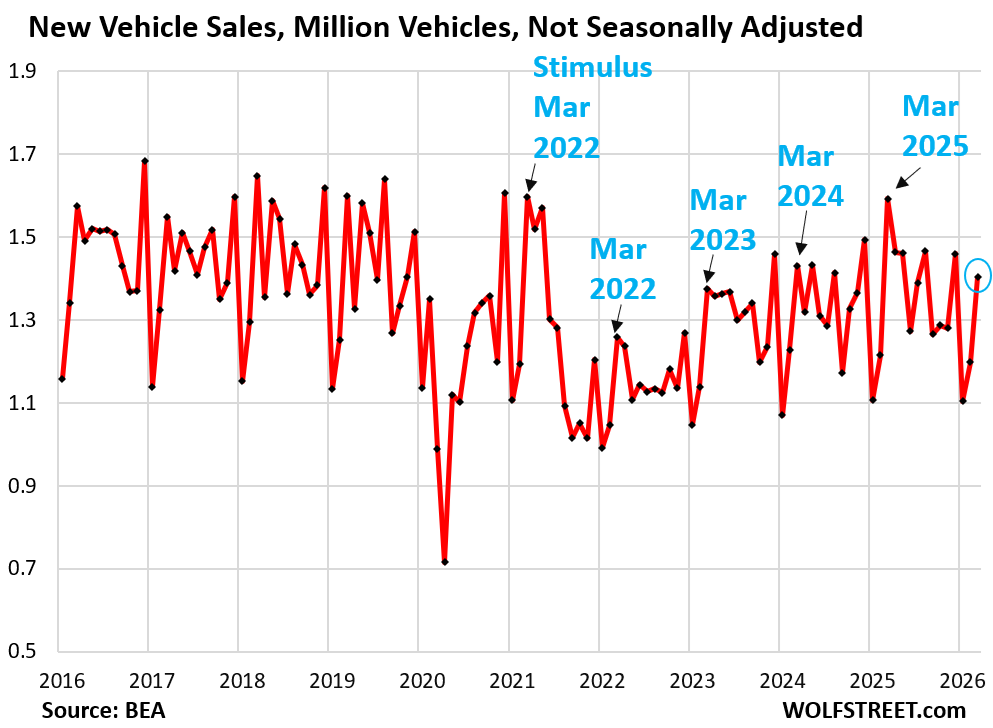
What marked new vehicle sales in March this year was the huge spike in March last year when people – misled by the media about massive price increases on new vehicles due to the tariffs – went out and bought 1.59 million new vehicles, the most for any March since 2018. This effort to frontrun the tariffs created a huge outlier.
And March this year is compared to March last year, and sales this year could not reproduce that outlier of March last year, and so year-over-year, sales fell by 11.9%.
But beyond the year-over-year metric, sales at 1.40 million vehicles in March were in the normal range of this unforgiving market where sales have been skittering lower for years – for over two decades actually (deliveries to end-users, Bureau of Economic Analysis today):
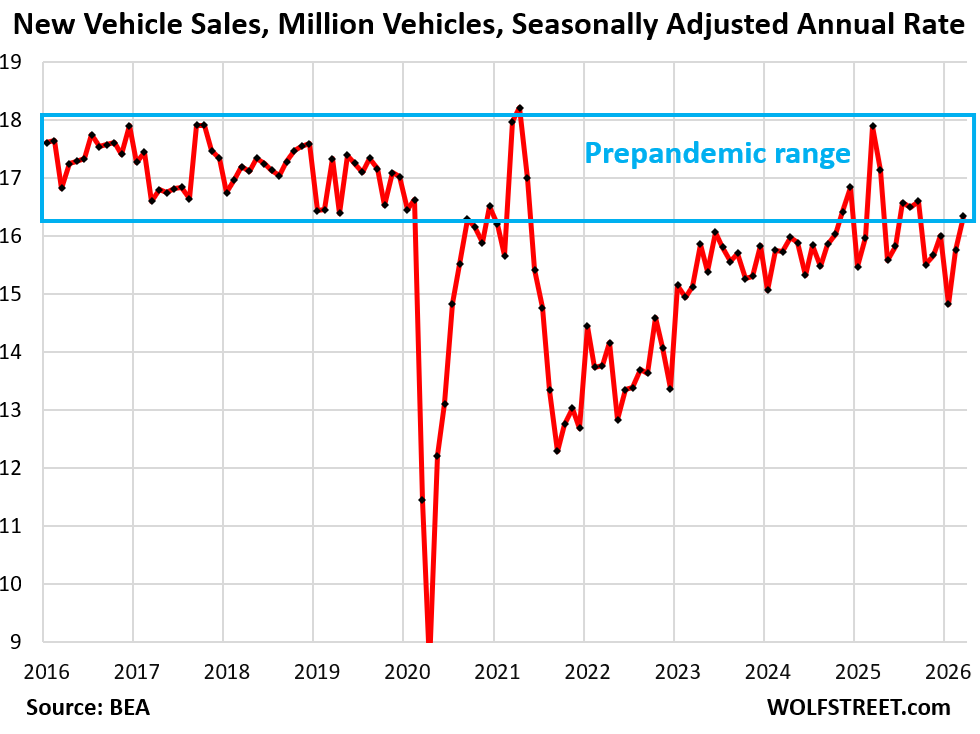
The seasonally adjusted annual rate of sales, which accounts for the number of selling days and seasonal factors, jumped to 16.3 million vehicles in March, still down by 8.7% from March 2025, but the second-best March since March 2021, which had been the highest for any March in years, boosted by another wave of stimulus checks and PPP money hailing down on Americans.
Also note the three high months July, August, and September 2025, which was when huge record EV sales pushed up overall vehicle sales. EV sales surged because the federal EV incentives were ending on September 30, and people were frontrunning the end of the incentives. This moved EV sales forward. Predictably, EV sales cratered in the months afterwards but appear to have bottomed out now.
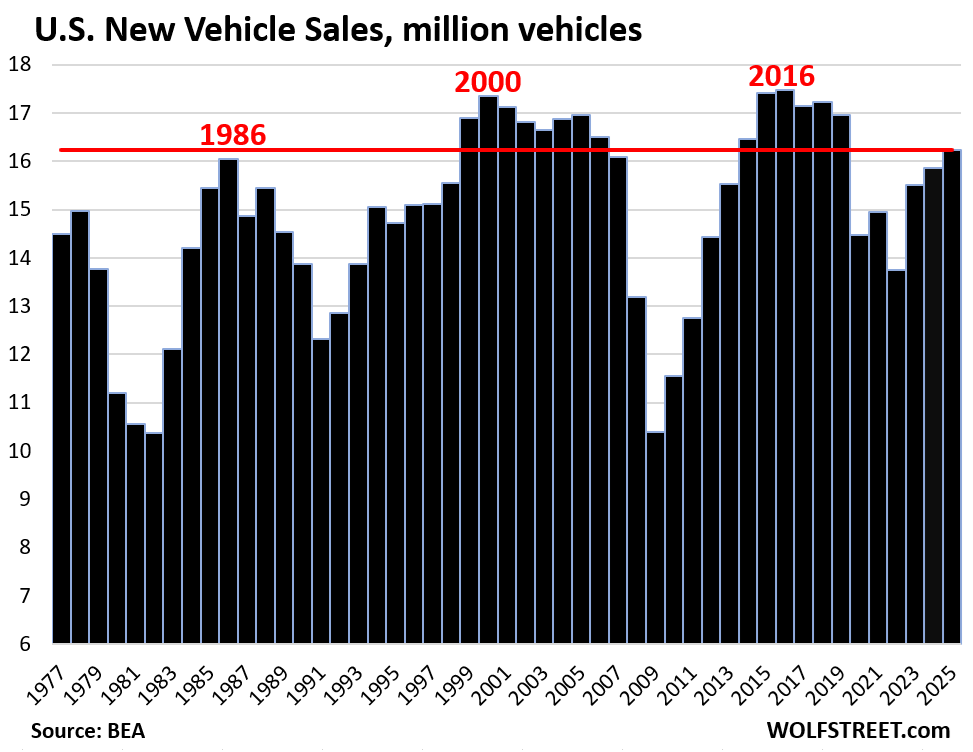
Annual new vehicle sales had peaked in 2000 and 2016 at nearly the same volume, each followed by a long deep plunge and a slow recovery.
The reason new vehicle sales have been in a long-term decline is because automakers, in their infinite wisdom and allegiance to Wall Street, kept jacking up prices to fatten their profit margins, and losing customers in the process.
This started a cycle where some automakers – specifically GM, Ford, and Stellantis among the big ones – decided to increase their dollar-sales and their profit margins by raising prices, accepting that they cannot raise their sales volume, which led to high prices crushing their sales volume.
Other automakers have butted into the equation, particularly Hyundai-Kia, and their sales continued to soar from record to record. So not all automakers are losers in this game.
This is the most important chart to describe the tough US auto market:
As a result… Automakers ended up eating all of the tariffs and reported tens of billions of dollars in earnings warnings because of them, and new vehicle prices didn’t budge, because automakers could not pass on the tariffs because demand was weak after automakers had jacked up their prices by 20% in just two years, and had bumped into that ceiling of consumers refusing to go further, and automakers couldn’t push prices beyond that ceiling without losing sales and market share.
In the fallout from those losses due to eating the tariffs, at least one CEO of a global automaker was forced out: Toyota’s CEO Koji Sato was shuffled to the side effective yesterday, after just three years on the job, and was replaced by CFO Kenta Kon, after Toyota’s profits plunged.
But Toyota’s aggressive prices in the US boosted its sales volume in 2025 and set a new record, while sales at GM, Ford, and Honda were far below their 2015 levels, and Stellantis was in full collapse mode.
Hyundai-Kia, which also ate the tariffs and shifted more production to its plants in the US – and is expanding its plants in the US – to dodge the tariffs, had a huge banner year and all-time record (my annual sales charts for each of the major automakers are here).
Sales by major automaker.
Some automakers, including GM, only report quarterly sales. Tesla doesn’t report US sales at all; it only reports global quarterly sales. All data as reported by each automaker today and yesterday.
#1 General Motors, Q1 sales: -9.7% from the banner Q1 last year, to 626,429 vehicles, all brands combined.
#2 Toyota, Q1 sales: -0.1% year-over-year, to 569,420 vehicles, Toyota and Lexus brands combined. Toyota division sales inched up by 0.3%; Lexus sales fell by 2.5%.
#3 Ford, Q1 sales: -8.8% year-over-year, to 457,315 vehicles, Ford and Lincoln brands combined.
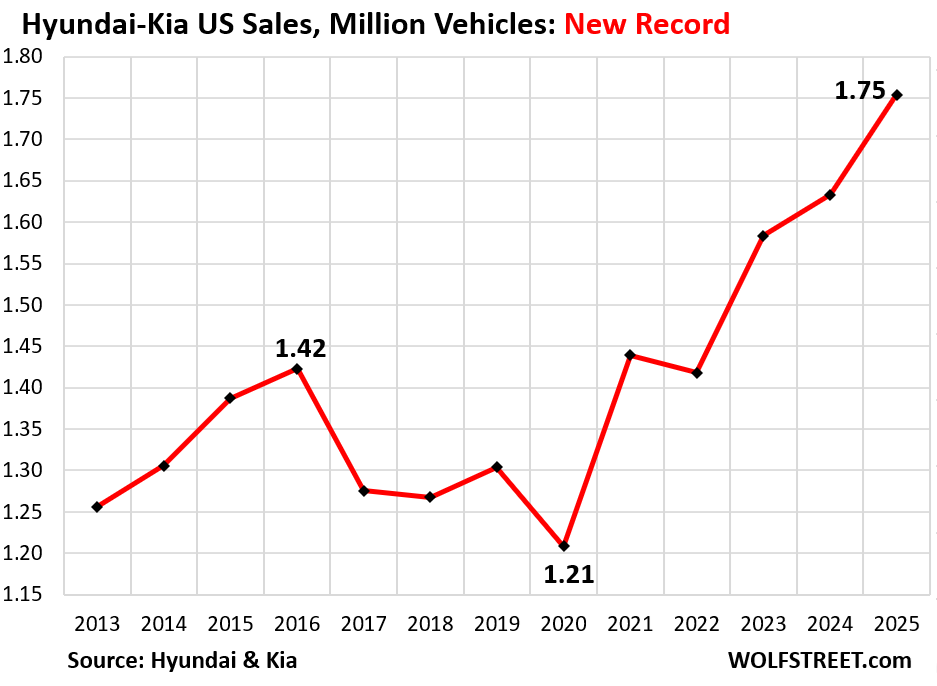
#4 Hyundai-Kia, Q1 sales: +2.5% year-over-year, to 412,403 vehicles, a record first quarter. While others whine about the strong Q1 2025 that they couldn’t overcome, Hyundai-Kia just went out and blew them away.
Hyundai-Kia’s annual sales, from my annual report on US auto sales, are on track to blow by Ford in the not-too-distant future to become the #3 in the US, behind GM and Toyota, with Ford dropping to #4:
#5 Honda, Q1 sales: -4.2% year-over-year, to 336,830 vehicles, Honda and Accura brands combined.
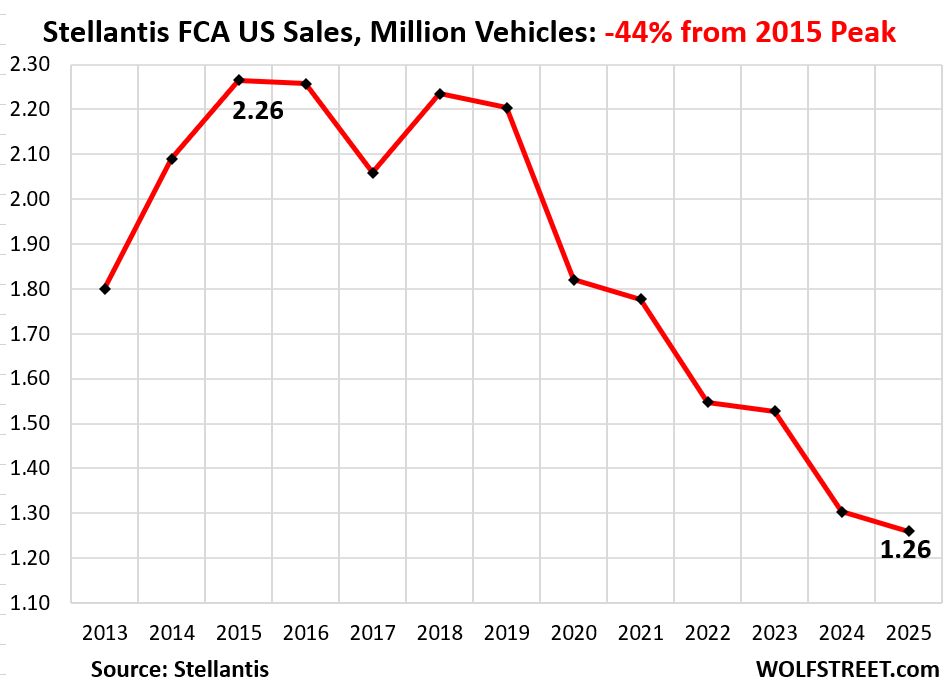
#6 Stellantis FCA, Q1 sales: +4% year-over-year, all brands combined, to 305,902, ticking up from the abysmal levels last year. Annual sales in 2025 were down by 44% from the peak in 2015.
#7 Nissan Q1 sales: -7.5% year-over-year, to 247,068 vehicles, Nissan and Infiniti combined. Annual sales in 2025 were down by 42% from the peak in 2017.
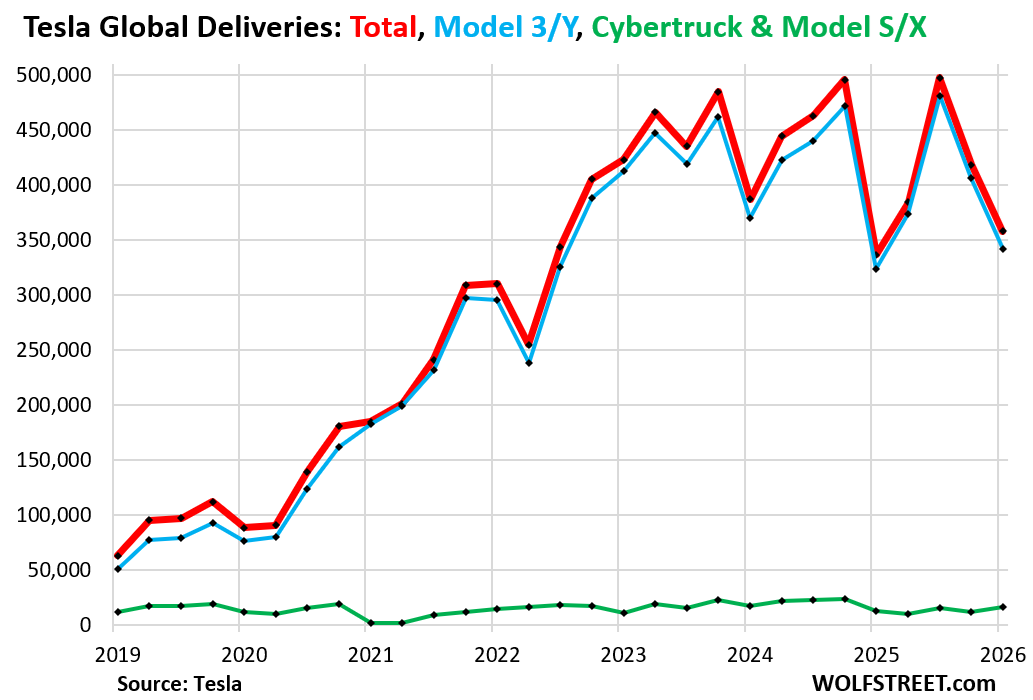
Tesla only discloses global sales, not US sales. In Q1, Tesla’s global deliveries rose 6.3% year-over-year to 358,023 vehicles (red line).
- Model 3 and Model Y: +5.6% YoY, to 341,893 vehicles (blue).
- “Other Models” (Cybertruck, Model X, Model S): +25.2% YoY to 16,130 vehicles, clinging to the bottom of the chart (green line).
Tesla is no longer a growing automaker. Q1 sales were well below Q1 2024 (386,810) and Q1 2023 (422,875). It’s just a normal automaker now, with flat to declining sales, like Ford and GM: