Multifamily CRE Meltdown Keeps Getting Uglier


The US government holds half of all multifamily mortgages. The rest is spread around.
There are about $2.3 trillion in multifamily commercial real estate (CRE) loans out there, backed by buildings with rental apartments. The US government, via Fannie Mae and Freddie Mac, holds about $1.2 trillion of that. Fannie and Freddie have become very aggressive multifamily CRE lenders. So, dear taxpayer, you’re on the hook for about half of the multifamily CRE debt.
The rest is held around the globe by banks, insurance companies, real estate funds, alternative asset managers – a melted-down mortgage just hit Bridge Investment Group, a unit of PE giant Apollo (more on that in a moment) – holders of Commercial Mortgage-Backed Securities (CMBS) and Collateralized Loan Obligations (CLOs).
All of them have gotten hit by melted-down mortgages as the higher interest rates make it just about impossible to refinance the balloon payments when they come due on fixed-rate loans, or to make interest payments on variable-rate loans pegged to SOFR, which jumped when the Fed started hiking its policy rates. The result has been wave after wave of multifamily defaults, and it keeps getting worse.
CMBS holders got hit by another default: The $210 million interest-only 5-year mortgage on a Class A 283-unit 20-acre waterfront apartment property, “The Cove at Tiburon,” across the Bay from San Francisco. The mortgage had been issued in 2020 to refinance the property at ultra-low interest rates. At the time, everyone in real estate thought that ultra-low interest rates would be a permanent feature.
The interest-only mortgage became delinquent when it wasn’t paid off in October, after having already been modified and extended in November 2025. It could not be refinanced at current interest rates because the declining rental income wasn’t enough to cover operating expenses and the interest payments at today’s interest rates. Now there are talks underway to extend it for another six months, according to Trepp, which analyzes and tracks CMBS. Extend and pretend forevermore.
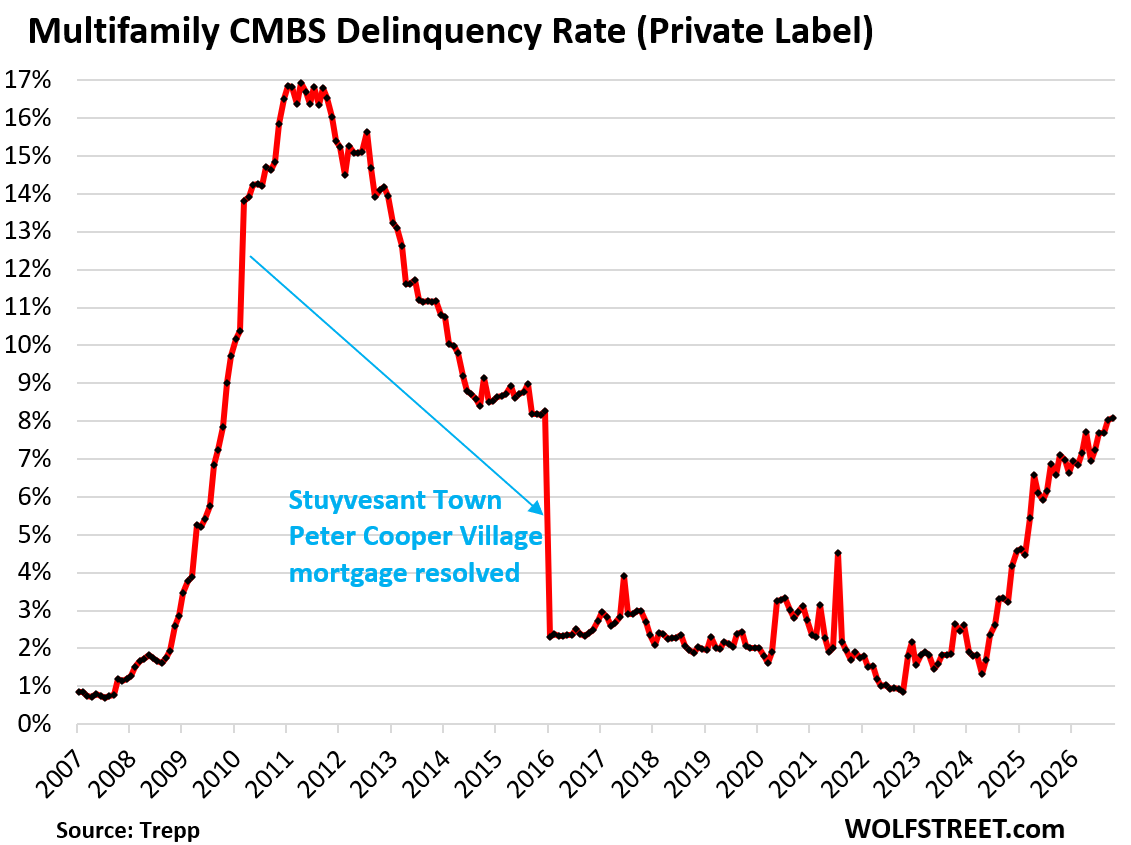
The multifamily CMBS delinquency rate rose to 8.1% in October, driven by this delinquency, the highest since 2016, when the $3 billion delinquent loan on the huge 11,250-apartment campus, Stuyvesant Town–Peter Cooper Village, in Manhattan, was paid off by the acquirers of the property.
Back in 2024, Morningstar DBRS, which rates the CMBS that includes the loans on The Cove at Tiburon, wrote about the problems already lining up:
“At issuance [of the loan in 2020], Morningstar DBRS shadow-rated the loan investment grade given that the property benefits from a prime waterfront location, superior amenities, and limited competition within the submarket. However, despite these aspects, which Morningstar DBRS expected to contribute to cash flow stability over the loan term, the property’s reported occupancy rate and cash flow trended downward shortly after issuance, primarily as a result of a slowdown in leasing activity….
“As per the March 2024 rent roll, the property was 80.2% occupied at an average rental rate of $5,789 per unit, compared with June 2022 figures of 91.9% and $5,852 per unit, respectively.
“It appears that new leases are being signed at lower rental rates to curb increases in vacancy rates, resulting in lowered cash flows.…”
And now that property would have to be refinanced at much higher interest rates, and that just doesn’t pencil out.
Other lenders got hit too.
Bridge Investment Group, an alternative investment manager owned by PE giant Apollo, is now stuck with the defaulted $360 million loan on The Beaudry, a new high-end 64-floor apartment tower in downtown Los Angeles, with 785 units and amenities such as floor-to-ceiling windows, saltwater pool, spa, rooftop lounge, 24/7 athletic club, a full-swing golf simulator, etc.
The tower, which opened in 2023, was developed by giant real-estate developer and landlord Brookfield for about $600 million. Because the $360 million loan cannot be refinanced at today’s interest rates without a massive capital infusion, Brookfield decided to hand over the keys, walk away from the property and the loan, and let the lender worry about the whole schmear, according to the WSJ today.
Brookfield, which already defaulted on mortgages of numerous office towers in Los Angeles and around the country, has played a substantial role in the Office CRE meltdown.
Bridge Investment Group is now trying to sell the Beaudry loan – and thereby the rights to the property.
The Beaudry has lots of competition: Over 10,000 new apartments were built from 2017 to 2021 in downtown L.A., the most of any other downtown in the country, according to RentCafe, cited by the WSJ.
Then came working from home, and proximity to now substantially vacant and defaulting office towers wasn’t such a magnet anymore.
At the Beaudry, rents start at $2,424 a month for a 539-square-foot studio on the sixth floor. Up the scale, a two-bedroom 1,200 sf apartment on the eighth floor is listed at $4,905. The same floorplan on the 20th floor is listed at $5,730. A 3-bedroom 1,700 sf unit on the 49th floor is listed at $8,893. All of them with big views.
Asking rents average around $4,200 a month at the Beaudry, according to CoStar, cited by the WSJ, far below what Brookfield had aimed for. “A lot of students live here,” Max Xing, a student at the University of Southern California, told the WSJ. He moved into a studio in August. But the Beaudry was designed as high-end living for professionals working downtown, Andrew Parks, a lead designer on the Beaudry, told the WSJ. “We wanted to go for something that felt very sophisticated.”
In addition to the higher interest rates, here are two other pieces to the multifamily meltdown, including:
- Growing supply: The Growth of the Vacant Housing Stock in the US, Q3 2026
2. Pressure on multifamily rents: Single-Family & Multifamily Rents in the US and 22 Large US Metros
Related Articles
- Stock Markets News
Developers up their perk game, the Home of the Week and more top real estate stories
- Forex News
Mega and Large Investors Pull Back from Housing Market, Become Net Sellers, Small Investors Continue to Pile In
- General News
After Decades of Low Mortgage Rates, Homebuyers Are Facing a New Normal
- General News
PulteGroup Cuts Unsold Homes, but Land Keeps Cash Under Pressure
- Stock Markets News
Market Factors: Stock ideas for all risk tolerances