Financial & Forex Market Recap – Oct. 13, 2026


The dollar fell against all seven majors as Treasury yields eased after Fed’s Williams saw no need for 2027 hikes, while oil climbed and chipmakers slid ahead of U.S. CPI.
The dollar fell against all seven major currencies on Tuesday as Treasury yields eased after New York Fed President John Williams said one more hike may be appropriate this year and none looks necessary in 2027.
The 10-year Treasury yield slipped to near 5.22%, oil rose 1.6% on Middle East supply worries, and the S&P 500 finished little changed after a chipmaker selloff in Asia. Gold fell, Bitcoin gained, and traders looked ahead to Wednesday’s U.S. CPI report.
Check out the forex news and economic updates you may have missed in the latest trading session!
News Headlines & Data:
- U.K. BRC Retail Sales Monitor for September 2026: 1.0% y/y (0.8% y/y forecast; 0.5% y/y previous)
- Japan PPI for September 2026: 6.8% y/y (7.7% y/y forecast; 7.6% y/y previous)
- Australia NAB Business Confidence for September 2026: -13.0 (-9.0 forecast; -8.0 previous)
- Germany CPI Growth Rate for September 2026: 3.3% y/y (3.3% y/y forecast; 2.9% y/y previous)
- U.S. NFIB Business Optimism Index for September 2026: 97.9 (96.0 forecast; 98.7 previous)
- U.S. ADP Employment Change Weekly for September 26, 2026: 24.75k (23.75k previous)
- U.S. Existing Home Sales for September 2026: 3.99M (3.97M forecast; 3.98M previous)
- Chip stocks slid after Broadcom’s CEO compared AI investing to casino gambling and Chinese rival CXMT flagged progress on a new memory chip design
- The RBA’s September meeting minutes showed a unanimous 25 basis point hike to 4.60%, which board members tied to upside inflation risks from higher oil and commodity prices, AI-related demand and tight domestic capacity. They left the door open to further increases
- JPMorgan reported a rare profit miss on slowing bond trading and dealmaking
Broad Market Price Action:
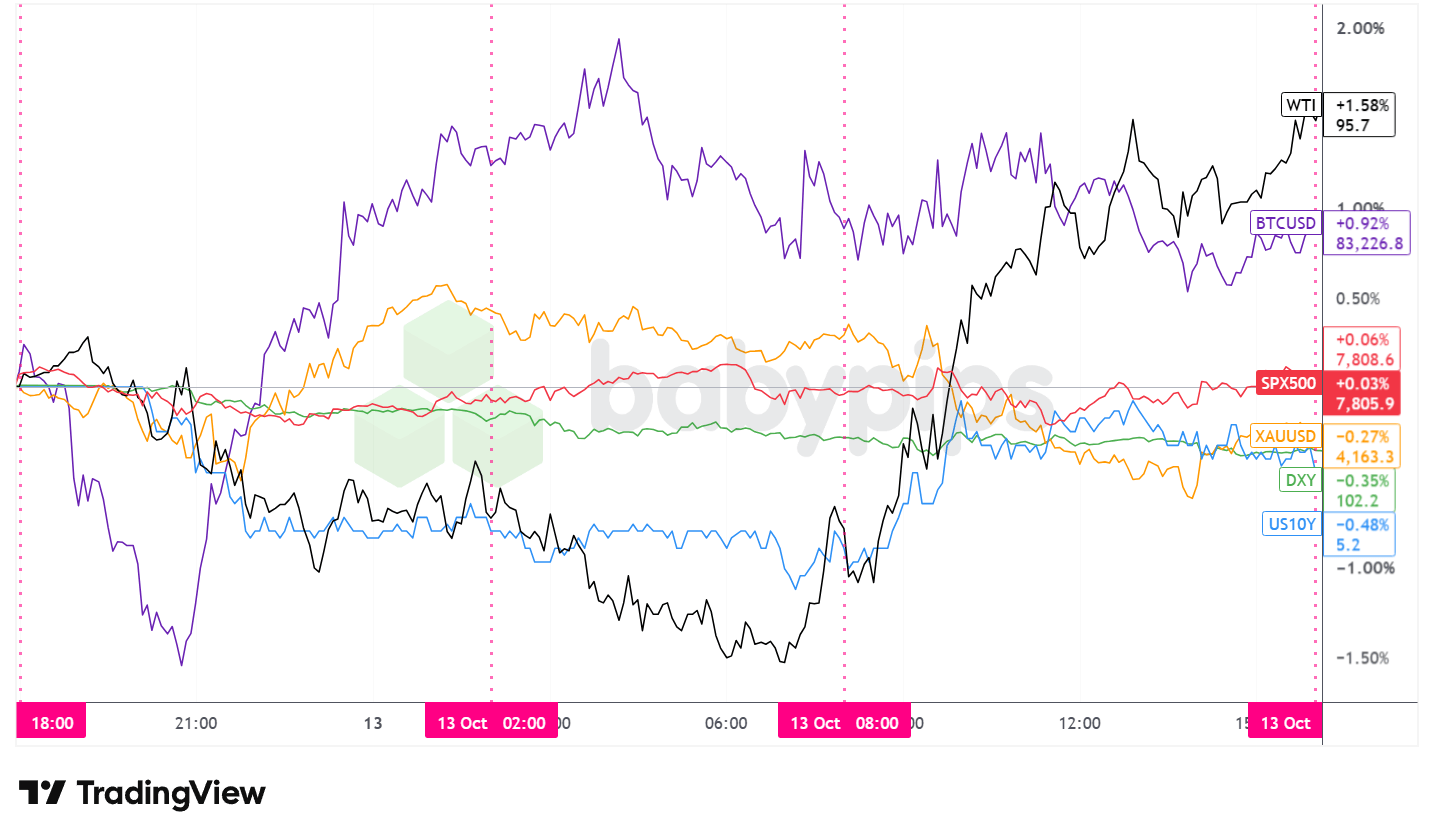
Chip stocks and oil drove the early trade, and Fed comments moved yields and the dollar in the afternoon. Most assets stayed in tight ranges before Wednesday’s CPI report.
WTI crude oil rose 1.6% to near $95.70 a barrel after a session that ran in two directions. Prices slipped overnight and through the European morning with no clear catalyst, a move that may have been a simple pullback or a reaction to Saudi Arabia’s talk of lifting pipeline export capacity to 10 million barrels a day, which would route more crude around the disrupted Strait of Hormuz. Crude turned higher around the start of U.S. trading and climbed into the afternoon as Middle East risks persisted. Reports that President Trump and Israeli Prime Minister Benjamin Netanyahu discussed possible action against Iran, attacks on commercial ships near the Strait of Hormuz and Saudi-led strikes on a Houthi-linked oil facility in Yemen may have revived supply worries. Higher oil can lift inflation concerns and Fed hike bets, and yields and the dollar firmed in the U.S. morning as crude climbed.
The 10-year Treasury yield fell about 3 basis points to near 5.22%. It dropped overnight while Asian equities sold off, held near 5.19% through Europe and climbed to a day high near 5.23% in the U.S. morning as oil rallied. Yields eased in the afternoon after Williams told Bloomberg News that one more hike may be appropriate this year and he sees no reason to expect more in 2027. The two-year yield edged up to near 4.80% while longer maturities fell, a pattern that may reflect a market reading of less tightening ahead. Fed Governor Christopher Waller said the surge in long-term yields is restraining demand in housing and autos, though that is not the Fed’s intention.
The S&P 500 finished little changed near 7,806 after a choppy day. A chip stock selloff that deepened in Asia weighed on tech shares, and South Korea’s Kospi lost more than 5%. Chips carry more weight in the Nasdaq 100, which fell about 0.3%, than in the S&P 500, which holds banks, energy producers and health care companies. The S&P 500 dipped to a midday low near 7,787 as oil and yields climbed and recovered in the afternoon as yields eased and the chip selloff faded. More S&P 500 stocks rose than fell and Microsoft hit a record high, so chipmaker weakness may have held the index flat. Bank earnings were mixed: JPMorgan, Citigroup and Wells Fargo posted record lending income, while JPMorgan missed profit estimates on slower bond trading and dealmaking.
Gold fell 0.3% to near $4,163 an ounce despite a weaker dollar. The metal climbed toward $4,200 in Asia as yields and the dollar slipped and gave back those gains in the U.S. morning as the 10-year yield and the dollar index bounced from their lows and oil rallied. Gold bottomed near $4,150 in the afternoon and recovered part of the loss as yields eased. Its moves matched Treasury yields more than the dollar on Tuesday. Traders may have held back from buying before CPI, because a report that confirms elevated energy costs could keep Fed hike bets alive and pressure a metal that pays no yield.
Bitcoin rose 0.9% to near $83,200. It dropped about 1.5% early in the Asian session as chip stocks fell, reversed above $84,000 in the European morning as the dollar and yields declined, and faded from late morning into mid-afternoon as yields and oil climbed. It recovered after yields eased. No coin-specific headline stood out. A softer dollar may have supported the coin, while the chip selloff may have weighed on it early.
FX Market Behavior: U.S. Dollar vs. Majors
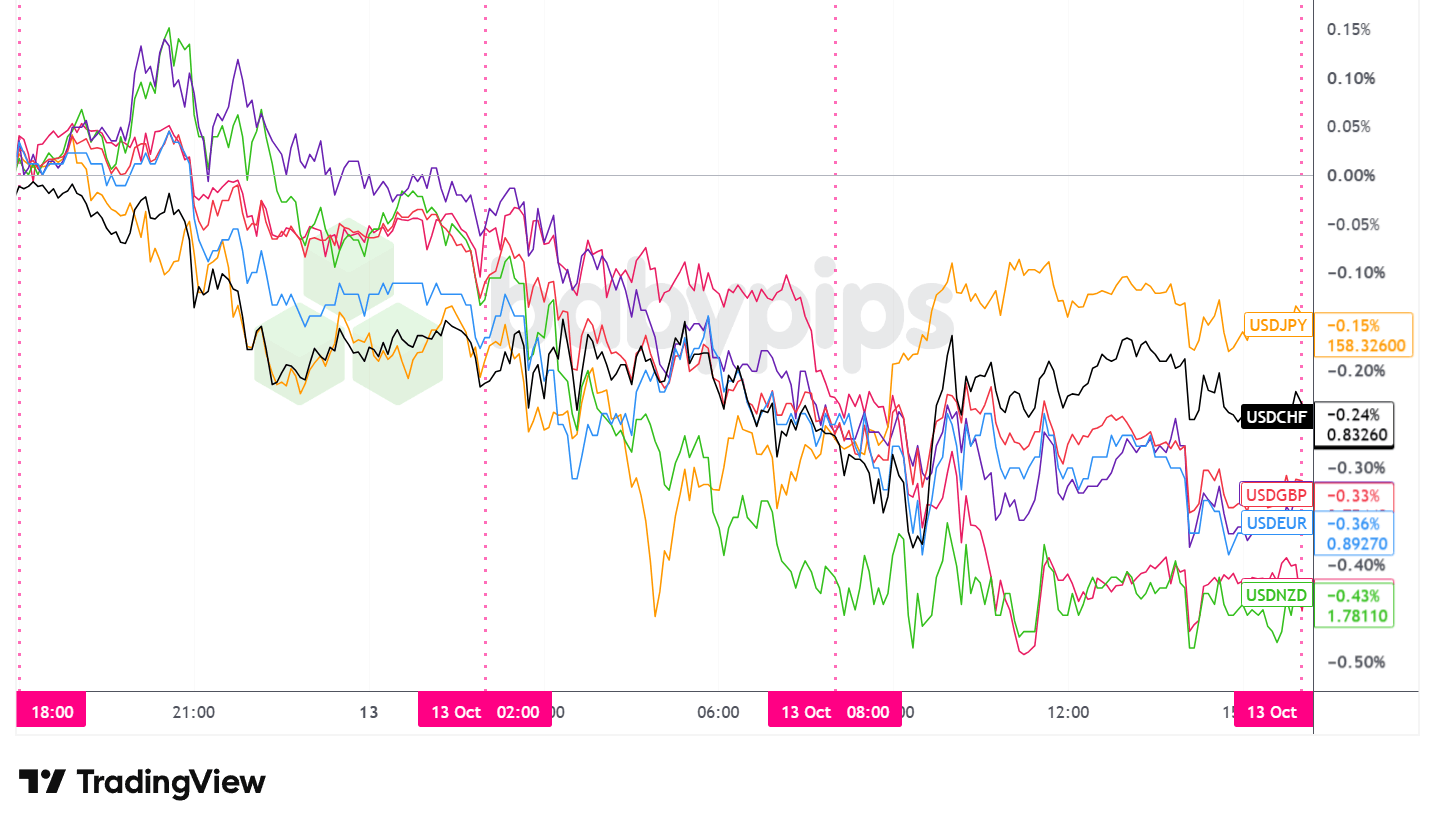
The dollar gave back part of Monday’s gains and fell against all seven majors on Tuesday. The Canadian dollar gained the most at about 0.45%, a move oil’s afternoon rally may have supported, and the yen gained the least at about 0.15%. The U.S. Dollar Index fell 0.35% to near 102.2. Falling Treasury yields appeared to drive most of the decline, and traders may have trimmed dollar positions before Wednesday’s CPI report.
The dollar slid against all seven majors in the Asian session as Treasury yields fell and a chip-led equity selloff weighed on risk appetite. The yen, Swiss franc and euro gained the most, each about 0.2%, a pattern that may reflect defensive positioning. The yen may have drawn support from Japan’s producer prices, which rose 6.8% y/y against a 7.7% forecast but stayed high enough to keep a Bank of Japan hike in view. The Australian dollar gained the least, about 0.1%, as NAB business confidence fell to -13.0 from -8.0. Hawkish RBA minutes that left the door open to more hikes may have limited the damage.
The dollar extended its decline against all seven majors in the London session, with the New Zealand dollar leading as risk sentiment improved and the Australian and Canadian dollars following. The euro edged higher after Germany’s inflation rate rose to 3.3% y/y from 2.9%, in line with forecasts, but gave back some of that gain before the session ended. The franc and the yen posted the smallest gains.
The dollar’s decline slowed in the U.S. session, and the majors split. The dollar firmed against the yen, New Zealand dollar and Swiss franc in the morning as Treasury yields and oil climbed, while the Canadian dollar kept gaining. Existing home sales beat forecasts at 3.99 million and left little mark on the currency market. The dollar index slid back toward its lows in the afternoon as yields eased after Williams’s remarks, which appeared to extend the dollar’s losses against the euro and sterling.
Upcoming Potential Catalysts on the Economic Calendar
- Australia Westpac Leading Index for September 2026 at 12:00 am GMT
- China CPI Growth Rate for September 2026 at 1:30 am GMT
- ECB President Lagarde Speech at 2:10 am GMT
- China Balance of Trade for September 2026 at 3:00 am GMT
- BoE Breeden Speech at 3:30 am GMT
- BoE Gov Bailey Speech at 5:30 am GMT
- Germany Wholesale Prices YoY for September 2026 at 6:00 am GMT
- BoE Pill Speech at 6:00 am GMT
- BoC Gov Macklem Speech at 6:05 am GMT
- ECB President Lagarde Speech at 8:30 am GMT
- Fed Bowman Speech at 9:40 am GMT
- U.S. MBA 30-Year Mortgage Rate & Applications for October 9, 2026 at 11:00 am GMT
- Canada Building Permits for August 2026 at 12:30 pm GMT
- U.S. CPI Growth Rate for September 2026 at 12:30 pm GMT
- ECB Schnabel Speech at 4:15 pm GMT
- Fed Barkin Speech at 5:30 pm GMT
Wednesday’s U.S. CPI report is the next test for the Fed’s hiking path. Higher gasoline prices likely lifted overall inflation in September while underlying price pressure may have eased, so the core reading and the breadth of price increases carry the most weight.
Boston Fed President Susan Collins said she is watching whether inflation spreads beyond energy into other goods and services. A soft core print would fit Williams’s outlook and may keep yields and the dollar under pressure, while a hot one could raise the odds of a hike at the Fed’s Oct. 27-28 meeting.
Speeches from the BoE’s Bailey, Breeden and Pill and the ECB’s Lagarde and Schnabel may show whether higher energy prices are pushing European policymakers toward more tightening, and China reports CPI and trade data overnight.
AI disclosure: A Babypips editor researched and directed this article, and AI tools helped analyze the intraday price data, research sources, initiate the draft, before a Babypips editor did the final review and edit. AI tools can misread data, make arithmetic errors, and state wrong information in a confident tone. Prices, levels, and percentage moves here are approximate because the market data was not captured at the exact close, so check the figures against your own data source before you rely on them. The explanations for market moves are possible reasons, not confirmed causes. This article is for education and is not a recommendation to trade.