Fed Should Hike “in the Near Term” if CPI & PPI this Week Are “Hot”: Fed’s Waller. So at the July Meeting? Treasury Yields Jump

“Sternly staring at inflation until it melts before our withering gaze is not an option,” he said with a sense of urgency.
Fed Governor Christopher Waller is getting nervous about inflation and doesn’t want the Fed to make the 2021 mistake again of waiting too long before hiking policy interest rates, and if the core components of the CPI report on Tuesday and the PPI report on Wednesday are “hot” again, “then the FOMC will need to consider tightening monetary policy in the near term,” he concluded his speech today.
Does “in the near term” mean the FOMC meeting later this month? Or the FOMC meeting in September? The calculus had been for rate hikes to start later this year. Now the July meeting is on the front burner? If CPI and PPI readings are hot this week, will there be a majority of voting members at the July meeting to vote for a rate hike?
“Inflation and monetary policy are at a crossroads,” he said in the speech.
“Sternly staring at inflation until it melts before our withering gaze is not an option,” he said with a sense of urgency.
He explained: “There are some crucial differences now compared with 2021, and there is still a credible case for inflation to begin to fall back to our 2 percent goal with policy at its current setting. But I am concerned about the equally plausible case that data in the coming weeks will show that inflation will remain at its elevated level or even trend higher, requiring tighter monetary policy in the near term.”
Again, “in the near term.” What the heck does that mean? Does that mean he knows there’s a potential majority of voting FOMC members for a rate hike at the July meeting?
So now he has joined the chorus of FOMC members that see inflation as a bigger and growing risk and that are getting increasingly edgy about it, while the labor market is now “near full employment and stable,” as Waller said, and has recovered from the weakness last year, and has moved down in the rankings on the Fed’s worry list.
“When inflation is well above its target and the labor market is near full employment and stable, any serious policy rule calls for raising the policy rate to bring down inflation,” he said.
And he cited the inflation data and what was behind the acceleration.
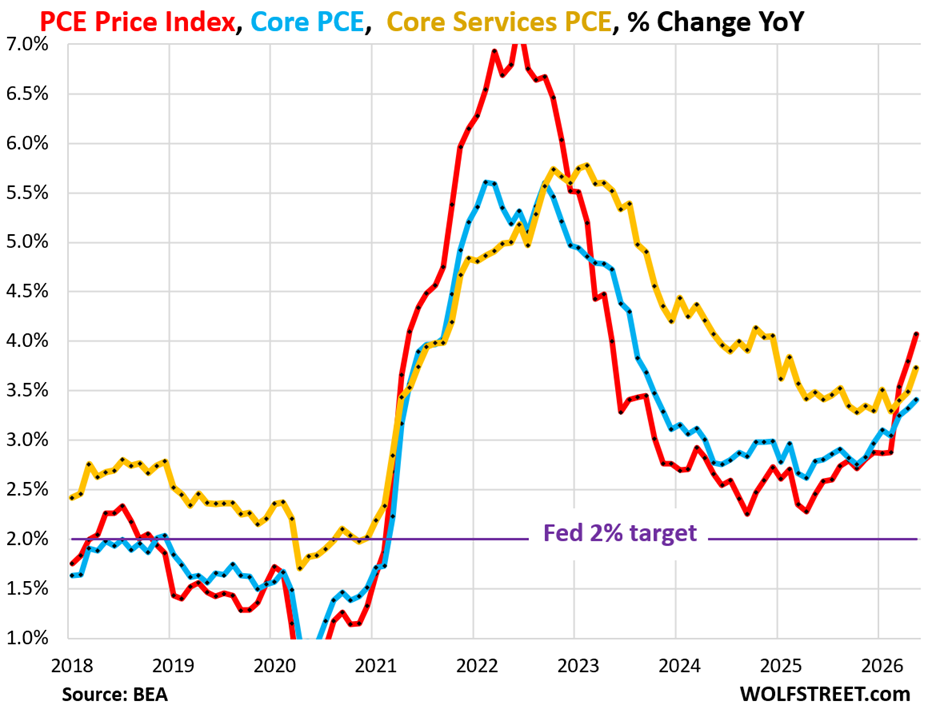
Inflation, as measured by the year-over-year increase of the all-items PCE price index (red line in the chart below) which the Fed uses as yardstick for its 2% inflation target, reached 4.1% in May, more than double the Fed’s target. It has been above target since March 2021.
Without the energy price spike, inflation as measured by the “core” PCE price index, which excludes energy components and foods, rose to 3.4% (blue line). It has also been accelerating since May last year.
The “core services” PCE Price index bottomed out at a too-high level late last year and started accelerating again this year and reached 3.7% (yellow). Core services dominate consumer spending.
An inflation hawk would have clamored for rate hikes starting last fall – when the Fed began to cut rates. But there are no inflation hawks left on the FOMC.
“So, the question is, will core inflation continue on its upward trajectory, or has it reached a turning point where it will begin to decline back toward our 2 percent target? The direction it takes has very different implications for the path of monetary policy,” he said.
“I am committed to returning inflation to the FOMC’s 2 percent goal but also determined to avoid overtightening policy and risking a recession,” he said.
While he expects the all-items inflation indexes to decelerate, as the price of gasoline has started to decline from the spike, he “will be focused on core inflation, and on that count, there are recent signs of continued pressure on goods prices,” he said.
“Core intermediate goods prices tracked in the producer price index [PPI], which may feed through to PCE prices, have increased noticeably in recent months. Also, purchasing managers for manufacturing businesses reported in June that their input prices have continued to increase, the 21st straight month they said so,” he said.
“Overall, I am monitoring price movements and am alert to the risk that the increase in core inflation is a sign that inflationary pressures are spreading through the economy,” he said.
“The FOMC has to be ready to tighten monetary policy to prevent a repeat of the 2021-to-2022 inflation episode. But there are two differences between now and then that make me cautious about leaning too heavily on that experience to make this decision,” he said.
So Waller returns to his roots as a well-reasoned centrist on inflation, after his sojourn in the dove-camp: At the FOMC meeting on July 30 last year, he’d dissented from the FOMC vote that kept rates unchanged because he’d wanted a rate cut; and he dissented again at the January 2026 meeting, when the FOMC kept rates unchanged after three cuts at the prior meetings, and he still wanted another rate cut; and during that entire time in dove-camp, he wanted to be Fed chair.
Treasury yields rose across the board today.
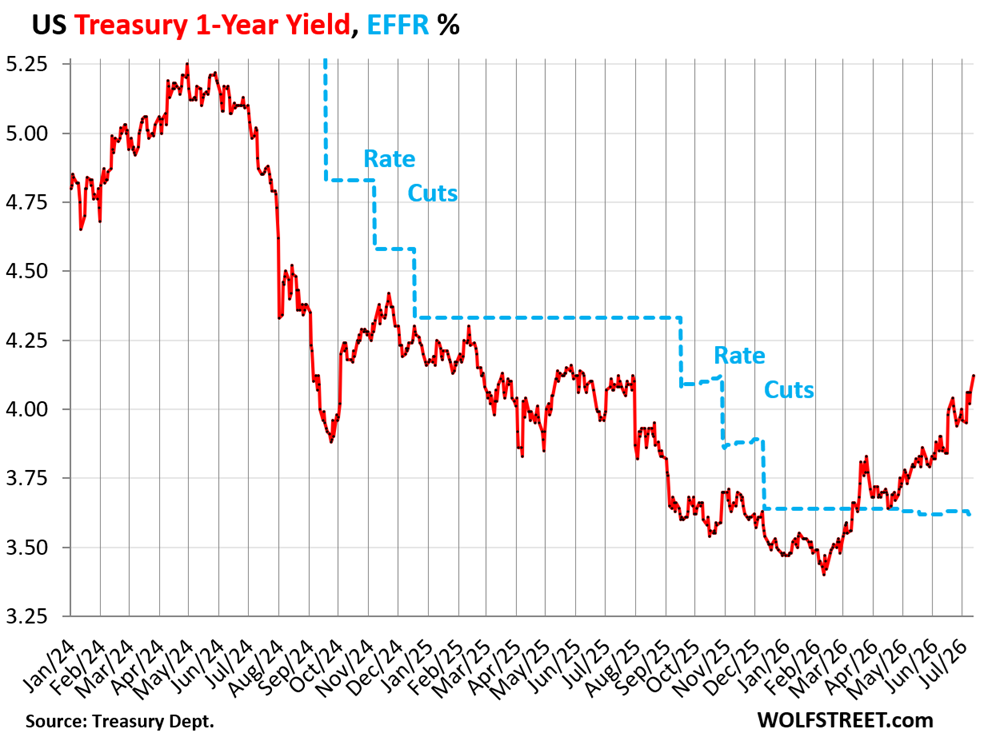
The 1-year Treasury yield rose by 6 basis points to 4.12% today, the highest since June 2025. It is now 50 basis points above the Effective Federal Funds Rate (EFFR, blue), which the Fed targets with its policy rates. The 1-year yield is pricing in the beginning of a rate-hike cycle:
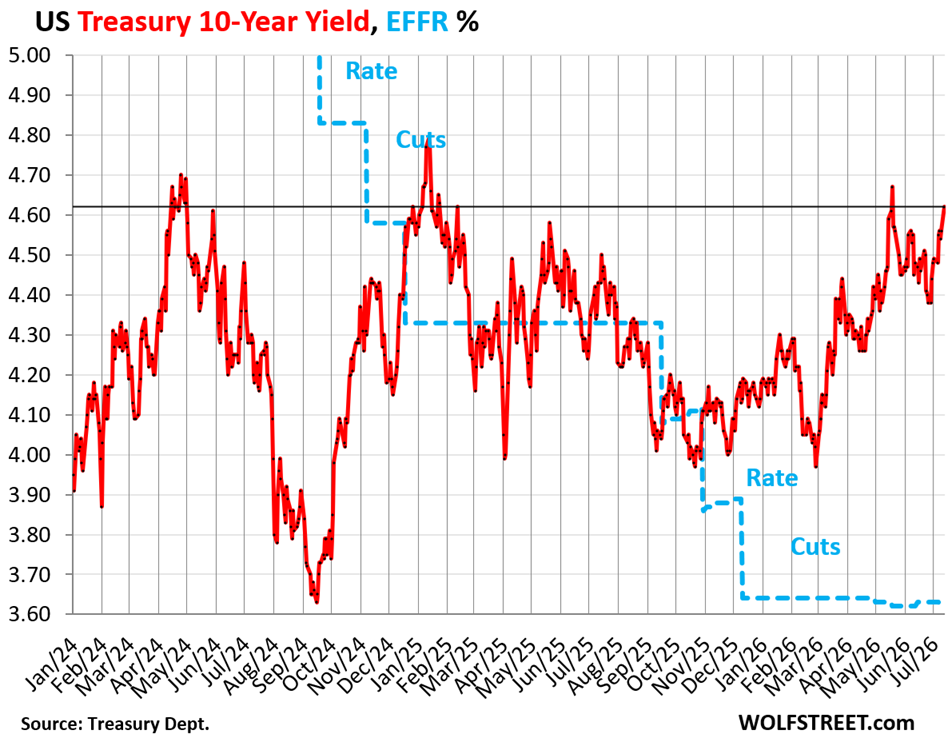
The 10-year Treasury yield rose by 6 basis points to 4.62%: