Comparing Forex Brokers in Brazil: Beyond Pix

To compare forex brokers from Brazil properly, check the contracting entity, look for CVM evidence, add up the real account and funding costs, and confirm the documents and support you would actually use are in Portuguese. Pix deposits and a Portuguese interface are conveniences, not authorisations, and neither one tells you who you are contracting with.
A Brazilian reader can start that shortlist with corretoraforex, a Portuguese-language broker comparison resource for Brazilian readers. It covers entity-specific reviews, trading costs, research into Pix funding, and a Radar CVM section that tracks regulatory alerts from the Brazilian regulator.
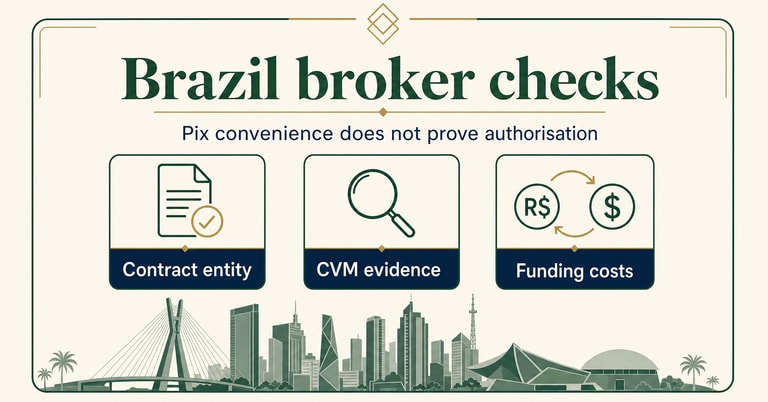
Why the entity and the CVM check come first
Every broker presents a brand, but the brand is not the contracting party. Somewhere in the terms and the account application there is a legal entity, registered in a jurisdiction, and that entity is what you sign a contract with. Two brokers with the same brand name can sit in different entities with different regulators, and the one that holds your money is the one that matters.
For Brazilian residents there is a specific question to answer. The Comissão de Valores Mobiliários states that a foreign intermediary offering securities to Brazilian residents must be registered in its distribution system, or conduct the offer through a properly CVM-registered local institution. That position is set out in the CVM’s own frequently asked questions on the forex market, and its alerts page publishes warnings about irregular offers, including forex offers.
A foreign licence from an overseas regulator does not by itself satisfy the CVM’s registration expectation. A broker saying it is regulated in another country has answered a different question from the one a Brazilian resident is asking. Approval abroad is not domestic permission.
Two cautions keep this check honest. A missing alert on the alerts page is not proof of approval, because absence of a warning is not presence of registration. And a helpful review, a translated website or a smooth onboarding flow cannot replace the official register or the contract you would sign. The check is narrow: what entity, what registration status with the CVM, and what does the contract say that entity is allowed to do for you.
Counting the real cost of an account
Once the entity question is answered, cost is where brokers genuinely differ. The bid-ask spread is the difference between the bid and the ask price, and it is a cost you pay on every position. A “zero spread” account is not a guaranteed average spread, because the spread varies with market conditions. Many low-spread accounts charge a round-turn commission, which covers both opening and closing the position, so the commission and the spread together form the real per-trade cost.
Here is an explicitly hypothetical comparison, not a quote or a test of any broker. Suppose Account A charges a spread of 0.2 pips plus a USD 7 round-turn commission per standard lot, while Account B charges a 1.0 pip spread with zero commission.
On EUR/USD, a conventional standard lot is 100,000 EUR, a pip is 0.0001 USD per EUR, and the pip value is USD 10 for one lot in a USD account. Account A therefore costs roughly 0.2 pips times USD 10, which is USD 2, plus USD 7 in commission, or USD 9 per round turn. Account B costs 1.0 pip times USD 10, which is USD 10 per round turn.
Over 20 round turns of one lot, Account A costs about USD 180 against USD 200 for Account B, before swaps, slippage and currency conversion. This assumes the same pair, the same size and the same period, and counts the spread once per turn rather than double counting it.
Two mechanics qualify the arithmetic. Slippage can improve or worsen an execution in either direction, and an ordinary stop-loss does not guarantee your exit price. Leverage magnifies losses as readily as gains. This example is arithmetic, not a recommendation to trade that size: at 0.10 lots, every figure above simply scales by one tenth under the same assumptions.
Funding in reais without assuming it is simple
Pix convenience hides a question worth asking directly. A deposit in BRL is not the same as an account currency in BRL. Ask the broker which currency is actually credited to your account, what conversion rate and fee apply, and what the withdrawal route back to your Brazilian bank looks like. Do not assume Pix acceptance exists for a given broker without confirming it.
A funding ledger, written with variables rather than current rates, shows which numbers matter. Suppose you deposit an amount D in BRL. Record the amount debited from your bank, the conversion rate used and the time it was quoted against a contemporaneous reference rate, the currency and amount credited to your trading account, and any explicit conversion fee or markup charged.
Later, when you withdraw an amount W, record the same rows in reverse: the amount debited from your account, the rate applied, the reference rate at that time, the amount credited in BRL, and any explicit fee.
One distinction matters in that ledger. If the broker charges an explicit conversion fee or a markup over a reference rate, that is a broker cost, and you can write it down as one. But a difference between the rate at deposit and the rate at withdrawal may simply reflect BRL/USD market movement between those two moments, which is currency exposure, not a broker fee. Compare the rate you were given with a reference rate at the same time before calling it a cost, and ask the broker in writing whether its conversion carries a spread or fee, rather than assuming it does or does not.
How BabyPips readers can carry this further
Two BabyPips guides slot into this process. The article on advertised spreads versus tested spreads in Australia explains why a broker’s advertised number and a measured number can differ, and how to think about which basis a cost claim rests on. The pricing logic transfers to any market, but the specific figures and the ASIC protections in that article describe Australian brokers, and they do not apply to a Brazilian account.
The guide on what FCA regulation means for UK forex traders is useful for the opposite reason. It shows why the entity and its jurisdiction shape what a regulator requires, what protections exist and what a client agreement covers. Reading it makes clear that UK rules are not inherited by a Brazilian resident contracting with an entity elsewhere.
A reusable evidence checklist
David Levy, Head of Content at CompareForexBrokers, has published a short instruction on his personal professional page that fits this task exactly: “check the claim against the source, do not take it on trust.” That published statement is the right habit for every row below.
Before shortlisting any broker from Brazil, collect this evidence yourself:
- The legal entity named in the terms of service and the account application, written down exactly.
- Its registration status checked against the CVM’s official materials, with the date you checked.
- The full per-trade cost: spread basis, round-turn commission, and any account fee, combined.
- The funding path: credited currency, conversion rate and any explicit fee in both directions, and the withdrawal route.
- Documents and support genuinely available in Portuguese, tested rather than claimed.
- The leverage offered and your own loss tolerance at that leverage, since leverage magnifies losses.
- Slippage and execution terms as stated in the order execution policy.
A broker that fails the entity or registration check does not belong on the shortlist regardless of its costs. A broker that passes those checks but cannot answer the funding questions in writing has answered them badly. Keep the shortlist to the brokers where every row above has a source you could show someone else, and the comparison you end up with will rest on evidence rather than convenience.
Forex and CFDs involve substantial risk, and leverage magnifies losses. This article is general education, not personalised investment advice.