EU manufacturers could give up on competing with China by 2030, warns commerce chief


Jens Eskelund says Europe may need to allow its companies to become part of Chinese firms’ supply chains Europe’s manufacturers could give up on attempting to compete with their Chinese counterparts by the end of the decade if current trends continue amid fears over mass job losses, the head of the European Union Chamber of Commerce in China has warned. In a case of “if you can’t beat them, join...
Europe’s manufacturers could give up on attempting to compete with their Chinese counterparts by the end of the decade if current trends continue amid fears over mass job losses, the head of the European Union Chamber of Commerce in China has warned.
In a case of “if you can’t beat them, join them”, Jens Eskelund said European companies operating in China were now thinking “Made in China for China” could be replaced by a philosophy of “Made in China for the world”.
Eskelund, who heads the influential Beijing-headquartered body, said European manufacturers could find themselves at an existential crossroads by the end of the decade, asking themselves: “What is the point of trading?”
As the EU gets tough with China with a deficit running at a record £1bn (€1.18bn) a day and an increasing mood for protectionism in Brussels, Berlin and Paris, he said European countries might need to shift their policies to allow domestic manufacturers to become part of Chinese firms’ supply chains, rather than treat them as competitors.
Eskelund, who is also a managing director of the shipping group Maersk’s Chinese operations, pointed to a report by Goldman Sachs that forecasted Chinese exports would lower the EU’s gross domestic product by 0.5% by the end of the decade while reducing Germany’s by up to 0.9%.
“It raises the question, if China’s trade delivers negative value, why trade?” the Danish businessman said.

“If you are suddenly in a situation where trade creates a lot of value for one party, but it destroys value for the other, countries will begin to ask themselves, why do we trade?” he said, pointing to a potential doomsday scenario in which manufacturing disappeared from European countries, causing mass job losses, collapse in the tax base and potential multigenerational unemployment and spiralling social benefits costs.
Speaking in Brussels, where he has been in back-to-back meetings with European Commission officials to give them feedback from Beijing, he said Europe is at an inflection point.
“If we create new dependencies, ultimately that might result in Europe losing its ability to determine its own future,” with mass job losses and fraying of communities, Eskelund added.
That existential threat is already beginning to bite in Europe’s car, chemicals and renewable energy sectors, with the German automotive industry hit by a double whammy of reduced profits in China and cheap competition at home from Chinese companies such as BYD, Geely and SAIC Motor. Last week, BMW said its sales in China had dropped 22% in the first nine months of the year, in line with expectations of suppressed domestic demand, while issuing a second profit warning this year.
Eskelund is not a fan of the term “China shock 2.0” – which refers to the impact of the huge rise in exports of, cars, chemicals and components – on local industry to the EU in the last five years. He said it should not have come as a surprise as Beijing’s plans to displace imports were the enduring theme of the last three five-year plans since Beijing’s Made in China strategy was agreed in 2015.
“I don’t really like the term China shock 2.0 because these things that are happening should not be a shock because it is all written in their five-year plans so you should be able to anticipate that,” Eskelund said.
“The proof of concept here is that China has been laser-focused on reducing its own dependencies over the last 30 years,” he added, pointing to a concomitant reduction in imports.
A recent report by Centre for European Reform (CER) urged Germany to stop “admiring” Beijing and change its strategy, with China’s latest five-year plan (2026 to 2030) a doubling-down on “self-reliance”.
“It is committed to displacing imports in the few sectors where it still depends on foreign supply,” said the CER.
The sectors that have been identified in China’s latest five-year plan are AI, quantum computing; robotics; smart and green tech; biomanufacturing; brain-computer interfaces; and 6G communications.
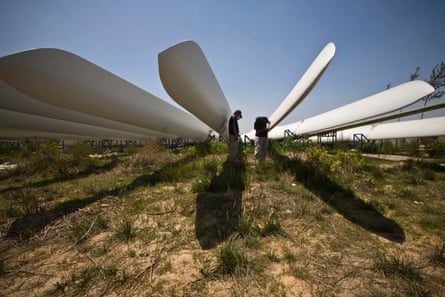
Solar panels, wind turbines, robots, driverless cars, advanced chips are part of China’s new strategy for global domination.
Eskelund’s advice to those industries in Europe is not to hide but brace themselves for China to deliver. Once a strategy is decided in Beijing, incentives, tax breaksand subsidies flow down by region to town and village levels. Officials across the country know what to focus on and do, he said.
His advice to EU leaders: “Engage with China and discuss getting to a point where everyone can see value is being created for both sides”, something he thinks Beijing understands.
While this might be an obvious point, Eskelund said a fundamental shift in approach was needed in Europe.
“China has always been very focused on outcomes, whereas Europe has been more focused on principles. It raises the question of whether following principles is delivering undesirable outcomes,” Eskelund said.
A view expressed in some quarters, including the UK, that trade imbalance could be addressed by increasing exports was just “fantasy”, said Eskelund, with this year’s surplus against the rest of the world expected to surpass 2025’s record $1.2tn (£900bn).
Eskelund said many companies were still making good money in China but the brutal competition in the country’s supply chains, combined with a currency undervalued by about 30%, left Europeans in the dust.
“What we see right now is that in almost all industrial verticals, almost anywhere in the world, you would have one and probably several Chinese competitors” he said.
“It’s just very, very difficult in most industries to compete with the Chinese.”
Giving up on trade is not the answer. If you can’t beat them join them. And that is what is now happening, the chamber has found.
“One way that they can compete with the Chinese supply chain is to become a part of the Chinese supply chain itself,” Eskelund said.
“For many companies it’s not the profit that you make in China that matters as much as the way Chinese supply chains enable you to compete on a global marketplace.”
This could mean making the products in China in joint domestic partnerships with European companies and getting into global supply chains in conjunction with Chinese firms.
“It is a sort of evolution from the old days when you came to China to service the Chinese market in China for China. It has now become: be in China, for the world. I think it’s a fairly significant shift,” Eskelund said.
For many of his members this had led to an “uptick in confidence” in the past year.
“This has turned out to be one of the ways that companies adapt, faced with a saturated market in China, they begin to explore exports,” he said.
Related Articles
- Business News
The Guardian view on EU ‘Made in Europe’ rules: a fatal blow to Brexiter delusions | Editorial
- Business News
Businesses still grappling with Brexit red tape and want change, says BCC
- Economy News
Analysis-China seeks high-tech upper hand in industry carrying 80% of global trade
- Business News
The engine parts that 'fight the laws of the universe'
- World News
UK found to be ‘dangerously’ reliant on China for critical minerals needed for defence and AI