Pump.fun KIMCHI token crashes 95% after co-founder Alon deletes repost


KIMCHI token crashes after a QR code promotion linked to Pump.fun co-founder Alon disappears, as Lookonchain flags $385K in suspected trading profits.

A Solana-based KIMCHI memecoin has plunged more than 95% after a promotional post linked to crypto trader Kimchi’s X account disappeared, triggering allegations of suspicious trading and questions about Pump.fun co-founder Alon’s involvement in promoting the token.
Summary- A KIMCHI token promoted through a QR code linked to trader Kimchi’s X account crashed after the post disappeared.
- Lookonchain reported that the token briefly reached a $14 million market capitalization before falling more than 95%.
- Blockchain analysts flagged profitable early trading, while allegations of hacking and deliberate fraud remain unconfirmed.
- Pump.fun’s daily revenue and active addresses declined during the same period, without evidence establishing a direct connection.
According to blockchain analytics firm Lookonchain, Kimchi’s account promoted a newly launched token after reportedly receiving 500 million KIMCHI tokens, while Alon reposted the announcement. Both posts subsequently disappeared, and the token’s market capitalization collapsed after briefly reaching approximately $14 million.
Today, kimchi (@kimchi1x) received 500M $kimchi and posted about the token, and @a1lon9 reposted it.
— Lookonchain (@lookonchain) October 23, 2026
But @a1lon9 later undid his repost, and @kimchi1x deleted the post.$kimchi quickly surged to a $14M market cap before crashing over 95%.
We found that the scammers used… pic.twitter.com/2jVqb55teF
Kimchi token crashes after Pump.fun co-founder deletes repost
The controversy began when an AI-generated promotional image appeared on Kimchi’s X account, featuring a QR code directing users to a newly created token on Pump.fun. Traders quickly bought the token, while Alon’s repost drew further attention to the promotion.
Within minutes, KIMCHI reportedly climbed past a $10 million market capitalization before reaching roughly $14 million. Its subsequent decline exceeded 95%, with some market observations placing the drop closer to 99% after the promotional post disappeared.
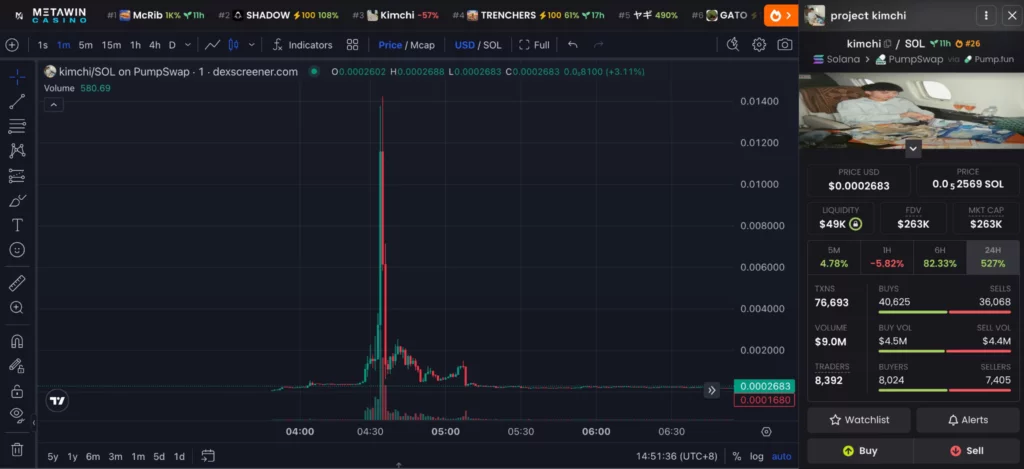
Market capitalization measures the estimated value of a token’s supply at the prevailing price. The reported $14 million peak therefore does not establish that investors collectively lost $14 million or that an equivalent amount of money entered the market.
Crypto trader Arez questioned the sequence, alleging that the QR code’s destination changed after the token attracted substantial trading. The trader said Alon subsequently withdrew his repost, while some buyers were left holding tokens purchased near the peak.
The incident followed recent attention surrounding Kimchi’s relationship with Pump.fun.
Lookonchain identifies over $385K in suspected trading profits
Lookonchain’s investigation identified several wallets that reportedly accumulated KIMCHI at relatively low prices before selling during the rally. The analytics firm estimated that the transactions generated more than $385,000 in combined profits.
Investigators identified three Solana addresses for examining the associated transfers. The wallet activity described by Lookonchain raises questions about trading patterns, but blockchain transfers alone do not establish who controlled the addresses or whether the traders had advance knowledge of the promotion.
A separate Bitquery investigation documented activity involving another KIMCHI launch around October 20. Its researchers identified three linked wallets that bought a newly issued token and quickly sold their holdings, generating approximately $104,000 in gains.
Bitquery explicitly stated that it could not connect those wallets to the deployer through direct transfers. Its findings concern a separately identified token and transaction sequence, so the reported profits should not be combined with Lookonchain’s estimate without matching the contracts and timestamps.
Traders demand answers over deleted KIMCHI promotion
Following the collapse, some traders accused the accounts involved of promoting an unsafe token. An X user known as tontheneko demanded refunds, arguing that Alon should have verified the promotion before sharing it with his followers.
Hello @a1lon9, I hope you immediately refund anyone who lost money on this coin.
— ton (@tontheneko) October 22, 2026
You literally retweeted a rug pull and made hundreds of people lose money.
It was your responsibility as @Pumpfun founder to double check and confirm what you are posting with kimchi before… pic.twitter.com/3QNtkWSYA8
Those accusations remain allegations, not established findings of fraud or misconduct. Neither the promotional repost nor subsequent deletion independently proves that Alon or Kimchi coordinated the trading or benefited financially from the token’s price movements.
A suspected account hack has been suggested as another explanation, although the available statements do not confirm unauthorized access. No verified refund arrangement or official finding assigning responsibility was identified.
The episode follows scrutiny of Pump.fun token survival rates, with an October Bitquery study finding that 79% of launches in its sample recorded no trading after their first day. That study covered a larger token sample and did not examine the latest KIMCHI promotion specifically.
Pump.fun revenue falls as activity declines
Meanwhile, Lookonchain highlighted a decline in activity on Pump.fun after Kimchi reportedly removed the platform’s name from his X biography. The researcher compared daily revenue of $1.61 million with $1.35 million two days later, representing a decline of approximately 16%.
Just 2 days later, @kimchi1x removed @Pumpfun from his bio.
— Lookonchain (@lookonchain) October 23, 2026
Interestingly, over those 2 days, Pumpfun's revenue dropped 16% from $1.61M to $1.35M, while active addresses fell 11% from 178,539 to 159,492.
Meanwhile, @kimchi1x may have received 1.35B $PUMP ($6.25M) in marketing… pic.twitter.com/NI0kAcCz5Z
Active addresses fell from 178,539 to 159,492 over the same comparison, a drop of roughly 11%. However, the timing does not demonstrate that the KIMCHI controversy caused either decline.
The DefiLlama protocol dashboard separately showed approximately $1.35 million in daily revenue and 159,492 active addresses. Its methodology distinguishes platform revenue from total fees paid by traders.
Recently, Pump.fun introduced perpetual futures trading through Hyperliquid, expanding its services beyond memecoin launches. Subsequently, the platform launched Pump Bridge to support cross-chain transactions, with its published performance figures based on testing conducted between September 28 and October 7.