Kraken's Parent Payward Expands Beyond Crypto Trading as Revenue Falls 12%


Kraken’s parent Payward is increasingly relying on businesses outside crypto trading to support its financial performance as weaker market activity weighs on transaction fees.
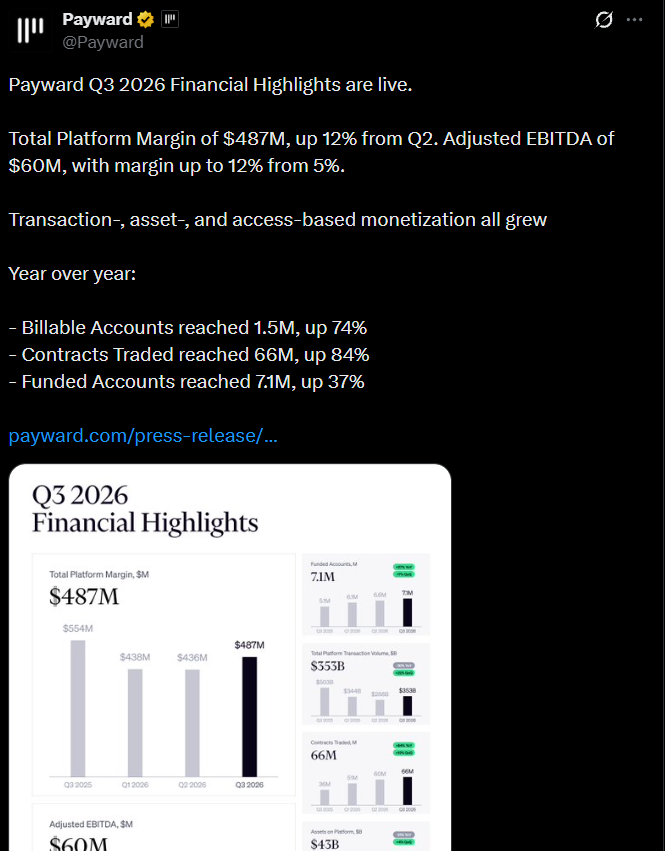
The company reported $487 million in total platform margin for the third quarter of 2026, representing a 12% decline from the same period last year. However, its expanding financial services operations helped offset some of the pressure, with revenue connected to client assets and access to products, data, and services accounting for a larger share of its business.
Payward also reported signs of improvement compared with the previous quarter, as total platform margin increased 12% and adjusted earnings recovered alongside a pickup in trading activity.
Payward’s Revenue Declines as Crypto Trading Activity Weakens
The third-quarter results reflect the challenges facing cryptocurrency exchanges as lower trading activity puts pressure on businesses that depend heavily on transaction fees.
Payward’s total platform margin reached $487 million, down 12% year over year. The company uses this metric instead of adjusted revenue, deducting trading costs and staking rewards paid to customers.
The decline comes amid similar difficulties across the exchange industry. Coinbase reported a 35% year-over-year drop in third-quarter revenue, while Gemini Space Station recorded a 19% decline in revenue alongside a 73% fall in trading volumes.
These figures highlight why major crypto platforms are increasingly looking for ways to diversify their income rather than depend almost entirely on market activity and trading fees.
Non-Trading Businesses Account for a Growing Share of Revenue
Payward’s expansion into financial services appears to be helping soften the impact of weaker cryptocurrency trading.
Income linked to client assets and access to products, data, and services accounted for 52% of the company’s total platform margin in the third quarter, compared with 46% during the same period last year. The company has been developing several business lines beyond its core exchange operations, including banking, asset management, and Payward Services, which provides financial infrastructure to other businesses.
Its strategy also extends into traditional futures, equities, tokenized stocks, payments, custody, and lending. By broadening its offering, Payward aims to generate revenue from a wider range of financial activities, reducing its exposure to fluctuations in cryptocurrency trading volumes.
The company has also identified artificial intelligence as a fifth business pillar. Its plans include developing a personal finance agent and investment funds connected to its xStocks tokenized equities platform.
AAVE Investment and Banking Partnerships Support Expansion Plans
Payward’s broader financial strategy also includes investments and discussions with established financial institutions.
In November, a fund affiliated with Payward and its clients purchased an undisclosed amount of AAVE tokens through secondary-market transactions. The move followed earlier discussions between the company and decentralized lending platform Aave about potential areas of cooperation.
The investment reflects Payward’s growing interest in decentralized finance and asset management, alongside its existing exchange and infrastructure operations. The company has also explored partnerships with major banks. Payward reportedly held discussions with Wells Fargo about providing liquidity for cryptocurrency trading. Separate talks with BNY focused on a potential financial infrastructure partnership involving digital assets, custody, wealth management, trading, and payments.
These initiatives could help Payward strengthen its position in both traditional finance and the digital asset industry, although the discussions do not necessarily mean that formal agreements have been reached.
Payward Shows Signs of Recovery Despite Annual Decline
Although third-quarter performance remained below year-earlier levels, the latest figures indicate that Payward’s business improved compared with the second quarter.
Total platform margin increased 12% quarter over quarter, while adjusted earnings also moved higher as cryptocurrency trading activity recovered and income from client assets and services expanded.
The improvement suggests that Payward’s diversification strategy is beginning to provide additional support during periods of weaker market activity. However, the annual revenue decline shows that the company’s core trading business remains exposed to broader cryptocurrency market conditions.
For Payward, the next challenge will be turning its growing range of financial services into a more consistent source of income while maintaining its position in the competitive crypto exchange market.
Do you think Payward’s expansion into banking, tokenized equities, and asset management can reduce its dependence on cryptocurrency trading?
Could Kraken’s broader financial services strategy give it an advantage over exchanges that continue to rely primarily on trading fees?