Bitcoin price crashes below $75K: is a brutal selloff to $70K next?


Bitcoin (BTC) continues to struggle on Monday, trading around $74,685 after extending its weekly losing streak to five consecutive weeks. The cryptocurrency remains below its 50-week Simple Moving Average (SMA) at $75,222, showing the growing dominance of sellers. The latest downturn comes amid weakening institutional demand, with US spot Bitcoin Exchange-Traded Funds (ETFs) recording $1.28 billion in net outflows last week. At the same time, stronger-than-expected US employment figures have reinforced expectations of tighter monetary policy, creating...
Bitcoin BTC continues to struggle on Monday, trading around $74,685 after extending its weekly losing streak to five consecutive weeks.
The cryptocurrency remains below its 50-week Simple Moving Average (SMA) at $75,222, showing the growing dominance of sellers.
The latest downturn comes amid weakening institutional demand, with US spot Bitcoin Exchange-Traded Funds (ETFs) recording $1.28 billion in net outflows last week.
At the same time, stronger-than-expected US employment figures have reinforced expectations of tighter monetary policy, creating further uncertainty for Bitcoin's near-term recovery.
Short Bitcoin as ETF outflows bite
Visit SiteBitcoin faces fresh selling pressure as institutional demand keeps draining.51% of retail investor accounts lose money when trading CFDs with this provider.Bitcoin ETF outflows reach highest weekly level since June
Institutional appetite for Bitcoin weakened considerably last week as investors continued withdrawing capital from US-listed spot BTC ETFs.
According to SoSoValue, the funds recorded combined net outflows of $1.28 billion, representing their largest weekly withdrawals since late June.
The latest figures also marked a second consecutive week of negative flows, suggesting that institutional investors remain cautious about Bitcoin's near-term prospects.
The sustained withdrawals are particularly concerning because spot ETFs have become an important source of institutional exposure to Bitcoin.
Persistent net outflows can add selling pressure to the market, especially when accompanied by deteriorating technical conditions.
Unless ETF demand improves in the coming sessions, Bitcoin could struggle to establish a meaningful recovery.
Another week of substantial withdrawals would further reinforce the prevailing bearish sentiment and potentially accelerate the ongoing correction.
Macroeconomic developments are also complicating Bitcoin's recovery, with stronger-than-expected US Nonfarm Payrolls (NFP) data prompting investors to reassess the Federal Reserve's interest rate outlook.
The upbeat employment figures suggest that the US labor market remains resilient, potentially giving policymakers greater flexibility to maintain restrictive monetary conditions or raise borrowing costs further.
According to the CME FedWatch figures, traders now assign an approximately 80.5% probability to a December interest rate hike, compared with 72.8% before the employment report.
Higher interest rates generally create a challenging environment for speculative assets, including cryptocurrencies.
For Bitcoin, this combination of weakening ETF demand and mounting monetary policy uncertainty could limit buying interest, particularly if upcoming economic data continues to support a hawkish Fed outlook.
Bitcoin price outlook: BTC risks falling toward $70,000
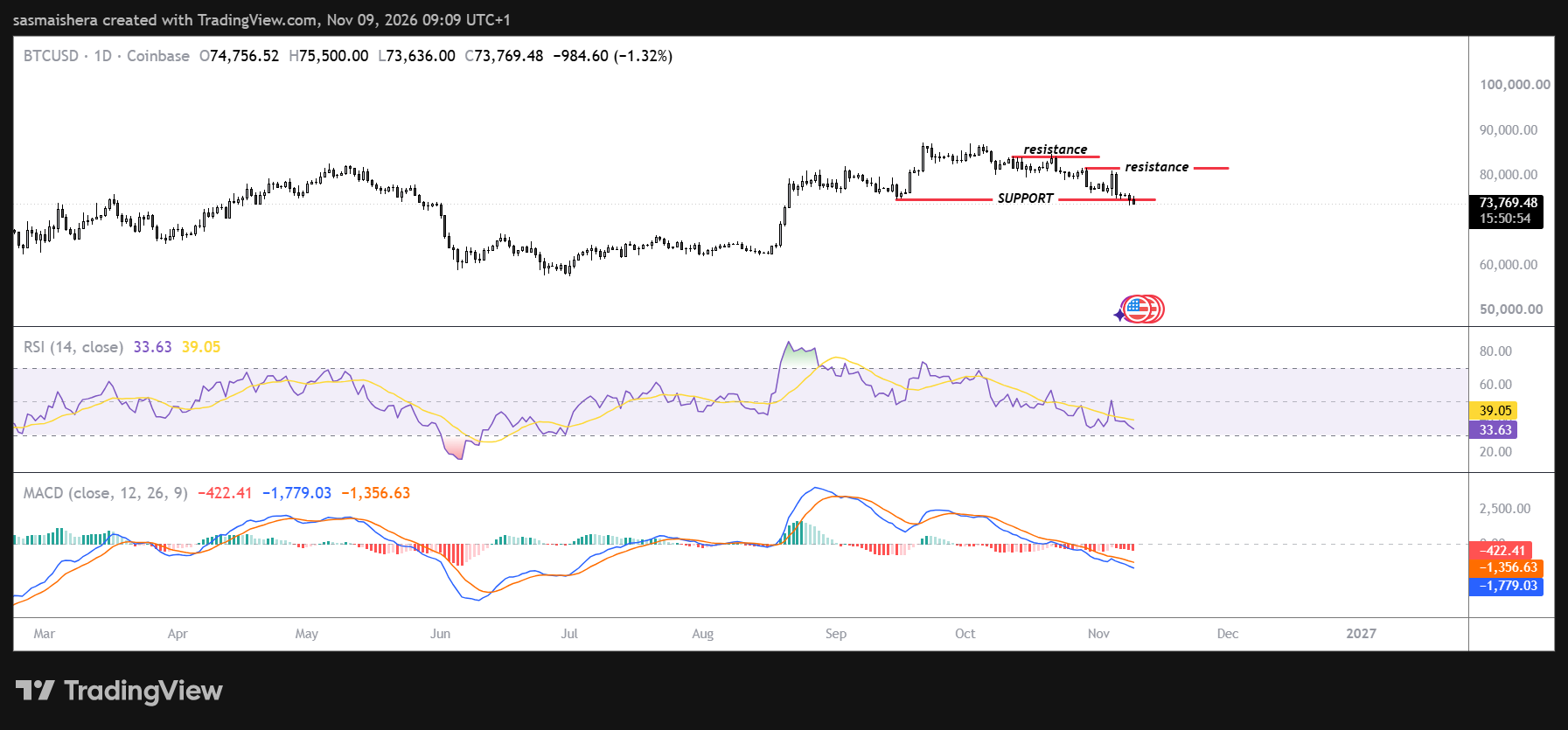
Bitcoin's technical outlook remains fragile after the cryptocurrency declined 4.47% last week, extending its losing streak to five consecutive weeks.
The weekly close below the 50-week SMA at $75,222 represents an important setback for buyers, as the indicator had served as a significant technical reference point.
At the time of writing on Monday, BTC trades near $73,700, with sellers maintaining control below this moving average.
If the current correction continues, Bitcoin could initially test the psychological support level at $70,000.
A sustained breakdown below this area would increase the likelihood of a deeper decline toward the 200-week SMA at $68,031.
Momentum indicators also suggest weakening buying pressure. The weekly Relative Strength Index (RSI) stands near 48, approaching the oversold threshold of 30, indicating that bullish momentum has faded.
Meanwhile, the weekly Moving Average Convergence Divergence (MACD) histogram remains positive, although its declining bars suggest that upward momentum is gradually weakening.
For investors navigating Bitcoin's volatility, choosing reliable crypto exchanges remains important, particularly as market uncertainty and sharp price swings increase trading risks.
A recovery above the 200-day EMA could encourage buyers to target the 100-day EMA, followed by the 50-day EMA. Beyond these levels, the $85,000 horizontal resistance zone remains a more ambitious upside target.
However, failure to reclaim these moving averages would leave Bitcoin vulnerable to further losses, particularly if institutional withdrawals continue and macroeconomic conditions remain unfavorable.
For now, the $75,222 level remains an important near-term threshold for Bitcoin, while $70,000 represents a key support area that traders will be watching as bearish pressure persists.
Related Articles
- Crypto News
Bitcoin price approaches $75,600 danger zone as ETF investors pull $398M
- Crypto News
Bitcoin price drops toward $74K as crypto liquidations top $1 billion
- Crypto News
Bitcoin price holds $76K as ETF outflows test $75K support
- Crypto News
Why is Bitcoin price down today?
- Crypto News
Bitcoin dips below $80k as ETF inflows return, but oil and geopolitical risks weigh