Who will reap the riches of the AI Gilded Age?
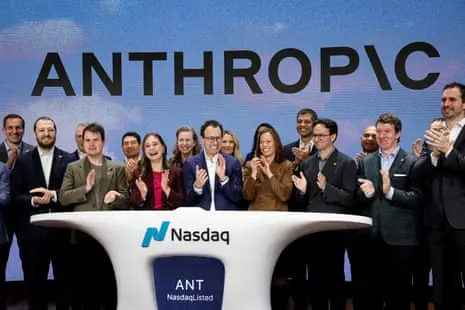
Artificial intelligence hasn’t quite recreated the Gilded Age, yet. Dario Amodei and his six co-founders have been made immensely rich. But their windfall from the initial public offering of Anthropic shares added up to somewhat more than $20bn each.
By Bloomberg’s count, there are more than 100 billionaires richer than Amodei – people such as Elon Musk, Jeff Bezos and Bill Gates, who made much of their money in earlier technological disruptions. Nvidia’s Jensen Huang made his fortune in chips. Zara’s Amancio Ortega makes clothes. Rupert Murdoch owns rightwing TV. The heirs of Sam Walton’s Walmart empire made their billions from groceries.
Though the first clutch of pure AI oligarchs might not yet have reached the very top, their arrival among the upper levels of America’s plutocracy is an early sign of how deeply the new technological revolution will reshape the distribution of the world’s wealth and income.
At first blush, it seems pretty clear that Anthropic’s AI offspring – along with their rivals from OpenAI, Alphabet and so forth – will propel a momentous surge in inequality, taking over the jobs of many of the high-skilled workers performing cognitive tasks that were shielded from previous rounds of automation. The persistent, indeed steepening, decline in the share of the national income accruing to workers threatens a future in which the owners of capital will take it all.
The recent bloodbath among technology stocks, which at one point toppled the newly traded shares in Anthropic to within cents of their IPO price, underscored the uncertainty that persists over precisely how AI will reconfigure the landscape of winners and losers across the economy. A ton of money will be made from AI. But an essential question remains unanswered: who, exactly, will reap the rewards?
One might remember the bubble at the dawn of the dotcom era that imploded in a stock market meltdown at the turn of the century. Early champions like e-commerce firm Webvan, once valued at $8bn, or news portal Broadcast.com, bought by Yahoo for $5.7bn, are no longer with us. AltaVista, once a leading search engine, is now a distant memory, fading from memory like the sock puppet made famous in a Super Bowl ad by Pets.com (RIP).
The shakeout this time will be different. It will be bigger. It is all but certain to cause much more pain. But the uncertainty that spooked the stock market last week echoes the nervousness that led to that earlier collapse. Even if the technology changes the world, Anthropic and the rest of the crop of AI superchampions, spending quadrillions of dollars to train their agents, may not make enough money to pay for their bet.
What do we know? For all the excitement over artificial intelligence, businesses so far have been relatively slow to deploy the technology. According to the US Census, only about one in four companies use it. A survey of 62 countries by the Organization for Economic Cooperation and Development – the club of industrialized nations – found that only about 7%-9% of companies use AI intensively, in a way that might move the needle on productivity.
In other words, there is still a plausible future in which AI doesn’t cut it – too expensive or complicated to be deployed at scale by businesses who can’t figure out how to profit substantially from the tech.
Nobel prize economist Daron Acemoglu has projected that AI will deliver a boost to total factor productivity – a measure of how efficiently an economy turns labor and capital into productivity – substantially below 1% over a decade. Other studies have found little impact of AI adoption so far on corporate earnings, employment or productivity.
Glen Weyl from Microsoft Research and James Evans from the University of Chicago propose that for AI to deliver on its promise of enhanced prosperity requires a fundamental redesign of the world’s economic, financial and even political institutions.
Even if AI turbocharges some tasks, productivity gains across businesses will be limited by the progress in complementary tasks that don’t improve as quickly. Consider how computing power per dollar has risen by a factor in the hundreds of quadrillions over the past 50 years. Despite these remarkable gains, total factor productivity has risen by a factor of about 3.
Who makes the money remains unclear even in a scenario in which artificial intelligence becomes broadly adopted. In a world where many rival AI models are equally capable, the technology might become just another cheap corporate tool, even if it has awesome capabilities. This would be a sad prospect for the megalabs that have spent hundreds of billions to train them, not to say their lenders. But it would enable downstream businesses to reap enormous productivity gains.
If, on the other hand, a few tech giants monopolize AI’s awesome capabilities, one might expect a massive concentration of wealth and power in the hands of Amodei and his fellow technologists. Silicon Valley’s plutocracy understands this well. As Peter Thiel, the technology investor with a large stake in OpenAI, puts it, “Competition Is for Losers.”
The core question about how AI will reshape the distribution of prosperity is not only about how far the technology might move income from labor to capital, but also about how it will redistribute capital income. Will a concentrated clutch of businesses reap trillions, or will the profits be more broadly shared?
Will the world fit the dream of those investors that went long on Anthropic shares, hoping Amodei’s baby will rule our future, or might it look like the contrarians who shorted the stock?