How to make a bestseller: insiders reveal the tricks of the book trade


From cover design to shelf placement and influencer partnerships … how publishers will persuade you to buy their books this autumn Think about the last book you bought. How did you choose it? Was it from a recommendation, a review, a TikTok video? Did the cover grab you, were you swayed by the quotes on the front, or did you just happen to spot it on an appealing table as you walked into the...
Think about the last book you bought. How did you choose it? Was it from a recommendation, a review, a TikTok video? Did the cover grab you, were you swayed by the quotes on the front, or did you just happen to spot it on an appealing table as you walked into the shop? Did you think about all the nudges that led you to that decision – by the publisher, the bookseller or that person you follow on Insta?
The reality is that our reading choices are directed and massaged at every turn. “It’s all about the art of persuasion,” says Philip Gwyn Jones, who was a publisher for more than 30 years and is now a literary agent. And who are the persuaders? They’re the booksellers, the supermarket stock buyers, the publishing houses and their ranks of marketers and publicists. And, more recently, persuasion often comes from BookTokers and online influencers, social media videos, podcasts and Instagram posts. How is all this changing publishing?
We all judge books to some extent by their covers, but did you know how much thought goes into finding just the right cover, colour, font and design? These covers are focus-grouped, shown to supermarket buyers and often changed at their behest, according to Jamie Keenan, one of Britain’s leading book designers. “That happens quite a lot,” he says. “If Tesco with commercial books, or Waterstones with literary stuff, don’t like it, they’ve got a tremendous amount of clout.” (Waterstones and Tesco declined to speak to me for this piece.)
Meanwhile, online browsing and buying have brought about big changes. “There’s been a move towards more iconic book covers because of thumbnail images [on apps and websites],” Keenan explains. “One very simple emblem or logo that you can see from a distance, even when it’s two inches tall. Nice bright colours and big type,” he adds. “That’s what publishers are doing to attract people’s attention.”
It’s true: when I went into Waterstones last week, I felt like reaching for my sunglasses to shield the glare of garish, saturated colours screaming from the fiction shelves: more sweet shop than book store. When I shared a photo on Instagram, a number of authors messaged me. “I hate it,” said one (whose own latest novel has a brightly coloured cover). “It’s just so brash.” Yet ironically, because all these books look the same, the effect is to make them blend in, not stand out. “Jewel tones have the industry in a headlock,” messaged another.
And then there are the increasing numbers of copycat covers, so that every cosy crime novel suddenly looks like Richard Osman’s bestsellers – cream background, coloured border, hand-lettering – and all heartwarming Japanese books have to feature a cat. (At his last publishing house, says Gwyn Jones, for Japanese fiction “there was this unspoken imperative to put a cat on the cover even if there wasn’t a major role for a cat in the book. It did seem to make a difference.”) “You quite often get briefs on what are called comparable titles,” Keenan says. “That’s a nod-and-a-wink way of saying, ‘Can you do something that looks a bit like these three?’”
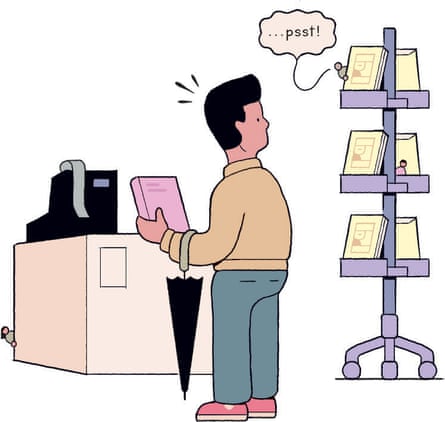
After the cover does its trick, we read the publisher’s description on the back. That’s the work of copywriters. “The cover designer has got them to pick up the book,” says a copywriter for a major commercial publisher. “It’s my job to make sure they don’t put it down again.”
The blurb is how we decide if this book is one for us. “You’ve got seconds to grab people,” says the copywriter. One of their tricks is to use Christopher Booker’s book The Seven Basic Plots. “Most stories can fit into three or four of Booker’s categories: The Quest, Overcoming the Monster and so on. It gives you tools to tell the story of the book in different ways. You want to say: ‘It’s the same but different.’”
What if an author isn’t writing what’s on trend right now? “For the best part of two decades,” the copywriter says, “we had Scandi noir: very dark, psychological thrillers. Now cosy crime is absolutely everything. If a writer is still writing noir and wants their books to be in the supermarkets, it needs to look like the books that are selling in supermarkets.” That means “you’ll find books being packaged rather differently to how they [really] are”. These cosy crime blurbs need to, frankly, make death and violence sound like a minor inconvenience, so they focus on the mystery aspect (the books are “ingenious”, full of “twists and turns”) or the welcoming narrative tone (“delicious’” and “delightful”) or the sense of tradition they follow as “quintessentially British” stories. But “publishers are lemmings,” the copywriter says, “and that’s where the market is.”
“There has been a sense since the mid-2000s that popular fiction readers’ tastes have narrowed,” they continue, “following one or two big trends. That parallels [the rise of] social media. Romantasy and cosy crime are the main areas of current growth.”
Whatever the genre, “a blurb has to tell a little story,” says Louise Willder, another copywriter, and author of a book on the subject, Blurb Your Enthusiasm. But, “we’re aware not every word we write will get read.” That’s because, explains the commercial copywriter, “People read in an ‘F’ [shape] – they’ll read across the top and then they won’t read the next line, they’ll just drop down to the next paragraph. So you’re trying to hit your marks at the start of each paragraph.” Cliches have always been rampant, they just shift with time. So “witty” becomes “whip-smart”. “It’s never ‘moving’, it has to be ‘deeply moving’,” says Willder.
Publishers’ blurbs aren’t the only thing on book covers; they are also clogged with endorsements from fellow authors. According to Willder, “audiences say they’re mistrustful” of these. There’s a sense that they are favours for friends – which may be justified. When it comes to quotes, “networking is crucial” confirms the commercial copywriter. “I’ll try to get two or three endorsements from my circles, or the author’s circles,” adds Gwyn Jones.
Author endorsements are, in any event, more often aimed at booksellers than readers. Even though many books are now sold online, the visibility of books in shops remains crucial to their success. Although some names may offer more effective badging than others – certain authors “seem to pop up on every single book”, says Brett Wolstencroft, manager at independent chain Daunt Books. “Stephen King has endorsed so many people,” says the commercial copywriter. “Tony Parsons is another culprit.”
Not all booksellers need to be persuaded, it should be said – some need to be paid. One experienced publicist I spoke to said: “To get books into supermarkets, you have to pay quite a lot of money. The general public thinks that those top 10s are earned positions and they are very much not earned positions. They’re paid for.” This practice used to be widespread. TG Jones, formerly WH Smith, also charged publishers for chart space, according to a 2022 BBC report, though the chain said that sales performance was also a factor. And in the time before James Daunt took over, Waterstones charged publishers to put their books on display tables. But now, one Waterstones bookseller tells me, “everything is down to individual booksellers”.
Publishers send out early copies of books to booksellers, because if they read and like them, they can kickstart a book’s success. Books need advocates, and booksellers are among the finest. Wolstencroft tells me that “the public trust us [as booksellers] because they know we really have read these books, we really do like them, we’re not driven by the tricks of the publisher.”
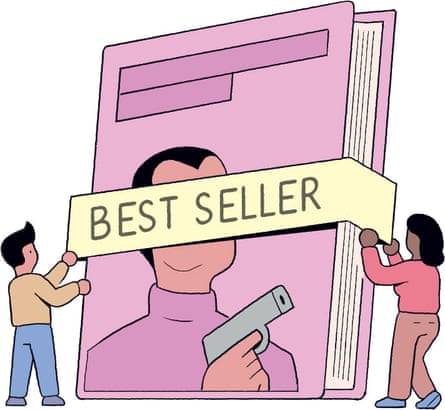
But what about the tricks of the bookseller? Three of the four window displays in Daunt’s Marylebone branch are each focused on one title. “People have a very limited attention span,” Wolstencroft says. “Give them a wall of different books and they’ll move on quite quickly.”
Conversations with customers – hand-selling books – are crucial, because “they’re not just talking to one person, but to 30, 40 people around them in the shop. And the business of hearing a book recommended is incredibly powerful,” Wolstencroft adds. “Three or four people will come to the till in the next five minutes with that book.”
In many bookshops, a surrogate for hand-selling books are the cards attached to shelves praising particular books – shelf talkers, as they’re known. The Waterstones bookseller tells me that these “go a long way if they read sincerely. If they’re short and just say ‘I love this book’ or ‘It really made me cry’, that will work almost 100% of the time. One that doesn’t feel emotional will never work.” Waterstones, however, has a “standard that there have to be three review cards per bay [of shelves], so sometimes you have to churn them out to fill the bay. And if nobody [in the shop] has read it, you just steal something off Goodreads.” Those cards, they admit, “are less successful”.
“Enthusiasm is the thing that sells,” the bookseller tells me. “People often ask for recommendations and you’re supposed to go for the [Waterstones] book of the month, [but] I like to recommend things I actually want people to read.” Smaller independent bookshops can manage personal recommendations via tailored book subscription services. “I don’t really use the word subscription,” says David Headley, who runs Goldsboro Books in London and Brighton. “We call it a book club, with members rather than subscribers.”
Goldsboro has four book clubs, each sending out a new work of fiction in an exclusive edition to its members every month, including clubs for fantasy (with 2,000 members) and a recently launched club for debut fiction, with almost 500 members. Numbers like these give Goldsboro’s clubs tremendous clout. Being chosen for one of them – Headley picks the books himself – “can get you into the top 10 bestsellers”, he tells me.
How does he choose the books? “I go into publishers every six months and they pitch their books that are coming out.” But the final choice is Headley’s, and publishers don’t contribute to the cost. “We pay for everything, so if I buy 2,000 books, I have to sell them.”
Headley is also a literary agent, and several of his own client authors have appeared as Goldsboro book club choices. How does that work? “Not every author gets that privilege,” he says. “I don’t ever take on a client and promise them that. But if I really love the book and think people should read it, then I’ll choose it.”
What publishers are always chasing is the elusive word-of-mouth recommendation, an artificial version of a trusted friend pressing a favourite new book on you. That’s what can be provided by booksellers and, increasingly, online influencers, on platforms such as TikTok and YouTube. “Influencers are important because they talk to a community and they’re trusted by the community,” says Lee Dibble, digital marketing director at Pan Macmillan. “Jack Edwards [who has 1.6 million followers on YouTube and 1.2 million on Instagram] or Dua Lipa can create huge interest from nowhere,” adds Gwyn Jones. See, for example, how Edwards put a rocket under Fyodor Dostoevsky in 2024, helping the obscure novella White Nights shift more than 100,000 copies.
How do publishers persuade influencers to cover their books? “You might gather influencers round a restaurant table,” says Gwyn Jones. For books that publishers have spent a lot of money on, the process begins early. “Big dinners a year and a half ahead of publication,” a publicist tells me. “If it’s a debut they’ll invite [the debut author] alongside lots of established names to draw the [influencers] in.”
“You’re trying to buy their favour,” says Gwyn Jones of the influencers. In some cases, the buying is literal: “There are some BookTokers who expect to get paid to review books,” says the publicist. “It feels like you’re breaking some sort of contract there.” It is not, they add, about securing a positive review. “It’s more that it’s so competitive, some people think they can charge just to cover your book.”
This is separate from paid partnerships, where, as Dibble puts it, “they have to make it really clear they’ve been paid for that work” and “there might be a brief where there’s a couple of messages [the publisher] wants to get across, but it’s completely up to them how they talk about it”.
It’s arguable, however, that any paid advert by an influencer muddies the waters of that crucial trust relationship with their community. “The whole thing of it being a common endeavour sort of dies the minute you start charging for your services,” says Gwyn Jones. Search Instagram or TikTok for “books” and “ad” and you’ll find numerous book influencers with text such as: “my fave author has a new book out and it is one of her best” or “this series felt like three arrows in the chest”. If they’re being paid to post this, how can their followers be sure it’s a sincerely held opinion?
Publicists are the publisher’s frontline in seeking to secure attention for their books, but even this has changed in the digital age. “There’s an old adage where you have to see [the book] seven times before you buy it, so you’re trying to cover as many bases as you can,” the publicist tells me. As well as space in traditional media, this means social media (“a huge part” of publicity now) and new media. “If you can get an author on a really big podcast, that book can go to number one,” the publicist says. And “the big podcasts for books aren’t podcasts about books – The News Agents, Fearne Cotton’s Happy Place, or Davina McCall. You’re trying to pull out the lifestyle angles.”
Some traditions persist: “I stand by the fact,” the publicist tells me, “that there is no such thing as bad publicity. When there was all the controversy over The Salt Path, sales actually went up.”
There are areas that remain largely out of publishers’ control, such as Amazon. But they do have some techniques. Publishers now usually add subtitles to a book on Amazon (“For readers of Sally Rooney”) to try to draw stray web searches. They also tag books with keywords. But it only goes so far. “You won’t show up next to Richard Osman by mentioning him 100 times in the metadata,” Dibble says.
If you’ve ever wondered why your favourite author is constantly urging you on social media to pre-order their new book, it’s because “the impact of Amazon rankings is huge”, the publicist tells me. “Preordering can have the biggest impact, and then it’s much easier to stay [in the charts] because it’s a snowball effect.” And where once search engine optimisation (SEO) was the big thing, now it’s GEO – generative engine optimisation, or “making sure our books are discoverable by chat bots”, Dibble says. So how do you court ChatGPT or Claude? It’s an evolving science, she says, but “you can format your content in particular ways that bots like, such as author Q&As or listicles”.
Are prizes still important? “Definitely, absolutely,” says Philip Gwyn Jones. “You’ve got to make choices and prizes help people make choices.” It is, of course, not possible to sway prize juries, but there are other tools available. “You think about the kind of people who get put on prize juries and review regularly and you send the book to them,” says Gwyn Jones. You decide, as a publisher, which books to submit: “an exercise in diplomacy, as you can imagine … A publisher’s responsibility is to manage it in such a way that it doesn’t cause any outlandish hissy fits.”
“Those meetings can get really heated,” agrees the publicist, who adds that another tool in their armoury is to “strategically publish books so they tie in with eligibility periods for book prizes”.
But what came across time and again from the people I spoke to is how authenticity is key. “It’s not like Quaker Oats,” says one publicist. “You’ve got to be passionate.” “I would only pitch things that are genuinely good,” says another. “Trust is the important thing,” David Headley adds.
All of these techniques can help to give a book a leg up, but nothing guarantees success even then. “We’re always quoting [screenwriter] William Goldman,” says Louise Willder. “‘Nobody knows anything.’” In the end, as readers and browsers, despite all the nudges and cajolery and the tricks of the trade, the final decision really is ours.